. 2009 Mar-Apr;2(3-4):189-95.
doi: 10.1242/dmm.002113. Epub 2009 Feb 23.

Human embryonic stem cell-derived motor neurons expressing SOD1 mutants exhibit typical signs of motor neuron degeneration linked to ALS

Affiliations

Human embryonic stem cell-derived motor neurons expressing SOD1 mutants exhibit typical signs of motor neuron degeneration linked to ALS

Saravanan Karumbayaram et al. Dis Model Mech. 2009 Mar-Apr.

Abstract

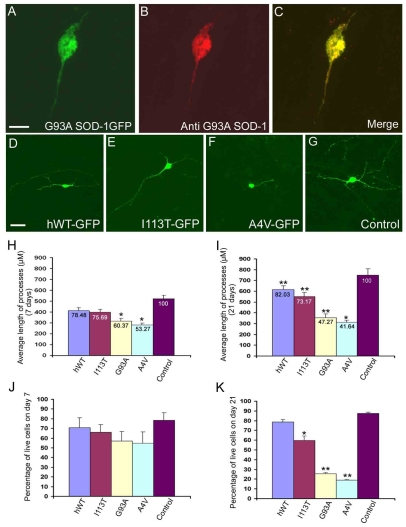
Human embryonic stem cell (hESC)-derived neurons have the potential to model neurodegenerative disorders. Here, we demonstrate the expression of a mutant gene, superoxide dismutase 1(SOD1), linked to familial amyotrophic lateral sclerosis (ALS) in hESC-derived motor neurons. Green fluorescent protein (GFP) expression under the control of the HB9 enhancer was used to identify SOD1-transfected motor neurons that express human wild-type SOD1 or one of three different mutants (G93A, A4V and I113T) of SOD1. Neurons transfected with mutant SOD1 exhibited reduced cell survival and shortened axonal processes as compared with control-transfected cells, which could survive for 3 weeks or more. The results indicate that hESC-derived cell populations can be directed to express disease-relevant genes and to display characteristics of the disease-specific cell type. These genetically manipulated hESC-derived motor neurons can facilitate and advance the study of disease-specific cellular pathways, and serve as a model system to test new therapeutic approaches.


Figures
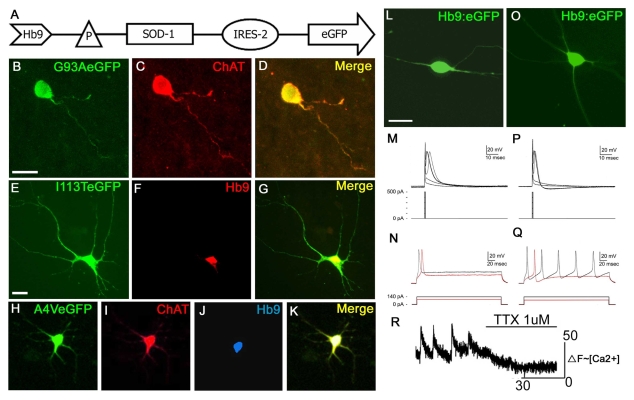
Fig. 1.
Fig. 1.
Generation of SOD1-transgenic motor neurons from hESCs. (A) Wild-type SOD1 and mutant G93A, I113T and A4V SOD1 cassettes were cloned into the BamHI site of the E/Hb9-3.6kb:EGFP vector containing the HB9 enhancer linked to the h-globin gene basal promoter. (B-D) G93A–GFP-transfected motor neurons co-stained for ChAT. (E-G) I113T–GFP-transfected motor neurons co-stained for HB9. (H-K) A4V–GFP-transfected motor neurons co-stained for ChAT and HB9. (L-Q) Action potential properties of hESC-derived motor neurons fall into two distinct classes that are typical of developing motor neurons. Panels (L-N) represent less differentiated cells with neurites extending =100 μm. Panels (O-Q) represent more highly differentiated cells with extensive axonal arborizations. Hb9:EGFP-positive cells were whole-cell patched in the current-clamp mode. Short duration (0.5 milliseconds) current pulses of increasing amplitude evoke single action potentials with a distinct threshold (M,P). Longer duration (250 milliseconds) current pulses elicit single action potentials (red) when the amplitude of the injected current is near to the threshold [(N) 100 nA; (Q) 80 nA]. When the amplitude of the stimulus pulse is increased, the more mature hESC-derived motor neurons respond with repetitive firing (Q). (R) Representative trace of fluo-3 ΔF (~[Ca2+]i) versus time for a single cell. Bath application of tetrodotoxin (TTX, 1 μM) abolishes spontaneous Ca2+ oscillations. Abbreviations: P, promoter; IRES-2, internal ribosomal entry site 2. Bars, 10 μm (B-D); 20 μm (E-O).
Fig. 2.
Fig. 2.
Mutant SOD1 alters cell morphology and viability.(A-C) Staining of G93A–GFP-transfected cells with the G93A-specific antibody shows an accumulation of G93A SOD1 cells in the soma and processes at 21 days after transfection.(D-G) Representative fluorescent micrograph of cells transfected with wild-type SOD1, the SOD1 mutants or the control vector after 21 days. (H,I) Average length of neurites on days 7 and 21 after transfection. The values at the top of the bars represent the relative percentage difference between motor neurons transfected with the respective mutants or wild-type SOD1 compared with those expressing the control GFP vector. The length of neurites at 7 days after transfection was reduced by 21.52% (F=3.49, P>0.05) in cells expressing wild-type SOD1, 24.31% (F=6.69, P>0.05) in cells expressing I113T SOD1, 39.63% (F=14.26, P<0.05) in cells expressing G93A SOD1 and by 46.73% (F=11.49, P<0.05) in cells expressing A4V SOD1. (J) Percentage cell survival from day 4 to day 7 after transfection. (K) Percentage cell survival from day 4 to day 21 after transfection; *P<0.05 and **P<0.01 compared with the control. All experiments were executed in triplicate by a blinded observer. Statistical analysis of the percentage of GFP-positive cells compared with wild-type cells shows significant differences with the G93A (F=13.10, P<0.05) and A4V (F=19.18, P<0.01) mutations. Abbreviation: hWT, human wild type. Bars, 10 μm (A-C); 20 μm (D-G).

References

    1. Beers DR, Henkel JS, Xiao Q, Zhao W, Wang J, Yen AA, Siklos L, McKercher SR, Appel SH. (2006). Wild-type microglia extend survival in PU.1 knockout mice with familial ALS. Proc. Natl. Acad. Sci. USA 103, 16021–16026 - PMC - PubMed
    1. Beltran-Parrazal L, Lopez-Valdes HE, Brennan KC, Diaz-Munoz M, de Vellis J, Charles AC. (2006). Mitochondrial transport in processes of cortical neurons is independent of intracellular calcium. Am. J. Physiol. Cell Physiol. 291, C1193–C1197 - PubMed
    1. Boillee S, Yamanaka K, Lobsiger CS, Copeland NG, Jenkins NA, Kassiotis G, Kollias G, Cleveland DW. (2006). Onset and progression in inherited ALS determined by motor neurons and microglia. Science 312, 1389–1392 - PubMed
    1. Bradley WG, Good P, Rasool CG, Adelman LS. (1983). Morphometric and biochemical studies of peripheral nerves in ALS. Ann. Neurol. 14, 267–277 - PubMed
    1. Broom WJ, Auwarter KE, Ni J, Russel DE, Yeh LA, Maxwell MM, Glicksman M, Kazantsev AG, Brown RH., Jr (2006). Two approaches to drug discovery in SOD1-mediated ALS. J. Biomol. Screen 11, 729–735 - PubMed

Publication types

MeSH terms