


Localized spatial clustering of HIV infections in a widely disseminated rural South African epidemic
- PMID: 19261659
- PMCID: PMC2720393
- DOI: 10.1093/ije/dyp148
Localized spatial clustering of HIV infections in a widely disseminated rural South African epidemic
Abstract
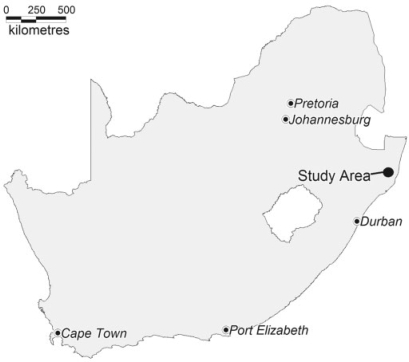
Background: South Africa contains more than one in seven of the world's HIV-positive population. Knowledge of local variation in levels of HIV infection is important for prioritization of areas for intervention. We apply two spatial analytical techniques to investigate the micro-geographical patterns and clustering of HIV infections in a high prevalence, rural population in KwaZulu-Natal, South Africa.
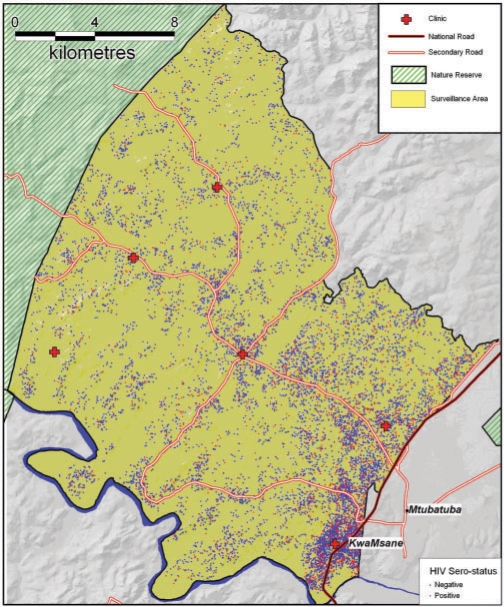
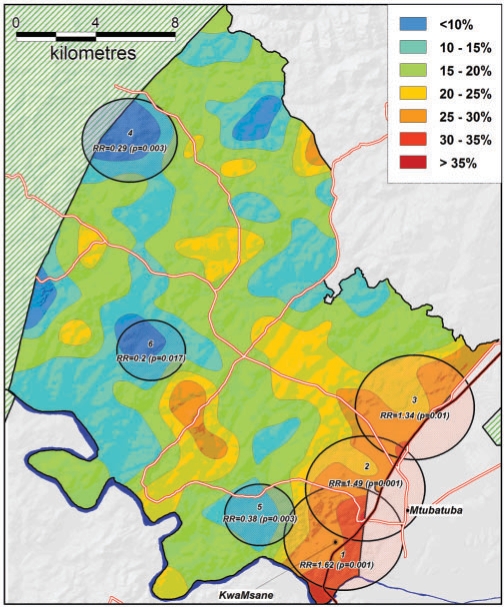
Methods: All 12,221 participants who consented to an HIV test in a population under continuous demographical surveillance were linked to their homesteads and geo-located in a geographical information system (accuracy of <2 m). We then used a two-dimensional Gaussian kernel of radius 3 km to produce robust estimates of HIV prevalence that vary across continuous geographical space. We also applied a Kulldorff spatial scan statistic (Bernoulli model) to formally identify clusters of infections (P < 0.05).
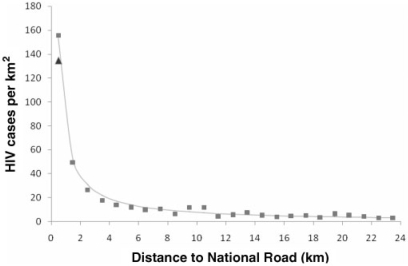
Results: The results reveal considerable geographical variation in local HIV prevalence (range = 6-36%) within this relatively homogenous population and provide clear empirical evidence for the localized clustering of HIV infections. Three high-risk, overlapping spatial clusters [Relative Risk (RR) = 1.34-1.62] were identified by the Kulldorff statistic along the National Road (P < or = 0.01), whereas three low risk clusters (RR = 0.2-0.38) were identified elsewhere in the study area (P < or = 0.017).
Conclusions: The findings show the existence of several localized HIV epidemics of varying intensity that are partly contained within geographically defined communities. Despite the overall high prevalence of HIV in many rural South African settings, the results support the need for interventions that target socio-geographic spaces (communities) at greatest risk to supplement measures aimed at the general population.
Figures
Comment in
-
Commentary: Spatial clustering of HIV infection: providing clues for effective HIV prevention.Int J Epidemiol. 2009 Aug;38(4):1016-7. doi: 10.1093/ije/dyp201. Epub 2009 Apr 30. Int J Epidemiol. 2009. PMID: 19406907 No abstract available.
References
-
- UNAIDS. 2008 Report on the Global AIDS Epidemic. UNAIDS, the Joint United Nations Programme on HIV/AIDS; 2008.
-
- DOH. National HIV and Syphilis Antenatal Prevalence Survey, South Africa 2006. Pretoria. Pretoria: Department of Health South Africa; 2007.
-
- Bärnighausen T, Tanser F, Gqwede Z, Mbizana C, Herbst K, Newell ML. High HIV incidence in a community with high HIV prevalence in rural South Africa: findings from a prospective population-based study. AIDS. 2008;22:139–44. - PubMed
-
- Anderson R, May R. Infectious Diseases of Humans: Dynamics and Control. New York: Oxford University Press; 1991.
