An investigation of satellite hemodialysis fallbacks in the province of Ontario
- PMID: 19261829
- PMCID: PMC2653667
- DOI: 10.2215/CJN.02890608
An investigation of satellite hemodialysis fallbacks in the province of Ontario
Abstract
Background and objectives: In Ontario, Canada, hemodialysis services are organized in a "hub and spoke" model comprised of regional centers (hubs), satellites, and independent health facilities (IHFs; spokes). Rarely is a nephrologist on site when dialysis treatments take place at satellite units or IHFs. Situations occur that require transfer of the patient back ("fallbacks") to the regional center that necessitate either in- or outpatient care. Growth in the satellite dialysis population has led to an increased burden on the regional centers. This study was carried out to determine the incidence, nature, and outcome of such fallbacks to aid resource planning.
Design, setting, participants, & measurements: Data were collected on 565 patients from five regional centers over 1 yr. These regional centers controlled 19 satellite dialysis centers including 7 IHFs.
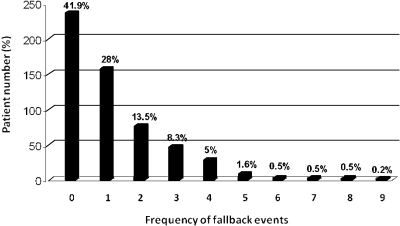
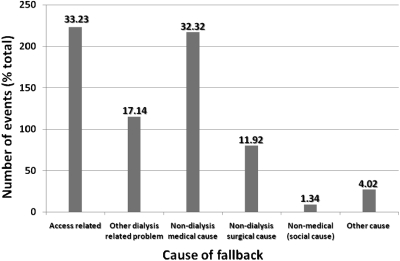
Results: There were 681 fallbacks in 328 patients: 1.21 incidents per patient or 2.1 incidents per patient year. Multiple fallbacks occurred in 170 patients. Fallback episodes lasted a mean of 10.3 d, requiring 4.6 dialysis treatments. Forty-five percent of fallbacks required hospitalization with a mean stay of 16.7 d. Access-related problems (33%) and nondialysis medical causes (32%) were the major causes of fallback. Resolution of the problem occurred in 87.8%, with the patient returning to the satellite. By the end of the study 77.3% were still satellite patients, 10.8% died, 3.8% returned to the regional center, 3.4% were transplanted, and 4.7% were transferred to other treatment modalities.
Conclusions: Fallbacks are common, yet the model operates well.
Figures
Comment in
-
Satellite dialysis in Ontario.Clin J Am Soc Nephrol. 2009 Mar;4(3):523-4. doi: 10.2215/CJN.00480109. Epub 2009 Mar 4. Clin J Am Soc Nephrol. 2009. PMID: 19261831 Free PMC article. No abstract available.
References
-
- Chronic Kidney Disease Program, Ministry of Health and Long-Term Care, Ontario. Model of Care: Expectations Document. February 16, 2004. Available at: http://www.health.gov.on.ca/login/kidney03.html. Accessed July 2004.
Publication types
MeSH terms
LinkOut - more resources
Full Text Sources
Medical