


Chronic administration of androgens with actions at estrogen receptor beta have anti-anxiety and cognitive-enhancing effects in male rats
- PMID: 19263246
- PMCID: PMC2693730
- DOI: 10.1007/s11357-009-9088-1
Chronic administration of androgens with actions at estrogen receptor beta have anti-anxiety and cognitive-enhancing effects in male rats
Abstract
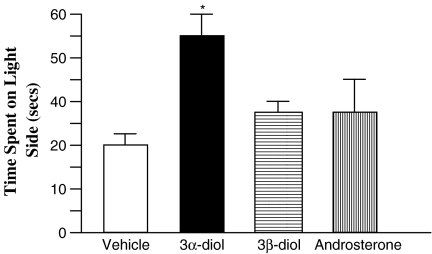
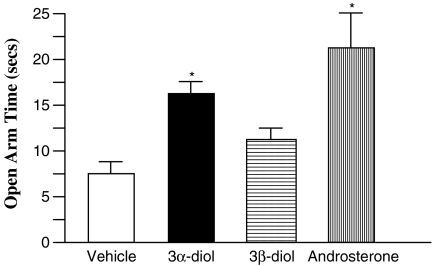
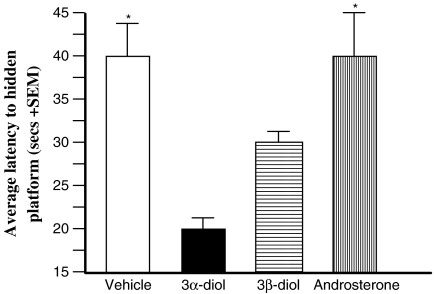
Androgen levels decline with aging. Some androgens may exert anti-anxiety and cognitive-enhancing effects; however, determining which androgens have anxiolytic-like and/or mnemonic effects is of interest given the different mechanisms that may underlie some of their effects. For example, the 5 alpha-reduced metabolite of testosterone (T), dihydrotesterone, can be further converted to 5 alpha-androstane,17beta-diol-3 alpha-diol (3 alpha-diol) and 5 alpha-androstane,17beta-diol-3beta-diol (3beta-diol), both of which bind with high affinity to the beta isomer of the intracellular estrogen receptor beta (ER beta). However, androsterone, another metabolite of T, does not bind well to ER beta. To investigate the effects of T metabolites, male rats were subjected to gonadectomy then implanted with silastic capsules of 3 alpha-diol, 3beta-diol, androsterone, or oil control. After recovery, the rats were tested in elevated plus maze (EPM), light/dark transition (LD), and Morris water maze (MWM). 3 alpha-diol both decreased anxiety-like behavior in the EPM and LD, and increased cognition in MWM, while 3beta-diol improved cognition in MWM, but had no effects on anxiety behavior, compared to vehicle or androsterone. These data suggest that the actions of 3 alpha-diol and 3beta-diol at ER beta may be responsible for some of testosterone's anti-anxiety and cognitive-enhancing effects.
Figures
References
Grants and funding
LinkOut - more resources
Full Text Sources
Research Materials