


doi: 10.1128/JVI.00063-09.
Epub 2009 Mar 4.
Selection of H5N1 influenza virus PB2 during replication in humans
Affiliations
- PMID: 19264775
- PMCID: PMC2682078
- DOI: 10.1128/JVI.00063-09
Item in Clipboard
Selection of H5N1 influenza virus PB2 during replication in humans
J Virol.
2009 May.
Abstract
Highly pathogenic H5N1 influenza viruses continue to cause concern, even though currently circulating strains are not efficiently transmitted among humans. For efficient transmission, amino acid changes in viral proteins may be required. Here, we examined the amino acids at positions 627 and 701 of the PB2 protein. A direct analysis of the viral RNAs of H5N1 viruses in patients revealed that these amino acids contribute to efficient virus propagation in the human upper respiratory tract. Viruses grown in culture or eggs did not always reflect those in patients. These results emphasize the importance of the direct analysis of original specimens.
Figures

Virus populations in the original specimens, the supernatants of MDCK cells, and the allantoic fluid of embryonated chicken eggs characterized by their PB2 genes. The PB2 genes from each sample were cloned into plasmids by reverse transcriptase PCR, ligation, and transformation. The plasmids were purified from independent E. coli transformants and their nucleotide sequences analyzed. The viruses possessing PB2-627Lys and PB2-701Asp (human type) are shown as black bars, those possessing PB2-627Glu and PB2-701Asn (also human type) as gray bars, and those possessing PB2-627Glu and PB2-701Asp (avian type) as white bars. The number of clones analyzed for each sample is indicated to the right of the bars. Results for the original specimens, the supernatants of MDCK cells (cultured in single wells), and the allantoic fluid of embryonated chicken eggs (three eggs for HN3040I, -3040II, and -3047 and one egg for HN3030I and -3062 were used; allantoic fluid from the same samples were pooled) are shown in the left, middle, and right columns, respectively. The MDCK cells were infected with 1,000-fold diluted HN3040I, 10-fold diluted HN3040II, 10-fold diluted HN3030I, original (nondiluted) HN3030II, 10-fold diluted HN3047III, and 1,000,000-fold diluted HN3062. The eggs were infected with 1,000-fold diluted HN3040I, 100-fold diluted HN3040II, 10,000-fold diluted HN3028I, 1,000-fold diluted HN3028II, 100-fold diluted HN3047III, and 10,000,000-fold diluted HN3062. ND, virus not detected.
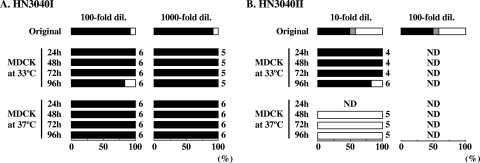
Alteration of virus populations characterized by the PB2 gene following their propagation in MDCK cells. The original specimens HN3040I (A) and HN3040II (B) diluted with minimal essential medium containing 0.3% bovine serum albumin at the indicated dilutions were inoculated into MDCK cells. The culture supernatants, incubated at 33°C (top rows) or 37°C (bottom rows), were independently harvested at the indicated times after inoculation and subjected to sequence analysis of the viral PB2 gene. The ratio of the viruses that had PB2-627Lys and PB2-701Asp, PB2-627Glu and PB2-701Asn, and PB2-627Glu and PB2-701Asp are represented by black (human type), gray (human type), and white (avian type) bars, respectively. The number of clones analyzed for each sample is indicated to the right of the bars. The results for the supernatants of the MDCK cells (cultured in single wells) infected with the 100- and 1,000-fold diluted HN3040I (A) and the 10- and 100-fold diluted HN3040II (B) from MDCK cells are shown. ND, virus not detected.
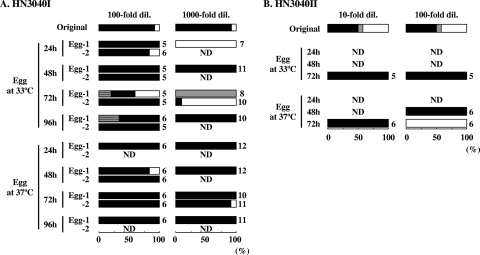
Alteration of virus populations characterized by the PB2 gene following their propagation in embryonated chicken eggs. The original specimens HN3040I (A) and HN3040II (B) diluted with phosphate-buffered saline as indicated were inoculated into embryonated chicken eggs. The allantoic fluid of the eggs, incubated at 33°C (upper rows) or 37°C (lower rows), was independently harvested at the indicated times after inoculation and subjected to sequence analysis of the viral PB2 gene. The ratio of the viruses that had PB2-627Lys and PB2-701Asn, PB2-627Lys and PB2-701Asp, PB2-627Glu and PB2-701Asn, and PB2-627Glu and PB2-701Asp are represented by the striped (human type), black (human type), gray (human type), and white (avian type) bars, respectively. The number of clones analyzed for each sample is indicated to the right of the bars. The results for the 100- and 1,000-fold diluted HN3040I (A) and the 10- and 100-fold diluted HN3040II (B) are shown. ND, virus not detected.
References
-
- Fouchier, R. A., P. M. Schneeberger, F. W. Rozendaal, J. M. Broekman, S. A. Kemink, V. Munster, T. Kuiken, G. F. Rimmelzwaan, M. Schutten, G. J. Van Doornum, G. Koch, A. Bosman, M. Koopmans, and A. D. Osterhaus. 2004. Avian influenza A virus (H7N7) associated with human conjunctivitis and a fatal case of acute respiratory distress syndrome. Proc. Natl. Acad. Sci. USA 1011356-1361. - PMC - PubMed
-
- Hatta, M., P. Gao, P. Halfmann, and Y. Kawaoka. 2001. Molecular basis for high virulence of Hong Kong H5N1 influenza A viruses. Science 2931840-1842. - PubMed
Publication types
MeSH terms
Substances
LinkOut - more resources
Full Text Sources
Medical
