


A yeast glycoprotein shows high-affinity binding to the broadly neutralizing human immunodeficiency virus antibody 2G12 and inhibits gp120 interactions with 2G12 and DC-SIGN
- PMID: 19264785
- PMCID: PMC2682088
- DOI: 10.1128/JVI.02537-08
A yeast glycoprotein shows high-affinity binding to the broadly neutralizing human immunodeficiency virus antibody 2G12 and inhibits gp120 interactions with 2G12 and DC-SIGN
Abstract
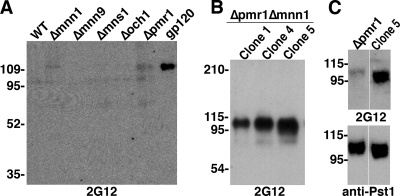
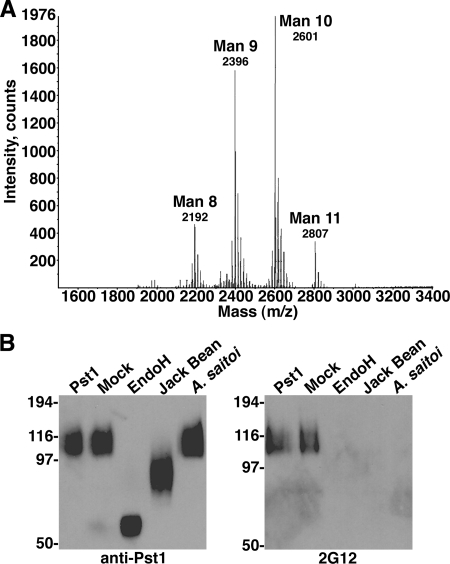
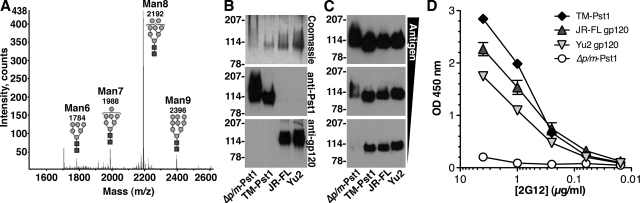
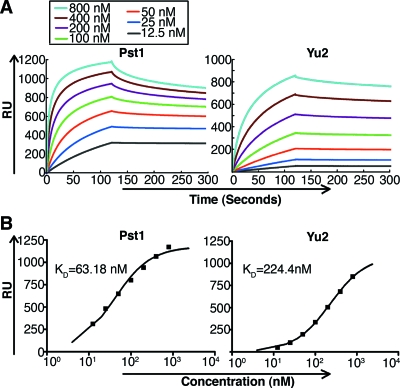
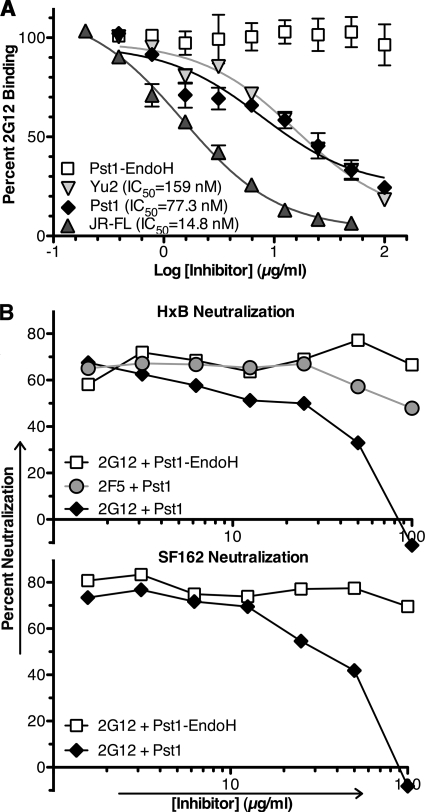
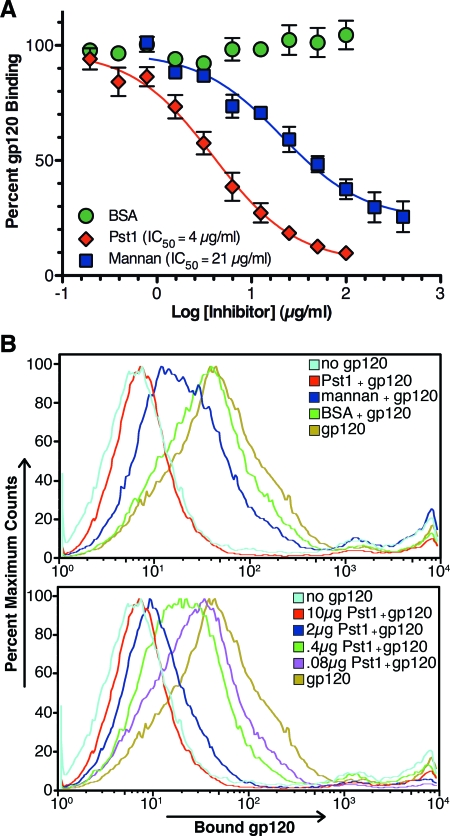
The human immunodeficiency virus type 1 (HIV-1) envelope (Env) protein contains numerous N-linked carbohydrates that shield conserved peptide epitopes and promote trans infection by dendritic cells via binding to cell surface lectins. The potent and broadly neutralizing monoclonal antibody 2G12 binds a cluster of high-mannose-type oligosaccharides on the gp120 subunit of Env, revealing a conserved and highly exposed epitope on the glycan shield. To find an effective antigen for eliciting 2G12-like antibodies, we searched for endogenous yeast proteins that could bind to 2G12 in a panel of Saccharomyces cerevisiae glycosylation knockouts and discovered one protein that bound weakly in a Delta pmr1 strain deficient in hyperglycosylation. 2G12 binding to this protein, identified as Pst1, was enhanced by adding the Delta mnn1 deletion to the Delta pmr1 background, ensuring the exposure of terminal alpha1,2-linked mannose residues on the D1 and D3 arms of high-mannose glycans. However, optimum 2G12 antigenicity was found when Pst1, a heavily N-glycosylated protein, was expressed with homogenous Man(8)GlcNAc(2) structures in Delta och1 Delta mnn1 Delta mnn4 yeast. Surface plasmon resonance analysis of this form of Pst1 showed high affinity for 2G12, which translated into Pst1 efficiently inhibiting gp120 interactions with 2G12 and DC-SIGN and blocking 2G12-mediated neutralization of HIV-1 pseudoviruses. The high affinity of the yeast glycoprotein Pst1 for 2G12 highlights its potential as a novel antigen to induce 2G12-like antibodies.
Figures


References
-
- Amberg, D., D. Burke, and J. Strathern. 2005. Methods in yeast genetics: a Cold Spring Harbor Laboratory course manual. Cold Spring Harbor Laboratory Press, Plainview, NY.
-
- Astronomo, R. D., H. K. Lee, C. N. Scanlan, R. Pantophlet, C. Y. Huang, I. A. Wilson, O. Blixt, R. A. Dwek, C. H. Wong, and D. R. Burton. 2008. A glycoconjugate antigen based on the recognition motif of a broadly neutralizing human immunodeficiency virus antibody, 2G12, is immunogenic but elicits antibodies unable to bind to the self glycans of gp120. J. Virol. 826359-6368. - PMC - PubMed
-
- Ballou, C. E. 1990. Isolation, characterization, and properties of Saccharomyces cerevisiae mnn mutants with nonconditional protein glycosylation defects. Methods Enzymol. 185440-470. - PubMed
-
- Bashirova, A. A., T. B. Geijtenbeek, G. C. van Duijnhoven, S. J. van Vliet, J. B. Eilering, M. P. Martin, L. Wu, T. D. Martin, N. Viebig, P. A. Knolle, V. N. KewalRamani, Y. van Kooyk, and M. Carrington. 2001. A dendritic cell-specific intercellular adhesion molecule 3-grabbing nonintegrin (DC-SIGN)-related protein is highly expressed on human liver sinusoidal endothelial cells and promotes HIV-1 infection. J. Exp. Med. 193671-678. - PMC - PubMed
Publication types
MeSH terms
Substances
Grants and funding
LinkOut - more resources
Full Text Sources
Other Literature Sources
Molecular Biology Databases
