. 2009 Jun;150(6):2898-905.
doi: 10.1210/en.2008-1016. Epub 2009 Mar 5.

Estrogen-dependent and -independent estrogen receptor-alpha signaling separately regulate male fertility

Affiliations

Estrogen-dependent and -independent estrogen receptor-alpha signaling separately regulate male fertility

Kerstin W Sinkevicius et al. Endocrinology. 2009 Jun.

Abstract

Estrogen receptor-alpha (ERalpha) plays a critical role in male reproductive tract development and fertility. To determine whether estrogen-dependent and -independent ERalpha mechanisms are involved in male fertility, we examined male estrogen nonresponsive ERalpha knock-in mice. These animals have a point mutation (G525L) in the ligand-binding domain of ERalpha that significantly reduces interaction with, and response to, endogenous estrogens but does not affect growth factor activation of ligand-independent ERalpha pathways. Surprisingly, we found that ligand-independent ERalpha signaling is essential for concentrating epididymal sperm via regulation of efferent ductule fluid reabsorption. In contrast, estrogen-dependent ERalpha signaling is required for germ cell viability, most likely through support of Sertoli cell function. By treating estrogen nonresponsive ERalpha knock-in (ENERKI) mice with the ERalpha selective synthetic agonist propyl pyrazole triol, which is able to bind and activate G525L ERalpha in vivo, we discovered male fertility required neonatal estrogen-mediated ERalpha signaling. Thus, our work indicates both estrogen-dependent and -independent pathways play separable roles in male murine reproductive tract development and that the role of ERalpha in human infertility should be examined more closely.


Figures
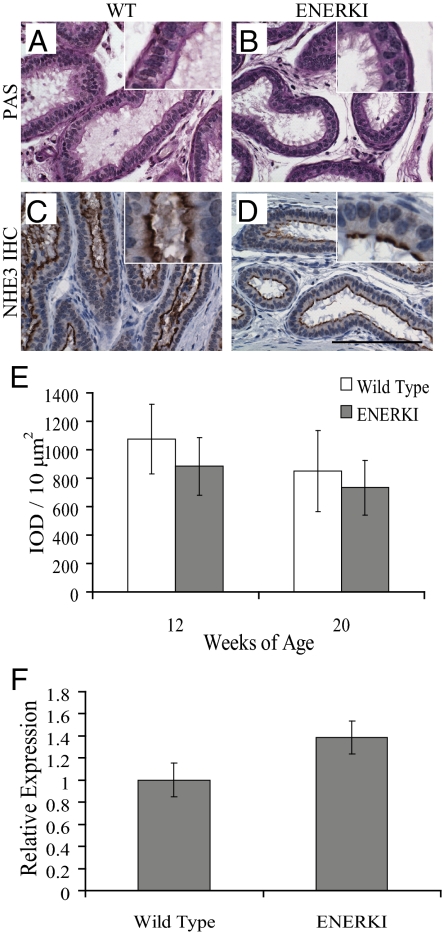
Figure 1
Figure 1
ENERKI efferent ductules exhibit normal histology. Representative efferent ductule tissue PAS staining and IHC for NHE3 from 12- or 20-wk-old wild-type (WT) (A and C) and ENERKI (B and D) mice. Efferent ductules of all genotypes were lined with a columnar epithelium consisting of ciliated and nonciliated cells (A and B). Similar levels of NHE3 were found along the brush border of nonciliated cells in both genotypes (C and D). Quantification of immunohistochemical staining confirmed wild-type and ENERKI NHE3 levels were not statistically different (E). The reported results represent the average integrated optical density (IOD) per 10 μm2 of tissue (which is directly proportional to the concentration of the molecule recognized by the stain) ± sd of three to seven samples per genotype. qRT-PCR results showing relative expression levels of wild-type and ENERKI efferent ductule NHE3 transcript levels (F). NHE3 expression levels of 20-wk-old mice were normalized to the wild-type control. The reported results represent the average ± sd of triplicate samples. ENERKI NHE3 transcript levels are not significantly different from wild-type levels. Bar, 100 μm.
Figure 2
Figure 2
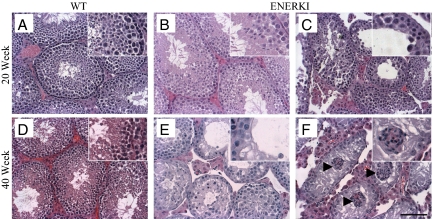
Heterogeneous testicular abnormalities occur in the seminiferous epithelium of 20- and 40-wk-old ENERKI mice. Representative testicular hematoxylin-and-eosin staining from 20- or 40-wk-old wild-type (WT) (A and D) and ENERKI (B, C, E, and F) mice. Wild-type testicular tissues from 20- (A) and 40-wk-old (D) mice had healthy seminiferous tubules supporting normal spermatogenesis. Some 20-wk-old ENERKI seminiferous tubules were normal (B), whereas others had severe abnormalities that included disorganization of the seminiferous epithelium, loss of sperm, Sertoli cell vacuolization (asterisks), and retraction of the Sertoli cell cytoplasm leading to an increased lumen diameter (C). Some 40-wk-old ENERKI testes exhibited these same abnormalities (E), whereas in others the injury progressed to reveal a Sertoli cell-only phenotype, in which the seminiferous epithelium lacked the presence of any germ cells (F). Some tubules also showed unusual clusters of Sertoli cells in the lumen of the tubules (arrowheads) (F). Bar, 100 μm.
Figure 3
Figure 3
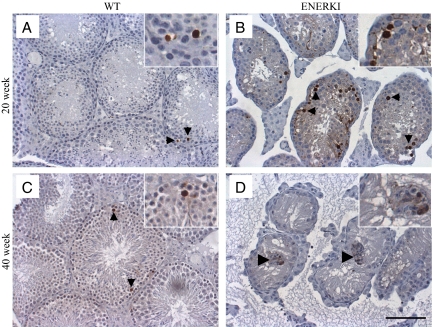
ENERKI mice exhibit increased testis TUNEL-positive germ cells compared with wild-type mice. Representative testicular TUNEL analysis from 20- and 40-wk-old wild-type (WT) (A and C) and ENERKI (B and D) mice. TUNEL analysis revealed there were significantly increased numbers apoptotic germ cells (black arrowheads) in 20-wk-old ENERKI testis sections (B) compared with wild-type sections (A) (P < 0.04). TUNEL-positive ENERKI germ cells were predominantly meiotic spermatocytes. Forty-week-old TUNEL germ cell staining was not significantly different between wild-type (C) and ENERKI (D) animals because most ENERKI tubules did not contain germ cells at this point. A few ENERKI Sertoli cells were TUNEL positive within the clusters of the Sertoli cells found in the lumen (large arrowhead) but not among the Sertoli cells that still remained adhered to the basement membrane (D). Bar, 100 μm.

Similar articles

Cited by

References

    1. Gronemeyer H, Gustafsson JA, Laudet V 2004 Principles for modulation of the nuclear receptor superfamily. Nat Rev Drug Discov 3:950–964 - PubMed
    1. Lonard DM, O'Malley BW 2006 The expanding cosmos of nuclear receptor coactivators. Cell 125:411–414 - PubMed
    1. Eddy EM, Washburn TF, Bunch DO, Goulding EH, Gladen BC, Lubahn DB, Korach KS 1996 Targeted disruption of the estrogen receptor gene in male mice causes alteration of spermatogenesis and infertility. Endocrinology 137:4796–4805 - PubMed
    1. Krege JH, Hodgin JB, Couse JF, Enmark E, Warner M, Mahler JF, Sar M, Korach KS, Gustafsson JA, Smithies O 1998 Generation and reproductive phenotypes of mice lacking estrogen receptor β. Proc Natl Acad Sci USA 95:15677–15682 - PMC - PubMed
    1. Hess RA 2003 Estrogen in the adult male reproductive tract: a review. Reprod Biol Endocrinol 1:52 - PMC - PubMed

Publication types

MeSH terms