Comparative Study
. 2009 Mar 15;182(6):3469-81.
doi: 10.4049/jimmunol.0801814.

Tc17, a unique subset of CD8 T cells that can protect against lethal influenza challenge

Affiliations
Comparative Study

Tc17, a unique subset of CD8 T cells that can protect against lethal influenza challenge

Hiromasa Hamada et al. J Immunol. .

Abstract

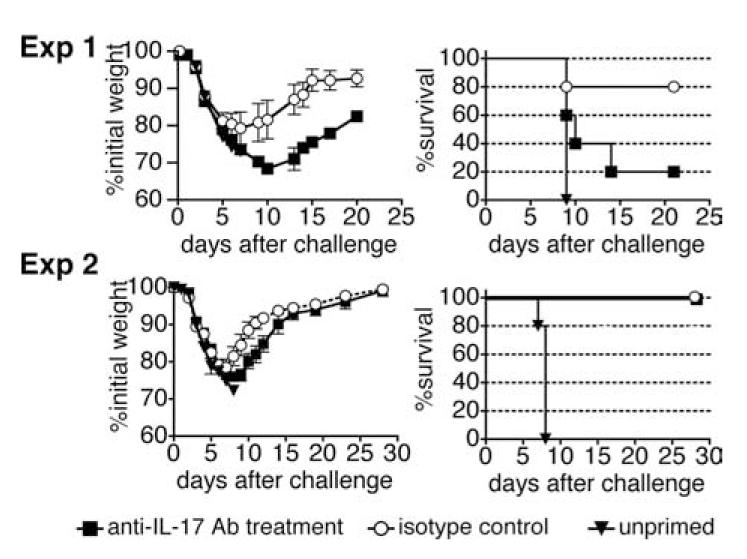
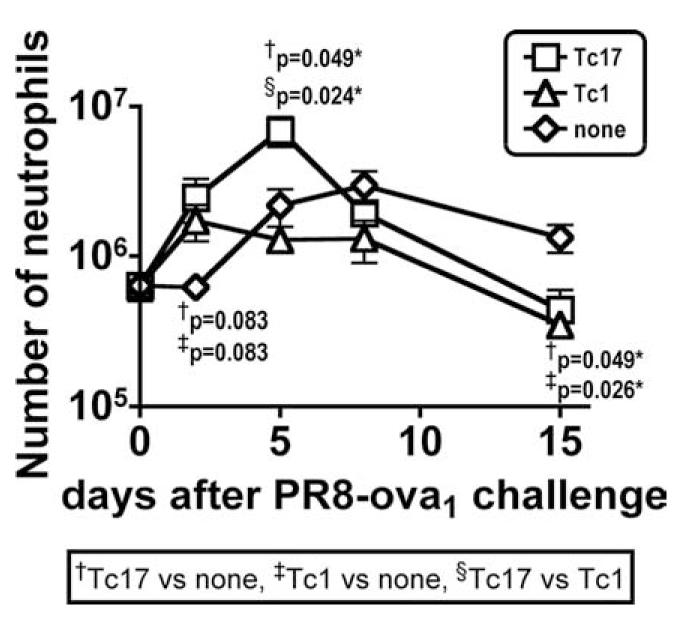
We show here that IL-17-secreting CD4 T (Th)17 and CD8 T (Tc)17 effector cells are found in the lung following primary challenge with influenza A and that blocking Ab to IL-17 increases weight loss and reduces survival. Tc17 effectors can be generated in vitro using naive CD8 T cells from OT-I TCR-transgenic mice. T cell numbers expand 20-fold and a majority secretes IL-17, but little IFN-gamma. Many of the IL-17-secreting cells also secrete TNF and some secrete IL-2. Tc17 are negative for granzyme B, perforin message, and cytolytic activity, in contrast to Tc1 effectors. Tc17 populations express message for orphan nuclear receptor gammat and FoxP3, but are negative for T-bet and GATA-3 transcription factors. The FoxP3-positive, IL-17-secreting and IFN-gamma-secreting cells represent three separate populations. The IFN-gamma-, granzyme B-, FoxP3-positive cells and cells positive for IL-22 come mainly from memory cells and decrease in number when generated from CD44(low) rather than unselected CD8 T cells. Cells of this unique subset of CD8 effector T cells expand greatly after transfer to naive recipients following challenge and can protect them against lethal influenza infection. Tc17 protection is accompanied by greater neutrophil influx into the lung than in Tc1-injected mice, and the protection afforded by Tc17 effectors is less perforin but more IFN-gamma dependent, implying that different mechanisms are involved.


Figures
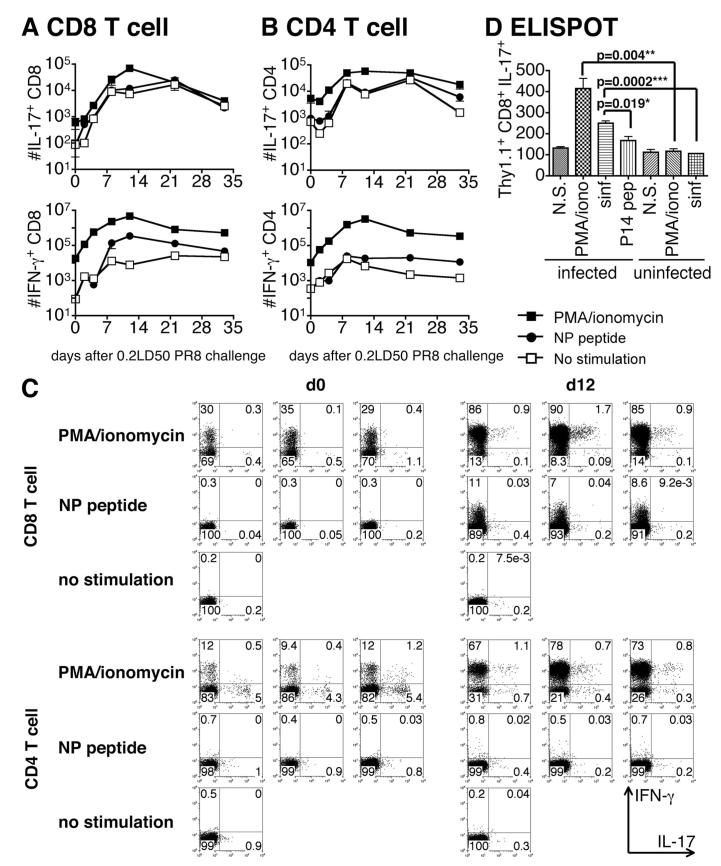
FIGURE 1
FIGURE 1
IL-17-secreting CD8 T cells in the influenza A-infected mouse. A and B, B6.Thy1.1 mice were infected with 0.2 LD50 influenza A/PR8. Mice were sacrificed at the times indicated, before and following challenge, and cells suspensions were prepared from lung and restimulated with PMA/ionomycin (■) or NP peptides (○) for 4 h or left unstimulated (□). Naive spleen cells from B6 mice were added as APCs. After restimulation, cells were stained with Abs to intracellular IL-17 (top) and IFN-γ (bottom) and surface CD8 (A) and CD4 (B). To exclude other type of cells, we gated on CD3+CD90.1+CD90.2-γδ- cells. Representative flow data are shown in C for days 0 and 12. D, Naive C57BL/6 mice were injected with 106 naive SIINFEKL/Kb-specific CD8 T cells from OT-1 mice carrying the Thy1.1 allele and were exposed to ∼2 LD50 of influenza A/PR8ova1. Uninfected mice served as a control. Mice were sacrificed on day 6 and cell suspensions were prepared from lung and spleen. Recipient T cells were removed by treatment with anti-Thy1.2 and complement and 8 × 10⁵ of the resulting cells, derived from the donor CD8 T cells and host non-T cells, were plated per well in an ELISPOT assay. Cells were left unstimulated (N.S.) or restimulated with PMA and ionomycin (PMA/iono) to assay all IL-17-secreting cells, or the albumin-derived SIINFEKL peptide (sinf) to assay IL-17-secreting OT-1 CD8 T cells, or the P14 peptide of LCMV (P14 pep) as the unrelated control.
FIGURE 2
FIGURE 2
Ab to IL-17 reduces heterosubtypic protection. In experiment 1, C57BL/6 mice were primed with 2500 TCID50 of cold-adapted A/Alaska6/77 on day -35 and were challenged with 4 LD50 of A/PR8 on day 0. Injections of depleting Ab or isotype control were given 1 day before and 1, 3, and 5 days after challenge. One group of five mice was treated with four injections of 0.1 mg of anti-IL-17 Ab. A second group of five was treated with four injections of 0.1 mg of isotype control IgG2b. A third control group was not primed. A second experiment of the same design but with 2-fold lower challenge dose is shown in experiment 2.
FIGURE 3
FIGURE 3
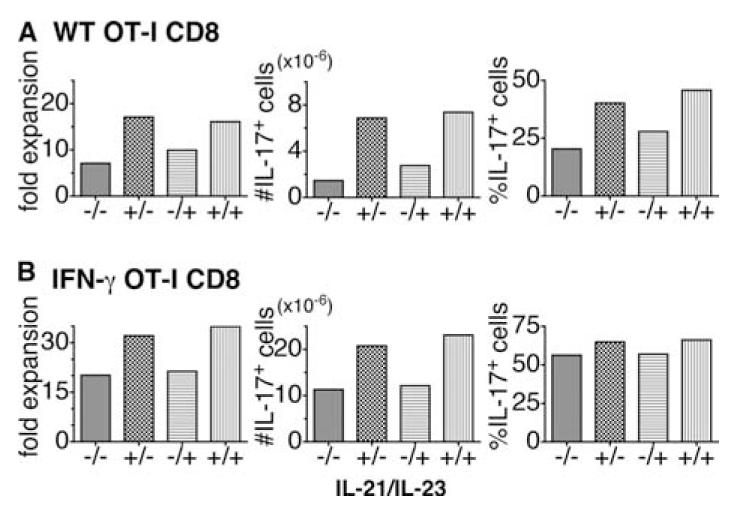
Generation of Tc17 effectors by in vitro culture. CD8 T cells were prepared from OT-1 (A) or OT-1.IFN-γ-/- mice (B), as described in Materials and Methods. In brief, 106 CD8 T cells from OT-1 mice were cultured for 4 days with (the OVA-derived peptide) SIINFEKL (10 μg/ml) pulsed onto mitomycin C-treated B blasts (one CD8 cell to three B cells) obtained by 3-day culture of T-depleted spleen cells in LPS and DXS. The following cytokines were added to the culture medium: IL-2 (4.7 ng/ml), IL-1β (10 ng/ml), IL-6 (20 ng/ml), and TGF-β (3 ng/ml). Abs to IL-4 (10 μg/ml) and IFN-γ (10 μg/ml) were also added. IL-21 (80 ng/ml) and IL-23 (50 ng/ml) were not added or were added singly or together in various combinations as indicated by plusses and minuses for IL-21/IL-23. Cultures were fed with additional medium containing IL-2 on day 2. Cells were harvested at day 4 and the fold increase (left-hand panel), the percent IL-17-secreting cells determined by intracellular cytokine staining (right-hand panel), and the calculated number of IL-17-secreting cells (middle panel). WT, Wild type.
FIGURE 4
FIGURE 4
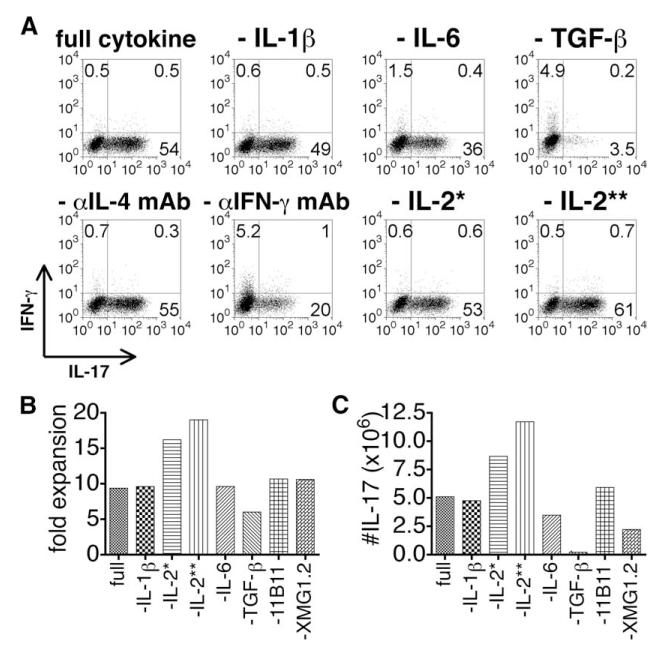
Determination of critical cytokines for Tc17 induction. Tc17 effectors were prepared using protocols as in Fig. 3 or with removal of each cytokine or Ab from the full cytokine and Ab mixture (IL-1β, IL-2, IL-6, IL-21, IL-23, TGF-β, anti-IL-4, and anti-IFN-γ). Cultures were fed with additional medium containing IL-2 on day 2 except IL-2 (**), which were not fed. Cells were harvested at day 4 and the number of cells and the number of IL-17-secreting cells was determined by intracellular cytokine staining (A). The fold increase is shown in B and the calculated number of IL-17-secreting cells is shown in C. One asterisk (*) indicates that this group had no IL-2 at the beginning of incubation, but fed only on day 2, and two asterisks (**) indicates no IL-2 throughout the entire experiment.
FIGURE 5
FIGURE 5
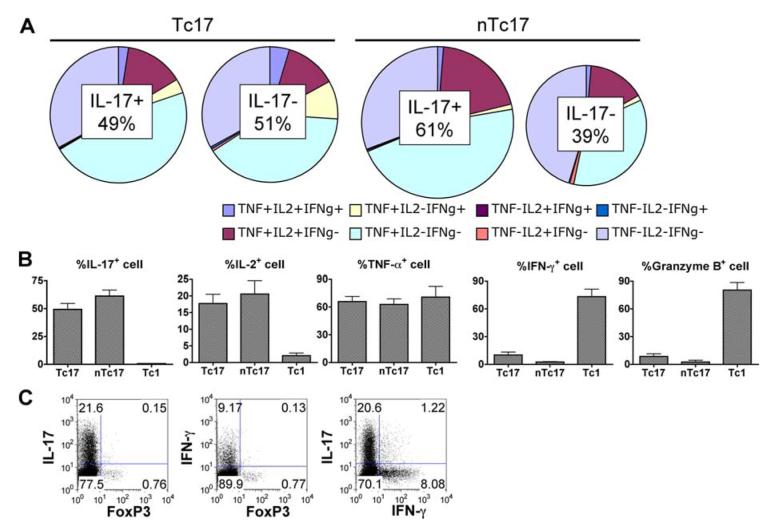
Cytokine secretion pattern, granzyme B expression, and FoxP3 expression of Tc17 effectors. In vitro-generated Tc17 from unselected and from CD44lowCD62Lhigh selected CD8 and Tc1 effectors were prepared as described in the legend to Fig. 3. The effectors harvested at day 4 were stimulated with PMA and ionomycin for 4 h and stained with a panel of Abs for intracellular cytokines, including IL-2, IL-17, IFN-γ, and TNF, and the results are shown in the pie diagrams (A). The graphs in B summarize the salient features of the staining of Tc17 compared with Tc1 and show also staining for granzyme B. Double staining for IL-17 and FoxP3, IFN-γ and FoxP3, and IL-17 and IFN-γ is shown in C.
FIGURE 6
FIGURE 6
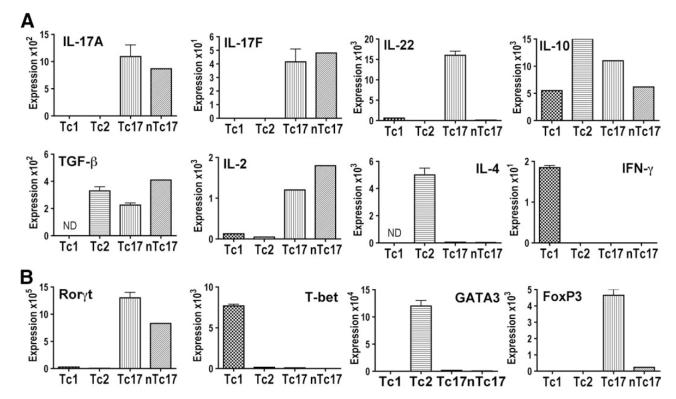
Cytokine and transcription factor message profiles of Tc17 CD8 effector populations. Tc1, Tc2, and Tc17 effector cells from unselected CD8 T cells (Tc17) and from naive CD44lowCD62Lhigh CD8 T cells (nTc17) were prepared as in Fig. 3. The cells were harvested at day 4 and RNA was extracted from the effector populations and assayed for message expression by TaqMan PCR (see Materials and Methods). Message expression was compared with GAPDH. A, Cytokine message for IL-2, IL-4, IL-17, IL-17F, IL-22, IL-10, IFN-γ, and TGF-β. B, Transcription factor message for RORγt, T-bet, GATA-3, and FoxP3.
FIGURE 7
FIGURE 7
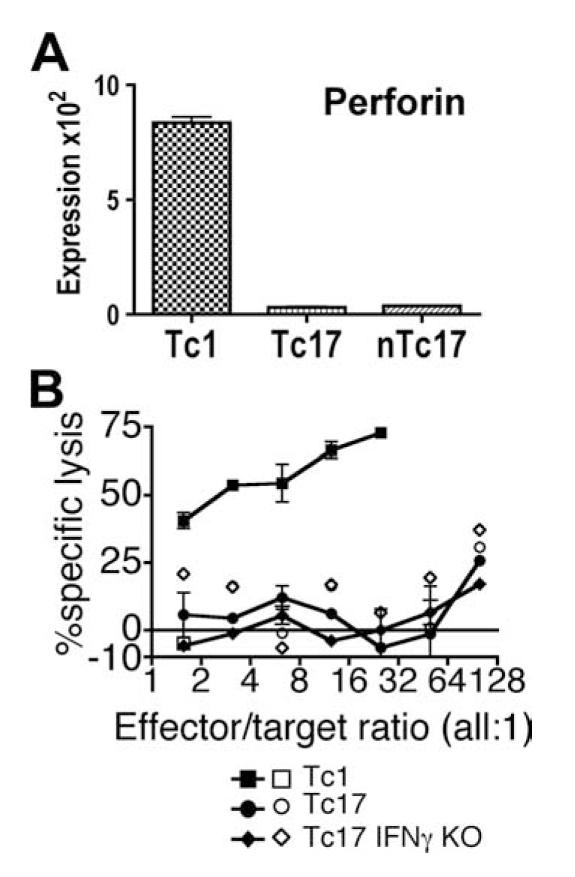
Perforin message expression and cytolytic activity of Tc17 CD8 effector populations. Tc1 and Tc17 effectors from unselected CD8 T cells (Tc17) and from naive CD44lowCD62Lhigh CD8 T cell (nTc17) populations prepared as in Fig. 3 were also assayed for perforin message expression (A). B, Cytolytic activity of OT-1 Tc1 (■ and □), OT-1 Tc17 (● and ○), and IFN-γ-deficient OT-1 Tc17 (◆ and ◇) effectors against specific SIINFEKL peptide-pulsed EL-4 (■, ●, and ◆) and nonspecific KAVYNFATM peptide-pulsed EL-4 (□, ○, and ◇) were assessed in the JAM assay, as described in Materials and Methods.
FIGURE 8
FIGURE 8
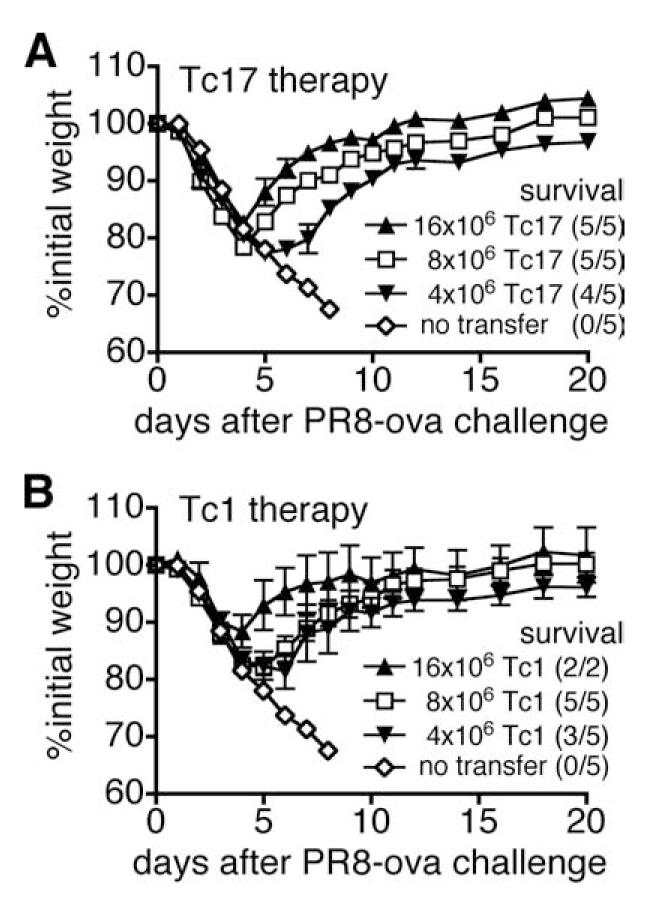
Tc17 effectors provide protection from lethal challenge with influenza A. Tc1 and Tc17 effector populations were prepared and 4, 8, or 16 × 106 cells of Tc17 (A) or Tc1 (B) were injected into naive C57BL/6 recipients that were challenged 1 day later with ∼2 LD50 A/PR8ova1. Control mice received no effector cells. Weight changes of mice were expressed as the percentage of initial weight.
FIGURE 9
FIGURE 9
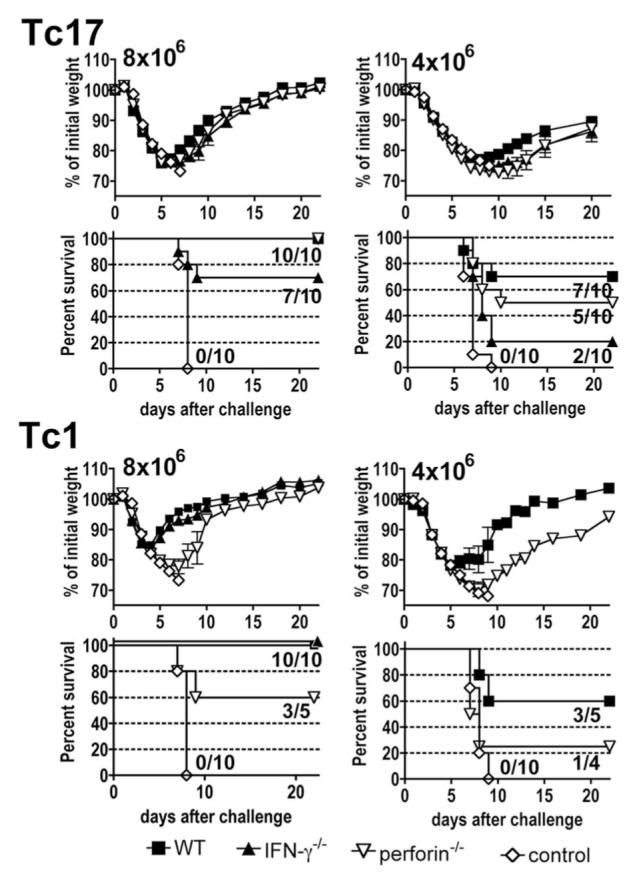
Effect of IFN-γ and perforin deficiencies on Tc17- and Tc1-mediated protection against influenza A. Tc1 and Tc17 effector populations from wild-type (WT), IFN-γ-/-, or perforin-/- were prepared and 4 or 8 × 10⁶ cells of Tc17 or Tc1 were injected into naive C57BL/6 recipients that were challenged 1 day later with ∼2 LD50 A/PR8ova1. Control mice received no effector cells. Weight changes of mice were expressed as the percentage of initial weight and percent survival is shown. The values inside the survival graphs indicate the number of surviving mice/the number of total mice.
FIGURE 10
FIGURE 10
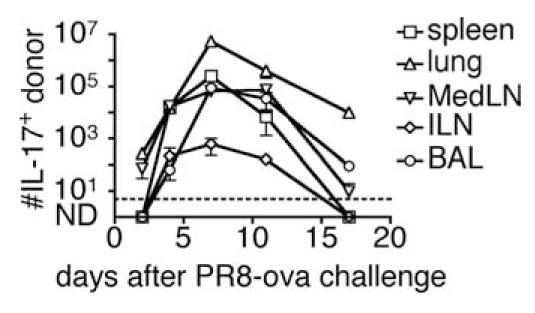
The number of transferred Tc17 after influenza A infection. Tc17 effectors from OT-1.CD45.1 were prepared and 2 × 10⁶ of Tc17 were i.v. injected into naive B6.Thy1.1 recipients. One day after Tc17 injection, B6.Thy1.1 mice were i.n. infected with ∼0.3 LD50 of influenza A/PR8oval. Mice were sacrificed at the times indicated following challenge, and cells suspensions were prepared from spleen (□), lung (△), MedLN (▽), ILN (◇), and BAL (○) and restimulated with PMA/ionomycin. After restimulation, cells were stained with Abs to intracellular IL-17 and surface CD8. The analysis was gated on CD45.1+CD45.2-CD90.1-CD90.2+ CD8 T cells to exclude other cell types.
FIGURE 11
FIGURE 11
The number of lung neutrophils in protected and control mice after influenza A infection. Tc17 effectors from OT-1.CD45.1 were prepared and 4 × 10⁶ of Tc17 (□) or Tc1 (△) were i.v. injected into naive B6.Thy1.1 recipients. Control mice were not injected (◇). One day after Tc17 or Tc1 injection, B6.Thy1.1 mice were i.n. infected with ∼0.3 LD50 of influenza A/PR8oval. Mice were sacrificed at the times indicated following challenge, and cells suspensions were prepared from lung. Neutrophils were gated on Gr-1high7/4highCD11b+F4/80-I-Ab-.

References

    1. Mosmann TR, Coffman RL. TH1 and TH2 cells: different patterns of lymphokine secretion lead to different functional properties. Annu. Rev. Immunol. 1989;7:145–173. - PubMed
    1. Swain SL, Bradley LM, Croft M, Tonkonogy S, Atkins G, Weinberg AD, Duncan DD, Hedrick SM, Dutton RW, Huston G. Helper T-cell subsets: phenotype, function and the role of lymphokines in regulating their development. Immunol. Rev. 1991;123:115–144. - PubMed
    1. Seder RA, Paul WE. Acquisition of lymphokine-producing phenotype by CD4+ T cells. Annu. Rev. Immunol. 1994;12:635–673. - PubMed
    1. Seder RA, Boulay JL, Finkelman F, Barbier S, Ben-Sasson SZ, Le Gros G, Paul WE. CD8+ T cells can be primed in vitro to produce IL-4. J. Immunol. 1992;148:1652–1656. - PubMed
    1. Croft M, Carter L, Swain SL, Dutton RW. Generation of polarized antigen-specific CD8 effector populations: reciprocal action of interleukin (IL)-4 and IL-12 in promoting type 2 versus type 1 cytokine profiles. J. Exp. Med. 1994;180:1715–1728. - PMC - PubMed

Publication types

MeSH terms