Comparative Study
. 2009 Mar 15;182(6):3628-37.
doi: 10.4049/jimmunol.0803401.

Chimpanzees use more varied receptors and ligands than humans for inhibitory killer cell Ig-like receptor recognition of the MHC-C1 and MHC-C2 epitopes

Affiliations
Comparative Study

Chimpanzees use more varied receptors and ligands than humans for inhibitory killer cell Ig-like receptor recognition of the MHC-C1 and MHC-C2 epitopes

Achim K Moesta et al. J Immunol. .

Abstract

Humans and chimpanzees have orthologous MHC class I, but few orthologous killer cell Ig-like receptors (KIR). Most divergent are lineage III KIR, which in humans include the inhibitory KIR2DL1 and 2DL2/3 specific for HLA-C. Six lineage III chimpanzee KIR were identified as candidate inhibitory MHC-C receptors and studied using cytolytic assays, to assess the capacity of a defined KIR to function with a defined MHC class I allotype, and direct binding assays with KIR-Fc fusion proteins. Pt-KIR2DL6 and 2DL8 were demonstrated to be inhibitory C1 receptors with a specificity and specificity-determining residue (lysine 44) like KIR2DL3. Analogously, Pt-KIR2DL7 is like KIR2DL1, an inhibitory C2 receptor having methionine 44. Pt-KIR3DL4 and 3DL5 are unusual lineage III KIR with D0 domains, which are also inhibitory C2 receptors with methionine 44. Removal of D0 from KIR3DL, or its addition to KIR2DL, had no effect on KIR function. Pt-KIR2DL9, a fourth inhibitory C2 receptor, has glutamate 44, a previously uncharacterized specificity-determining residue that is absent from human KIR. Reconstruction of the ancestral hominoid KIR sequence shows it encoded lysine 44, indicating that KIR having methionine 44 and glutamate 44 subsequently evolved by independent point substitutions. Thus, MHC-C2-specific KIR have evolved independently on at least two occasions. None of the six chimpanzee KIR studied resembles KIR2DL2, which interacts strongly with C1 and cross-reacts with C2. Whereas human HLA-B allotypes that have functional C1 epitopes are either rare (HLA-B*73) or geographically localized (HLA-B*46), some 25% of Patr-B allotypes have the C1 epitope and are functional KIR ligands.


Conflict of interest statement

DISCLOSURES

The authors have no conflicting financial interests.

Figures

Figure 1
Figure 1. Chimpanzees have inhibitory KIR that distinguish MHC-C1 and MHC-C2 allotypes similarly to human KIR2DL1 and KIR2DL3
Shown are the results of cytotoxicity assays in which the target cells were 221 cells expressing C1 (left panels) or C2 (right panels) and the effector cells were NKL cells expressing either chimpanzee (solid lines; Pt-KIR2DL6: ○, Pt-KIR3DL4: ◊) or hum an K IR (dashed lines; K IR 2D L 1: □, K IR 2D L 3: △).
Figure 2
Figure 2. The number of lineage III KIR in chimpanzees is biased towards inhibitory receptors and in humans towards activating receptors
Shown is a schematic depiction of the structure and domain organization for the receptors encoded by chimpanzee and human lineage III KIR genes. (St = extracellular stem, Tm = transmembrane domain, Cy = cytoplasmic domain). Only KIR encoded by orthologous genes (ie: KIR2DS4 and Pt-KIR2DS4) are on the same line. Expressed D0 domains are shaded black, short tailed cytoplasmic domains are white. Residues at the specificity-determining position 44 of D1 are shown in standard single letter amino acid code, as is the lysine residue encoded at position 233 in the transmembrane domain of activating receptors. Indicated by diamonds (◆) are the ITIM motifs present in the cytoplasmic domain of inhibitory KIR. The reactivity of monoclonal anti-KIR antibodies (EB6, DX27 and NKVFS1) with Pt-KIR was determined either using bead-bound soluble Fc-KIR fusion proteins and/or transduced NKL cells. For human KIR the antibody reactivities were either determined using the same methods (KIR2DL1, KIR2DL2, KIR2DL3) or are as reported previously (57, 58).
Figure 3
Figure 3. Unlike their human counterpart, chimpanzee C2-specific KIR can have glutamate or methionine as their specificity-determining residue
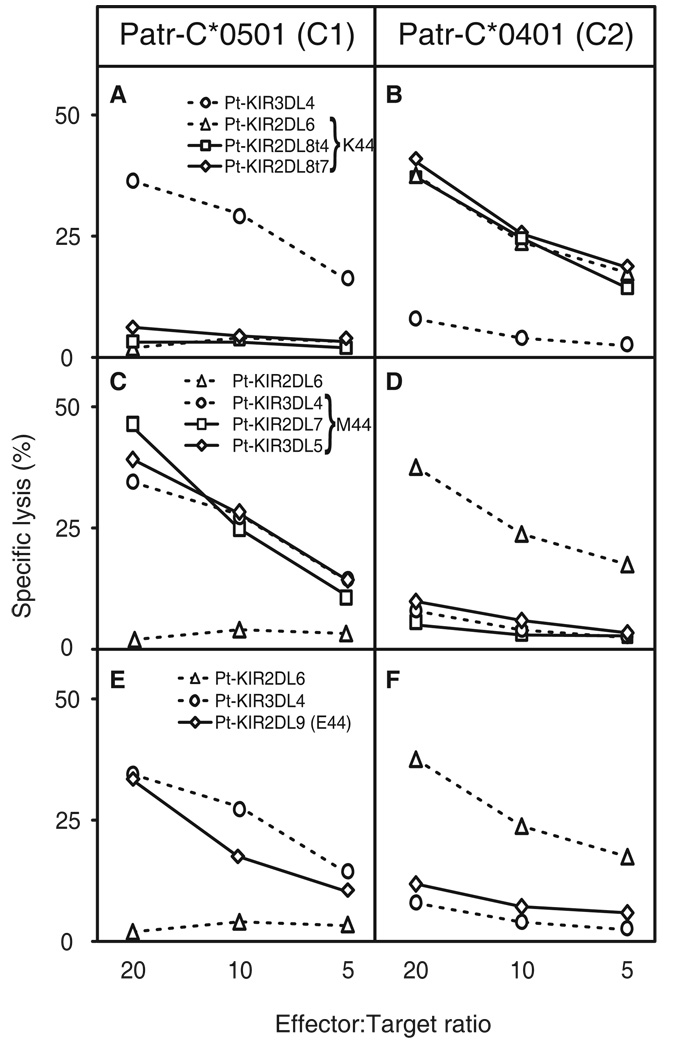
Shown are the results of cytotoxicity assays that illustrate the specificities of the six inhibitory lineage III KIR depicted in Fig. 2. Target cells were Patr-C*0501 that has the C1 epitope (left panels) and Patr-C*0401 that has the C2 epitope (right panels). Effector cells were transductants of NKL expressing a single Pt-KIR. Panels are organized according to the specificity-determining residue at position 44: lysine-44, top panels; methionine-44, middle panels; and glutamate-44, bottom panels. Specific lysis for NKL cells expressing Pt-KIR2DL6 (K44) and Pt-KIR3DL4 (M44), the prototypical C1-specific and C2-specific chimpanzee KIR (see Fig. 1) are included as controls in each panel (dotted line).
Figure 4
Figure 4. Distinct events have given rise to the multiple specificity determining residue of primate lineage III KIR
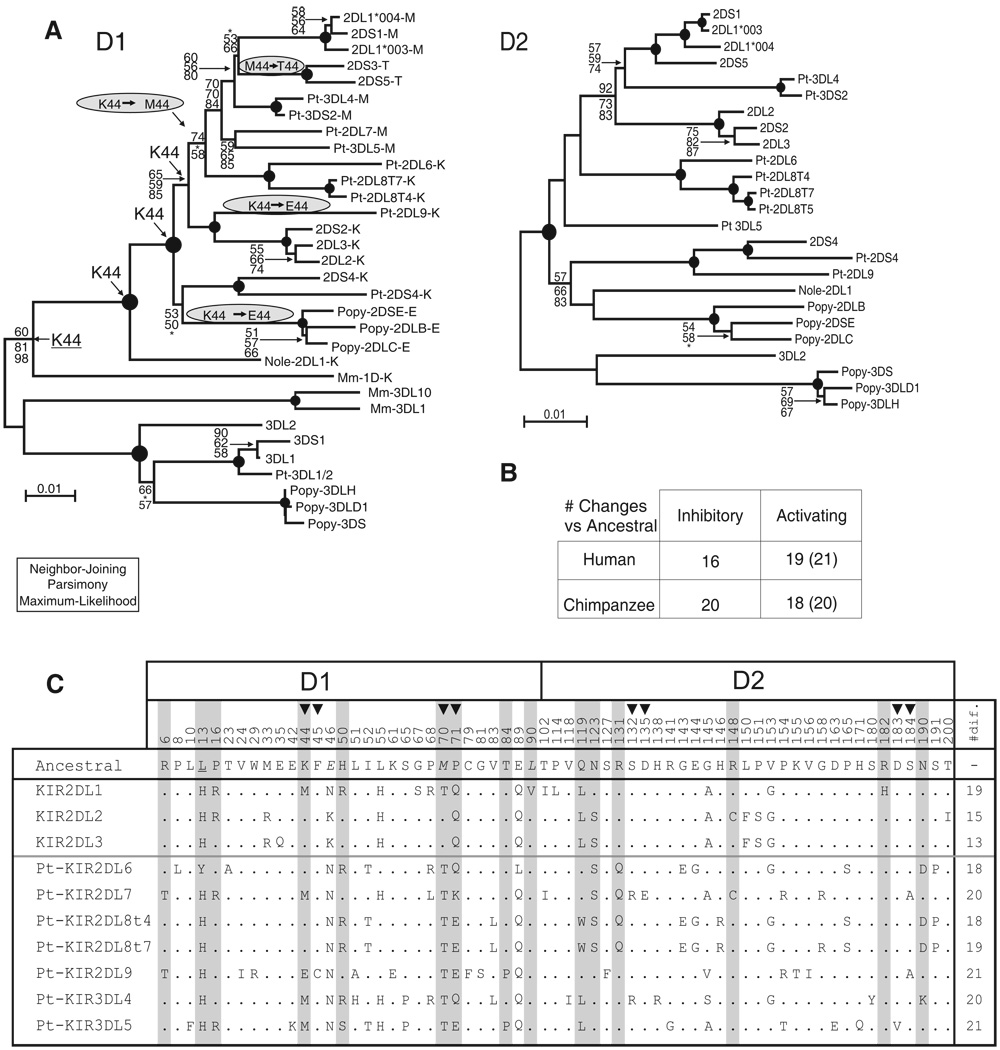
(A) Phylogenetic analysis was performed on genomic segments that encode the D1 (left panel) and D2 (right panel) domains from both lineage II and III KIR using Neighbor-Joining, Parsimony and Maximum Likelihood approaches. The NJ trees were used for display and rooted at the midpoint. Support is indicated for nodes where bootstrap support was >50 with two of the three methods, or signified by a solid circle where support was >80 with all three methods. Ancestral sequences were reconstructed and the residue for position 44 is indicated at several nodes (see arrows). At position 44 of D1, the presence of lysine is indicated by K, glutamate by E, methionine by M and threonine by T. (B) Summary of differences from the ancestral sequence. The average number of differences from the ancestral sequence is given according to species and signaling function. For activating KIR, averages are shown for all activating receptors and without KIR2DS4/Pt-KIR2DS4 shown in parenthesis (C) Comparison of substitutions in the amino-acid sequences of the D1 and D2 domains of human and chimpanzee inhibitory lineage III KIR with the sequence of the predicted ancestral hominoid lineage III KIR. Identity with the ancestral sequence is indicated by ‘.’ All residues in the ancestral sequence were predicted with p>0.99, except underlined residues, for which p>0.95, and residues in italics, which were statistically unresolved and for which the most likely residue is given. Positions that have been subject to positive selection are in grey shaded boxes (L. Abi-Rached, manuscript in preparation); arrowheads denote positions that contact MHC class I.
Figure 5
Figure 5. Presence or absence of the D0 domain does not affect the functional interaction of lineage III KIR with MHC class I
Shown are the results of cytotoxicity assays using NKL cells expressing mutant KIR in which the D0 domain was removed from either Pt-KIR3DL4 or Pt-KIR3DL5 (A), or in which the D0 domain from Pt-KIR3DL4 was added on to Pt-KIR2DL6, KIR2DL3 or KIR2DL1 (B). Target cells expressed either C1 (Patr-C*0301, cross-hatched bar; Patr-C*0401, dotted bar) or C2 (Patr-C*0501, white fill; Patr-C*0601, grey fill). Untransfected 221 expressing no MHC class I (black fill) are shown as a control. Results are shown for an effector:target ratio of 20:1.
Figure 6
Figure 6. Common chimpanzee MHC-B allotypes carry C1 epitopes that function as ligands for C1-specific KIR
(A) Summarizes the results of binding assays between Fc-KIR fusion proteins and beads coated with different HLA class I allotypes. Fusion proteins were made from Pt-KIR2DL6, Pt-KIR2DL7, Pt-KIR2DL8 (allele Pt-KIR2DL8t7 shown) and Pt-KIR2DL9. Mean values are given for nine HLA-C1, seven HLA-C2, and for the combination of 29 HLA-A and 48 -B allotypes. HLA-B*4601 and B*7301 are shown individually (and were not included in the group of HLA-A and –B) because they carry the C1 epitope. (B) Shows an alignment of the amino acid sequences for positions 65–83 of MHC-B and –C molecules. Positions 76 and 80, for which a valine 76, asparagine 80 motif is essential for the C1 epitope, are highlighted by greyshaded boxes. (C) Shows the results of cytotoxicity assays of NKL transductants expressing single KIR (Pt-KIR2DL7, 2DL6, 2DL8 and human KIR2DL3) as effector cells and 221 cells transfected with single MHC class I allotypes (Patr-C*0401, -C*0501, -B*1601, -B*0801, -B*2001, and B*1801). Bars are shaded according to the sequence motif at position 76 and 80 as shown on the right (C1: grey; C2: cross hatched, E76/I80: white, no MHC: black). Results are shown for an effector:target ratio of 20:1. (D) Comparison of the allele frequencies of the C1 and C2 epitopes for the MHC-C locus for chimpanzee and human populations. Human population data was compiled from the IHWG database and the number of individual populations within each world region is indicated. The mean frequency and range (in parenthesis) of all allotypes with the C1 and C2 epitope are shown. Note the more even frequency of C1 and C2 in the chimpanzee than human.

References

    1. Lanier LL. Evolutionary struggles between NK cells and viruses. Nat Rev Immunol. 2008;8:259–268. - PMC - PubMed
    1. Moretta L, Ferlazzo G, Bottino C, Vitale M, Pende D, Mingari MC, Moretta A. Effector and regulatory events during natural killer-dendritic cell interactions. Immunol Rev. 2006;214:219–228. - PubMed
    1. Raulet DH, Vance RE. Self-tolerance of natural killer cells. Nat Rev Immunol. 2006;6:520–531. - PubMed
    1. Trinchieri G. Biology of natural killer cells. Adv Immunol. 1989;47:187–376. - PMC - PubMed
    1. Hiby SE, Walker JJ, O’Shaughnessy K M, Redman CW, Carrington M, Trowsdale J, Moffett A. Combinations of maternal KIR and fetal HLA-C genes influence the risk of preeclampsia and reproductive success. J Exp Med. 2004;200:957–965. - PMC - PubMed

Publication types

MeSH terms