


doi: 10.1086/597417.
Attribution of Campylobacter infections in northeast Scotland to specific sources by use of multilocus sequence typing
Affiliations
- PMID: 19265482
- PMCID: PMC3985119
- DOI: 10.1086/597417
Item in Clipboard
Attribution of Campylobacter infections in northeast Scotland to specific sources by use of multilocus sequence typing
J Infect Dis.
.
Abstract
We show that a higher incidence of campylobacteriosis is found in young children (age, <5 years) living in rural, compared with urban, areas. Association of this difference with particular animal sources was evaluated using multilocus sequence typing. This evaluation was achieved by comparing Campylobacter isolates originating from these children, retail poultry, and a range of animal sources by use of source attribution and phylogenetic analysis methods. The results indicate that chicken is a major source of infection in young urban children, although not in their rural counterparts, for which ruminant and other avian sources are more important.
Figures
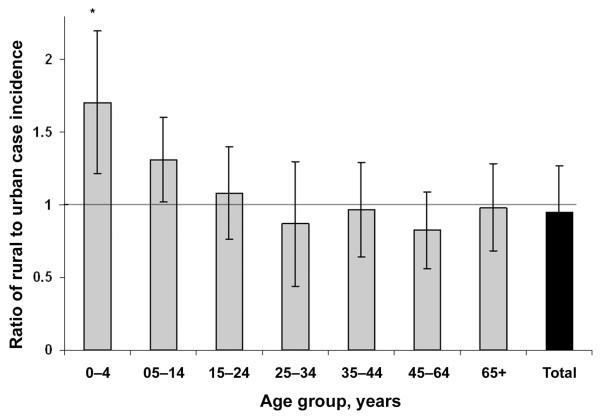
The ratio of rural/urban incidences of campylobacteriosis in Northeast Scotland in 2000–2006, as stratified by age. Error bars denote the SEM, and the asterisk denotes the statistical difference from 1, as determined by t test after sequential Bonferroni correction).
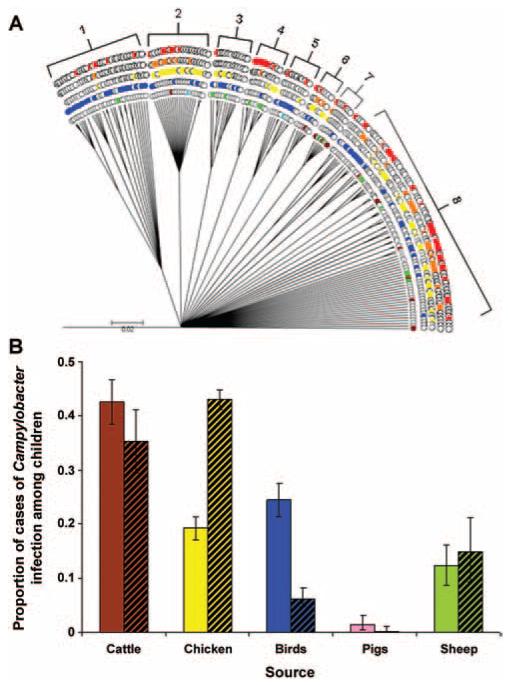
A, ClonalFrame tree of the main Campylobacter jejuni clade showing distribution of rural and urban young children with animal source sequence types (STs) (rural children are shown in red; urban children, orange; chicken, yellow; avian sources excluding chicken, blue; cattle, brown; pigs, pink; sheep, green; cattle and avian sources, gray; and pets, light blue). B, Attribution of the source of infection in children 0–4 years of age in rural areas and urban areas (bars with black diagonal lines), by probabilistic assignment of multilocus sequence typing allele frequency by use of Structure software.
References
-
- Centers for Disease Control and Prevention Preliminary FoodNet data on the incidence of infection with pathogens transmitted commonly through food—10 states, 2006. MMWR Morb Mortal Wkly Rep. 2007;56:336–9. - PubMed
-
- Locking M, Browning L, Smith-Palmer A, Brownlie S. Gastro-intestinal and foodborne infections. HPS Weekly Report. 2007;41:3–4.
-
- Stanley K, Jones K. Cattle and sheep farms as reservoirs of Campylobacter. J Appl Microbiol. 2003;94:104S–13S. - PubMed
Publication types
MeSH terms
Grants and funding
LinkOut - more resources
Full Text Sources
Medical
