. 2009 Mar 6:10:80.
doi: 10.1186/1471-2105-10-80.

CNV-seq, a new method to detect copy number variation using high-throughput sequencing

Affiliations

CNV-seq, a new method to detect copy number variation using high-throughput sequencing

Chao Xie et al. BMC Bioinformatics. .

Abstract

Background: DNA copy number variation (CNV) has been recognized as an important source of genetic variation. Array comparative genomic hybridization (aCGH) is commonly used for CNV detection, but the microarray platform has a number of inherent limitations.

Results: Here, we describe a method to detect copy number variation using shotgun sequencing, CNV-seq. The method is based on a robust statistical model that describes the complete analysis procedure and allows the computation of essential confidence values for detection of CNV. Our results show that the number of reads, not the length of the reads is the key factor determining the resolution of detection. This favors the next-generation sequencing methods that rapidly produce large amount of short reads.

Conclusion: Simulation of various sequencing methods with coverage between 0.1x to 8x show overall specificity between 91.7 - 99.9%, and sensitivity between 72.2 - 96.5%. We also show the results for assessment of CNV between two individual human genomes.


Figures
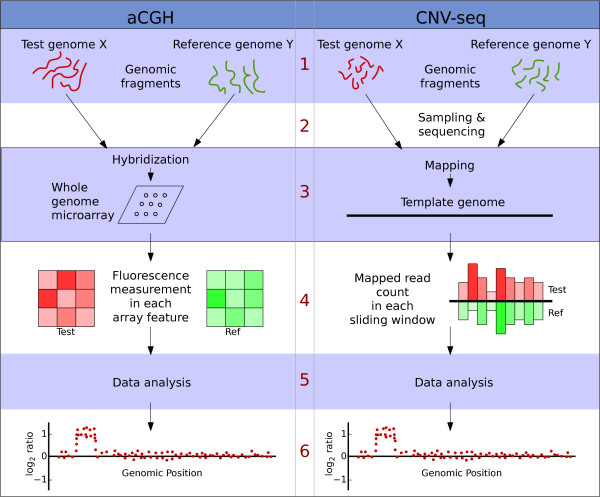
Figure 1
Figure 1
A comparison of the conceptual steps in aCGH and CNV-seq methods. 1. Starting material in both cases is genomic fragments from two genomes. 2. In CNV-seq the fragments are samples and sequenced. 3. Genomic fragments are directly hybridized on to an array. In CNV-seq the mapping is performed by sequence alignment. 4. In microarray the light intensities reflect the number of hybridized fragments. In CNV-seq the number of mapped reads are counted directly. 5. Data analysis, including estimation of copy number ratios, confidence values, etc. 6. Output of the results.
Figure 2
Figure 2
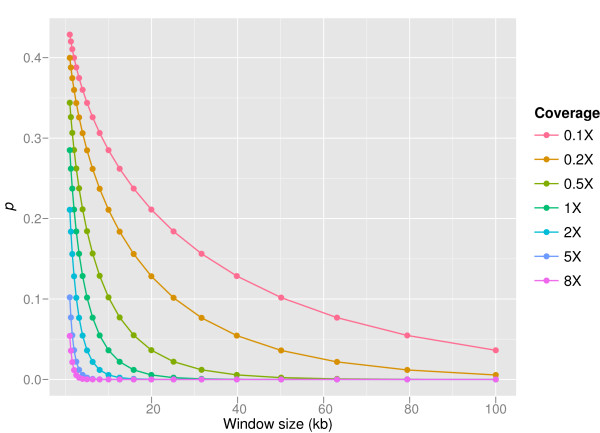
Dependencies of p in CNV-seq. The relation of p and sliding window size is shown on 0.1× to 8× sequence coverage for log2(r') = 0.6 and average read length 250 bases. The values are computed using equation (5). Increased window length results in decreased probability, p of observing ratio r' or higher by cheer chance. It is possible to compensate lack of coverage by increasing the window size, but this results in lowering the resolution.
Figure 3
Figure 3
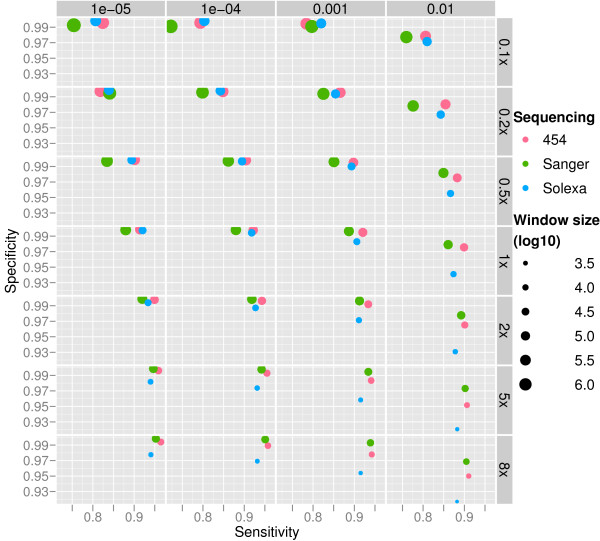
Performance of CNV-seq. The performance of CNV-seq on data simulating 454, Sanger and Solexa methods. Results are shown for 0.1×–8× coverages (right) and p-value range of 10-5-10-2 (top). Each dot represents an average of 100 simulations and the size of the dots represents the window (log10) size, i.e. resolution used. The window sizes are calculated using equation (5).
Figure 4
Figure 4
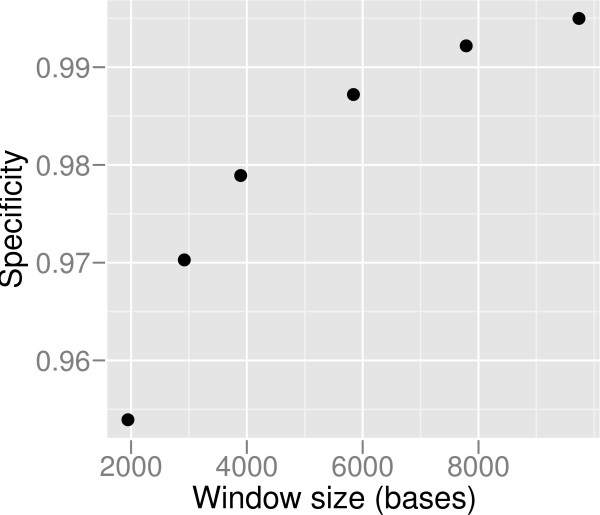
Specificity vs window size. In order to increase specificity, a larger than the theoretical minimum window size can be used by sacrificing resolution. The specificities using 1×, 1.5×, 2×, 3×, 4×, and 5× of the theoretical minimum window size are shown, for simulated Solexa sequencing data at 8× coverage.
Figure 5
Figure 5
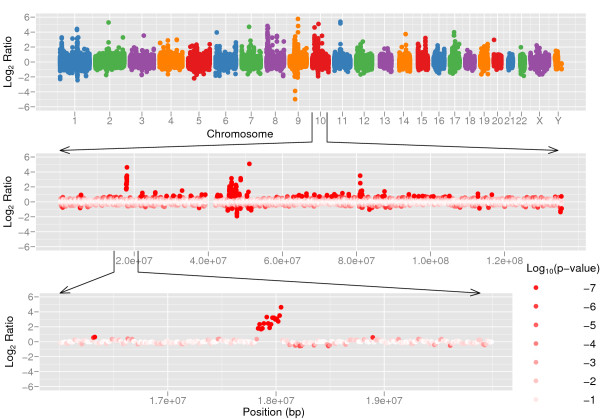
Copy number variation between two human individuals. Copy number variation detected by CNV-seq using shotgun sequence data from two individuals, Venter and Watson. The top panel shows a genome level log2 ratio plot. The middle panel shows the plot for chromosome 10. The bottom panel shows detailed view of a CNV region in chromosome 10. The red color gradient in the middle and bottom sections represents log10 p calculated on each of ratios.
Figure 6
Figure 6
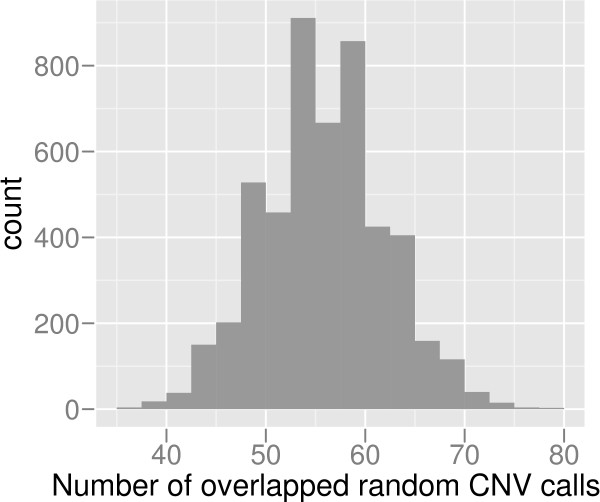
Permutation test of CNV calls. A permutation test was performed in order to test the significance of our CNV calls. The histogram shows the number of CNV calls overlapping with CNV in DGV. The X-axis shows the number of calls overlapping with DGV. The Y-axis shows the frequency of the overlapping number in 5,000 sets of permuted CNV calls.

References

    1. Sebat J, Lakshmi B, Troge J, Alexander J, Young J, Lundin P, Månér S, Massa H, Walker M, Chi M, Navin N, Lucito R, Healy J, Hicks J, Ye K, Reiner A, Gilliam TC, Trask B, Patterson N, Zetterberg A, Wigler M. Large-scale copy number polymorphism in the human genome. Science. 2004;305:525–528. doi: 10.1126/science.1098918. - DOI - PubMed
    1. Iafrate AJ, Feuk L, Rivera MN, Listewnik ML, Donahoe PK, Qi Y, Scherer SW, Lee C. Detection of large-scale variation in the human genome. Nat Genet. 2004;36:949–951. doi: 10.1038/ng1416. - DOI - PubMed
    1. Redon R, Ishikawa S, Fitch KR, Feuk L, Perry GH, Andrews TD, Fiegler H, Shapero MH, Carson AR, Chen W, Cho EK, Dallaire S, Freeman JL, González JR, Gratacòs M, Huang J, Kalaitzopoulos D, Komura D, MacDonald JR, Marshall CR, Mei R, Montgomery L, Nishimura K, Okamura K, Shen F, Somerville MJ, Tchinda J, Valsesia A, Woodwark C, Yang F, Zhang J, Zerjal T, Zhang J, Armengol L, Conrad DF, Estivill X, Tyler-Smith C, Carter NP, Aburatani H, Lee C, Jones KW, Scherer SW, Hurles ME. Global variation in copy number in the human genome. Nature. 2006;444:444–454. doi: 10.1038/nature05329. - DOI - PMC - PubMed
    1. Carter NP. Methods and strategies for analyzing copy number variation using DNA microarrays. Nat Genet. 2007;39:S16–S21. doi: 10.1038/ng2028. - DOI - PMC - PubMed
    1. Solinas-Toldo S, Lampel S, Stilgenbauer S, Nickolenko J, Benner A, Döhner H, Cremer T, Lichter P. Matrix-based comparative genomic hybridization: biochips to screen for genomic imbalances. Genes Chromosomes Cancer. 1997;20:399–407. doi: 10.1002/(SICI)1098-2264(199712)20:4<399::AID-GCC12>3.0.CO;2-I. - DOI - PubMed

Publication types

LinkOut - more resources