


Parafascicular thalamic nucleus activity in a rat model of Parkinson's disease
- PMID: 19268664
- PMCID: PMC2727617
- DOI: 10.1016/j.expneurol.2009.02.010
Parafascicular thalamic nucleus activity in a rat model of Parkinson's disease
Abstract
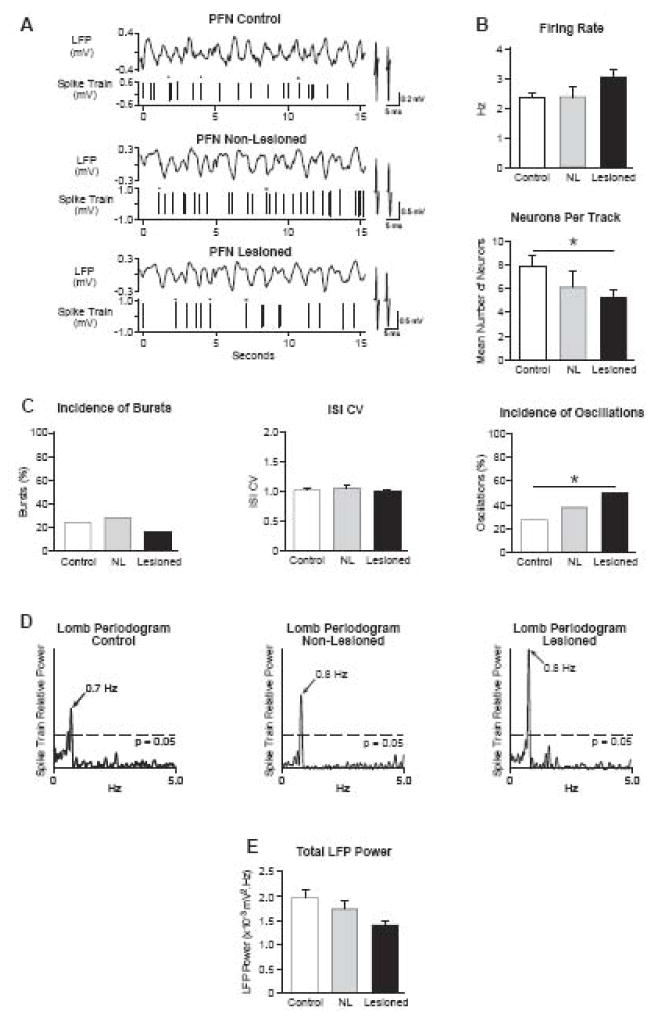
Parkinson's disease is associated with increased oscillatory firing patterns in basal ganglia output, which are thought to disrupt thalamocortical activity. However, it is unclear how specific thalamic nuclei are affected by these changes in basal ganglia activity. The thalamic parafascicular nucleus (PFN) receives input from basal ganglia output nuclei and directly projects to the subthalamic nucleus (STN), striatum and cortex; thus basal ganglia-mediated changes on PFN activity may further impact basal ganglia and cortical functions. To investigate the impact of increased oscillatory activity in basal ganglia output on PFN activity after dopamine cell lesion, PFN single-unit and local field potential activities were recorded in neurologically intact (control) rats and in both non-lesioned and dopamine lesioned hemispheres of unilateral 6-hydroxydopamine lesioned rats anesthetized with urethane. Firing rates were unchanged 1-2 weeks after lesion; however, significantly fewer spontaneously active PFN neurons were evident. Firing pattern assessments after lesion showed that a larger proportion of PFN spike trains had 0.3-2.5 Hz oscillatory activity and significantly fewer spike trains exhibited low threshold calcium spike (LTS) bursts. In paired recordings, more PFN-STN spike oscillations were significantly correlated, but as these oscillations were in-phase, results are inconsistent with feedforward control of PFN activity by inhibitory oscillatory basal ganglia output. Furthermore, the decreased incidence of LTS bursts is incompatible with inhibitory basal ganglia output inducing rebound bursting in PFN after dopamine lesion. Together, results show that robust oscillatory activity observed in basal ganglia output nuclei after dopamine cell lesion does not directly drive changes in PFN oscillatory activity.
Figures



Comment in
-
Facing the lack of anti-phase oscillation in the parafascicular nucleus after dopamine depletion.Exp Neurol. 2009 Sep;219(1):62-5. doi: 10.1016/j.expneurol.2009.05.031. Epub 2009 Jun 6. Exp Neurol. 2009. PMID: 19501087 Review.
References
-
- Albin RL, Young AB, Penney JB. The functional anatomy of basal ganglia disorders. Trends Neurosci. 1989;12:366–375. - PubMed
-
- Angaut P, Cicirata F, Serapide P. Topographic organization of the cerebellothalamic projections in the rat. An autoradiographic study. Neuroscience. 1985;15:389–401. - PubMed
-
- Aymerich MS, Barroso-Chinea P, Perez-Manso M, Munoz-Patino AM, Moreno-Igoa M, Gonzalez-Hernandez T, Lanciego JL. Consequences of unilateral nigrostriatal denervation on the thalamostriatal pathway in rats. Eur J Neurosci. 2006;23:2099–2108. - PubMed
-
- Batschelet E. Circular Statistics in Biology. New York: Academic Press; 1981.
Publication types
MeSH terms
Substances
Grants and funding
LinkOut - more resources
Full Text Sources
Medical
