


Adherence to biopsy guidelines for Barrett's esophagus surveillance in the community setting in the United States
- PMID: 19268726
- PMCID: PMC3139243
- DOI: 10.1016/j.cgh.2008.12.027
Adherence to biopsy guidelines for Barrett's esophagus surveillance in the community setting in the United States
Abstract
Background & aims: Current surveillance guidelines for Barrett's esophagus (BE) recommend extensive biopsies to minimize sampling error. Biopsy practice patterns for BE surveillance in the community have not been well-described. We used a national community-based pathology database to analyze adherence to guidelines and to determine whether adherence was associated with dysplasia detection.
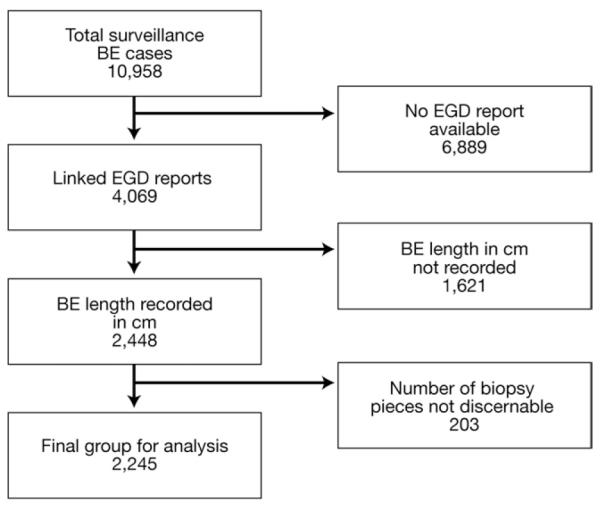
Methods: We identified 10,958 cases of established BE in the Caris Diagnostics pathology database from January 2002-April 2007. Demographic, pathologic, and endoscopic data were recorded. Dysplasia was categorized as low grade, high grade, or adenocarcinoma. Adherence was defined as > or =4 esophageal biopsies per 2 cm BE or a ratio > or =2.0. Generalized estimating equation multivariable analysis was performed to assess factors associated with adherence, adjusted for clustering by individual gastroenterologist.
Results: A total of 2245 BE surveillance cases were identified with linked endoscopy reports that recorded BE length and could be assessed for adherence. Adherence to guidelines was seen in 51.2% of cases. In multivariable analysis, longer segment BE was associated with significantly reduced adherence (3-5 cm, odds ratio [OR] 0.14, 95% confidence interval [CI] 0.10-0.19; 6-8 cm, OR 0.06, 95% CI 0.03-0.09; > or =9 cm, OR 0.03, 95% CI 0.01-0.07). Stratified by BE length, nonadherence was associated with significantly decreased dysplasia detection (summary OR 0.53, 95% CI 0.35-0.82).
Conclusions: Adherence to BE biopsy guidelines in the community is low, and nonadherence is associated with significantly decreased dysplasia detection. Future studies should identify factors underlying nonadherence as well as mechanisms to increase adherence to guidelines to improve early detection of dysplasia.
Figures


References
-
- Kubo A, Corley DA. Marked regional variation in adenocarcinomas of the esophagus and the gastric cardia in the United States. Cancer. 2002;95:2096–2102. - PubMed
-
- Pohl H, Welch HG. The role of overdiagnosis and reclassification in the marked increase of esophageal adenocarcinoma incidence. J Natl Cancer Inst. 2005;97:142–146. - PubMed
-
- Shaheen NJ. Advances in Barrett’s esophagus and esophageal adenocarcinoma. Gastroenterology. 2005;128:1554–1566. - PubMed
-
- Jemal A, Siegel R, Ward E, et al. Cancer statistics, 2007. CA Cancer J Clin. 2007;57:43–66. - PubMed
-
- Ries LAG, Melbert D, Krapcho M, et al. SEER Cancer Statistics Review, 1975-2005. Volume 2008. National Cancer Institute; Bethesda, MD: [Accessed: May 27, 2008]. 2008. Available at http://seer.cancer.gov/statfacts/html/esoph.html?statfacts_page=esoph.ht....
Publication types
MeSH terms
Grants and funding
LinkOut - more resources
Full Text Sources
Other Literature Sources
Medical
Miscellaneous
