Review
. 2009 Apr;30(4):174-81.
doi: 10.1016/j.tips.2009.01.002. Epub 2009 Mar 9.

The distinct roles of cyclooxygenase-1 and -2 in neuroinflammation: implications for translational research

Affiliations
Review

The distinct roles of cyclooxygenase-1 and -2 in neuroinflammation: implications for translational research

Sang-Ho Choi et al. Trends Pharmacol Sci. 2009 Apr.

Abstract

Cyclooxygenases (COX-1 and COX-2) are key enzymes in the conversion of arachidonic acid to prostaglandins and other lipid mediators. Because it can be induced by inflammatory stimuli, COX-2 has been classically considered as the most appropriate target for anti-inflammatory drugs. However, recent data indicate that COX-2 can mediate neuroprotection and that COX-1 is a major player in the neuroinflammatory process. We discuss the specific contributions of COX-1 and COX-2 in various neurodegenerative diseases and in models of neuroinflammation. We suggest that, owing to its predominant localization in microglia, COX-1 might be the major player in neuroinflammation, whereas COX-2, which is localized in neurons, might have a major role in models in which the neurons are directly challenged. Overall, the benefit of using COX-2 inhibitors should be carefully evaluated and COX-1 preferential inhibitors should be further investigated as a potential therapeutic approach in neurodegenerative diseases with an inflammatory component.


Figures
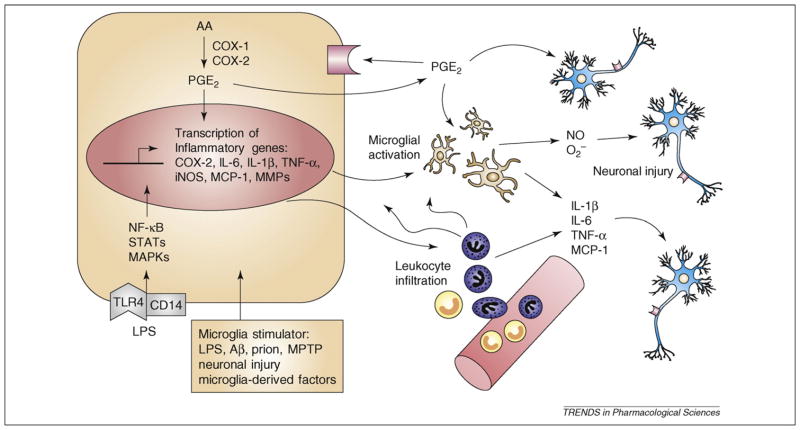
Figure 1
Figure 1
Microglia-initiated inflammatory cascade and neuronal injury. Various stimuli can target microglia, including LPS, Aβ and prion. In particular, the interaction of LPS with TLR4–CD14 can trigger intracellular signaling cascades (e.g. NF-κB, MAPKs and JAK–STAT), leading to microglial activation and transcriptional induction of downstream proinflammatory mediators, including iNOS, NADPH oxidase and COX-2, and the subsequent release of cytokines (e.g. IL-1β, IL-6 and TNF-α), chemokines (e.g. MCP-1), nitric oxide and PGs, which are associated with neuroinflammation. Because COX-1 is constitutively expressed in microglia, it functions as the primary source of PGs in the early phase of inflammation. LPS and other inflammatory stimuli also activate MMPs, which regulate BBB permeability and, consequently, cause infiltration of peripheral leukocytes into the brain. Recruitment of peripheral leukocyte exacerbates the inflammatory response and results in neuronal damage. Abbreviations: BBB, blood–brain barrier; COX, cyclooxygenase; IL-1β, interleukin-1β; iNOS, inducible nitric oxidase synthase; LPS, lipopolysaccharide; MCP-1, monocyte chemotactic protein 1; MMPs, matrix metalloproteinases; TLR4, toll-like receptor 4; TNF-α, tumor necrosis factor α.
Figure 2
Figure 2
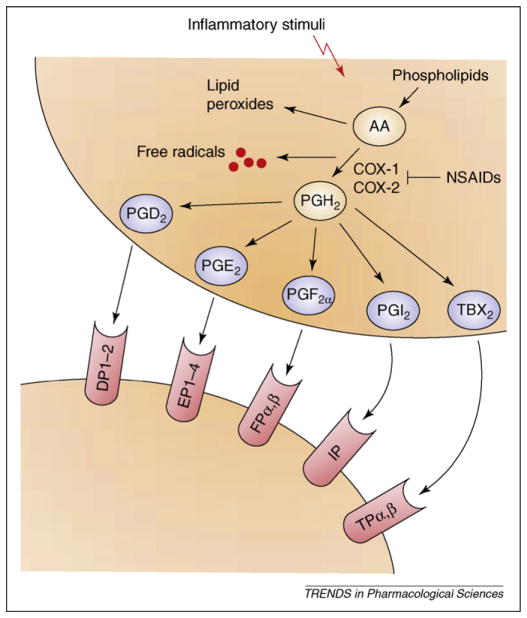
The COX metabolic pathway of arachidonic acid (AA). In resting cells, AA is stored in an esterified form within the cell membrane phospholipids. Upon stimulation by neurotransmitters, neuromodulators or inflammatory stimuli, AA is released in its unesterified form from phospholipids and metabolized by different enzymes. Both COX-1 and COX-2 catalyze the stepwise conversion of AA into two short-lived intermediates, PGG2 and PGH2. PGH2 is then metabolized to a variety of PGs and related compounds (collectively referred to as prostanoids; PGD2, PGE2, PGF, PGI2 and TXA2) by the activity of specific terminal enzymes. These PGs can modulate physiological and pathological cellular functions by interacting with specific presynaptic or postsynaptic PG receptors expressed in the brain (i.e. DP1–2. EP1–4, FPα,β and IP). NSAIDs, a widely used class of anti-inflammatory drugs including ibuprofen, indomethacin and naproxen, can inhibit both COX-1 and COX-2 activity and alleviate pain and inflammation. Abbreviations: AA, arachidonic acid; COX, cyclooxygenase; PGH2, prostaglandin H2; PGI2, prostacyclin; TXB2, thromboxane B2; NSAIDs, nonsteroidal anti-inflammatory drugs.
Figure 3
Figure 3
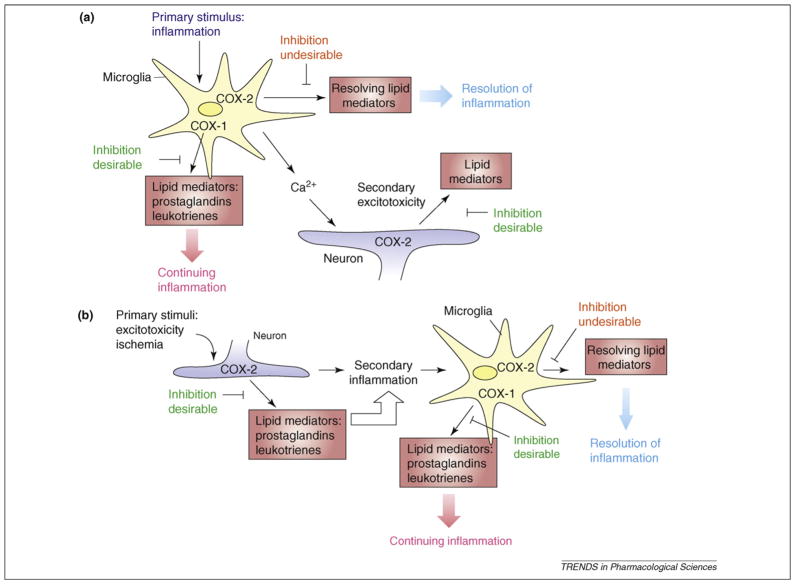
COX-mediated neurotoxicity or neuroprotection and downstream cellular events depend on whether the neuroinflammatory response is a primary (a) or a secondary response (b). COX-1 is predominantly localized in microglia and, thus, can immediately secrete PGs in response to inflammatory stimuli. Thus, COX-1 inhibition in primary neuroinflammation can attenuate the neuroinflammatory response. By contrast, COX-2, which is mainly localized in pyramidal neurons, contributes predominantly to increased PG synthesis in response to insults that directly challenge neurons, such as in ischemic and excitotoxic conditions. Under these circumstances, COX-2 inhibition can be beneficial in the early phase, whereas in the secondary neuroinflammatory response COX-1 inhibition might also be beneficial.

References

    1. Skaper SD. The brain as a target for inflammatory processes and neuroprotective strategies. Ann N Y Acad Sci. 2007;1122:23–34. - PubMed
    1. Heneka MT, O’Banion MK. Inflammatory processes in Alzheimer’s disease. J Neuroimmunol. 2007;184:69–91. - PubMed
    1. Hanisch UK, Kettenmann H. Microglia: active sensor and versatile effector cells in the normal and pathologic brain. Nat Neurosci. 2007;10:1387–1394. - PubMed
    1. Gao HM, Hong JS. Why neurodegenerative diseases are progressive: uncontrolled inflammation drives disease progression. Trends Immunol. 2008;29:357–365. - PMC - PubMed
    1. Block ML, et al. Microglia-mediated neurotoxicity: uncovering the molecular mechanisms. Nat Rev Neurosci. 2007;8:57–69. - PubMed

MeSH terms