


Tyrosine phosphorylation: thirty years and counting
- PMID: 19269802
- PMCID: PMC2670436
- DOI: 10.1016/j.ceb.2009.01.028
Tyrosine phosphorylation: thirty years and counting
Abstract
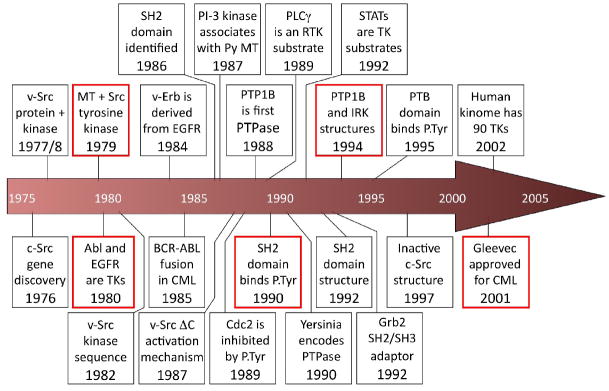
In the 30 years since its discovery, tyrosine phosphorylation has emerged as a fundamentally important mechanism of signal transduction and regulation in all eukaryotic cells, governing many processes, including cell proliferation, cell cycle progression, metabolic homeostasis, transcriptional activation, neural transmission, differentiation and development, and aging. Perturbations in tyrosine phosphorylation underlie many human diseases, and in particular cancer, and this has prompted the development of inhibitors of tyrosine kinases implicated in disease, a number of which have been approved for clinical use. The following is a brief personal reflection on some of the salient findings over the past 30 years that led to the development of tyrosine kinase inhibitors for disease therapy.
Figures
References
-
- Eckhart W, Hutchinson MA, Hunter T. An activity phosphorylating tyrosine in polyoma T antigen immunoprecipitates. Cell. 1979;18:925–933. - PubMed
-
- Hunter T, Eckhart W. The discovery of tyrosine phosphorylation: it’s all in the buffer! Cell. 2004;116:S35–39. - PubMed
-
- Pawson T. Specificity in signal transduction: from phosphotyrosine-SH2 domain interactions to complex cellular systems. Cell. 2004;116:191–203. - PubMed
-
-
Manning G, Whyte DB, Martinez R, Hunter T, Sudarsanam S. The protein kinase complement of the human genome. Science. 2002;298:1912–1934.. This paper describes the first complete catalogue of human protein kinases, and defines the set of 90 tyrosine kinases encoded by the human genome.
-
Publication types
MeSH terms
Substances
Grants and funding
LinkOut - more resources
Full Text Sources
Other Literature Sources
Miscellaneous
