


Detection of adenoviruses and rotaviruses in drinking water sources used in rural areas of Benin, West Africa
- PMID: 19270143
- PMCID: PMC2681688
- DOI: 10.1128/AEM.01807-08
Detection of adenoviruses and rotaviruses in drinking water sources used in rural areas of Benin, West Africa
Abstract
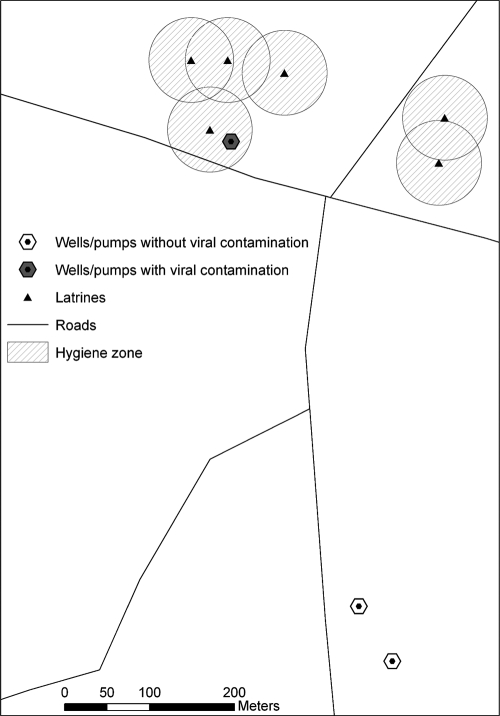
Diseases associated with viruses also found in environmental samples cause major health problems in developing countries. Little is known about the frequency and pattern of viral contamination of drinking water sources in these resource-poor settings. We established a method to analyze 10 liters of water from drinking water sources in a rural area of Benin for the presence of adenoviruses and rotaviruses. Overall, 541 samples from 287 drinking water sources were tested. A total of 12.9% of the sources were positive for adenoviruses and 2.1% of the sources were positive for rotaviruses at least once. Due to the temporary nature of viral contamination in drinking water sources, the probability of virus detection increased with the number of samples taken at one test site over time. No seasonal pattern for viral contaminations was found after samples obtained during the dry and wet seasons were compared. Overall, 3 of 15 surface water samples (20%) and 35 of 247 wells (14.2%) but also 2 of 25 pumps (8%) tested positive for adenoviruses or rotaviruses. The presence of latrines within a radius of 50 m in the vicinity of pumps or wells was identified as being a risk factor for virus detection. In summary, viral contamination was correlated with the presence of latrines in the vicinity of drinking water sources, indicating the importance of appropriate decision support systems in these socioeconomic prospering regions.
Figures
References
-
- Baggi, F., A. Demarta, and R. Peduzzi. 2001. Persistence of viral pathogens and bacteriophages during sewage treatment: lack of correlation with indicator bacteria. Res. Microbiol. 152:743-751. - PubMed
-
- Balk, D., T. Pullum, A. Storeygard, F. Greenwell, and M. Neuman. 2003. Spatial analysis of childhood mortality in West Africa. Popul. Space Place 10(33):175-216.
-
- Beller, M., A. Ellis, S. H. Lee, M. A. Drebot, S. A. Jenkerson, E. Funk, M. D. Sobsey, O. D. Simmons III, S. S. Monroe, T. Ando, J. Noel, M. Petric, J. P. Middaugh, and J. S. Spika. 1997. Outbreak of viral gastroenteritis due to a contaminated well. International consequences. JAMA 278:563-568. - PubMed
Publication types
MeSH terms
Substances
LinkOut - more resources
Full Text Sources
Other Literature Sources
