


Contrasting effects of heat treatment and incubation temperature on germination and outgrowth of individual spores of nonproteolytic Clostridium botulinum bacteria
- PMID: 19270146
- PMCID: PMC2681722
- DOI: 10.1128/AEM.02572-08
Contrasting effects of heat treatment and incubation temperature on germination and outgrowth of individual spores of nonproteolytic Clostridium botulinum bacteria
Abstract
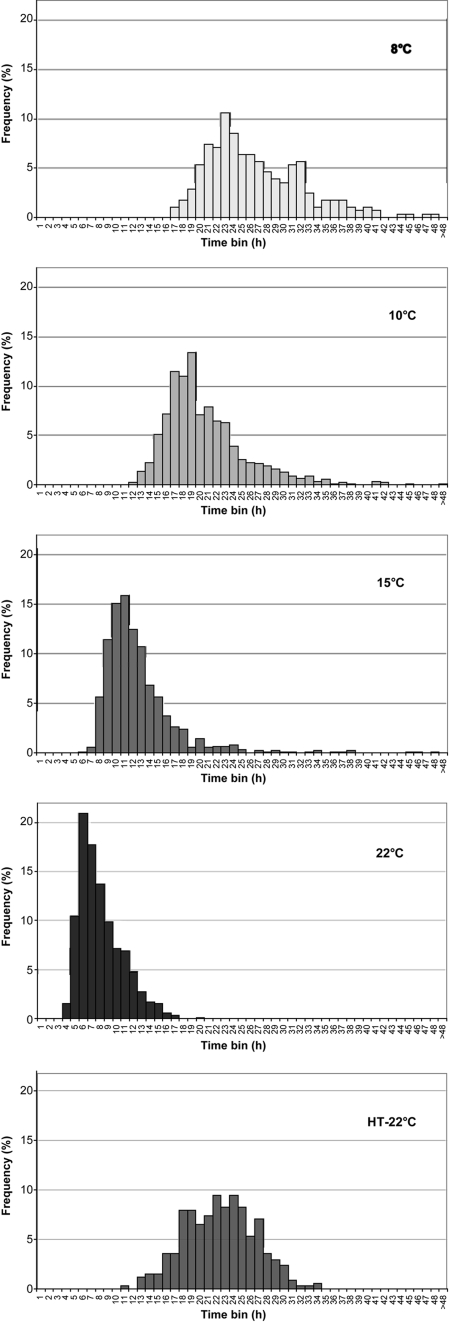
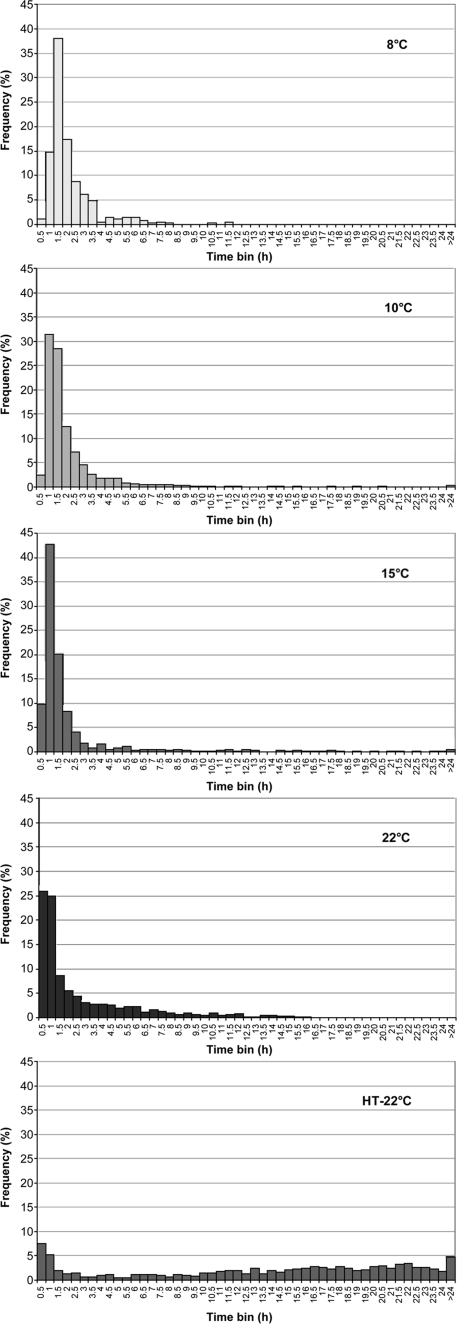
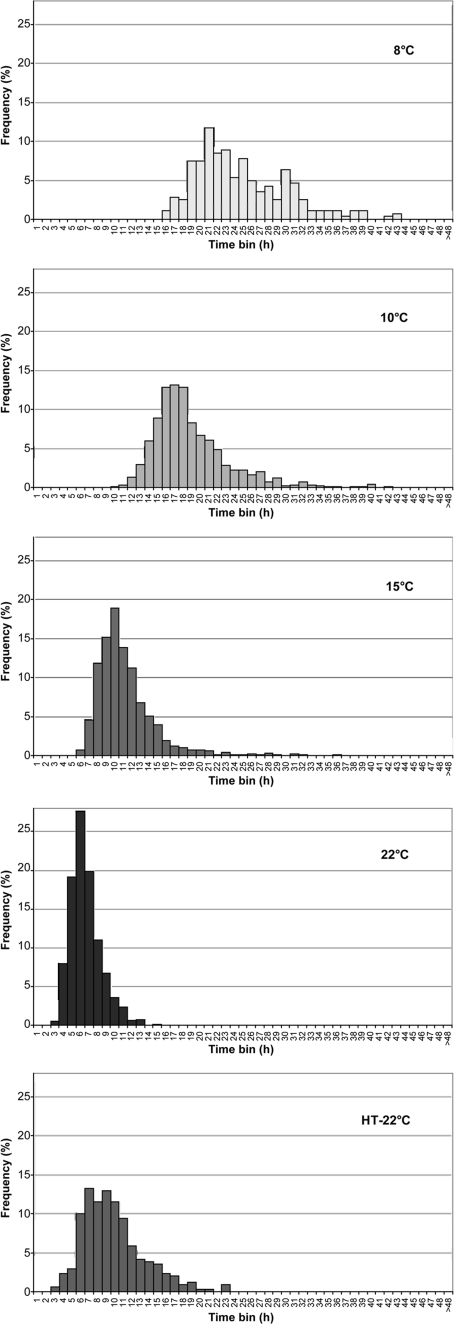
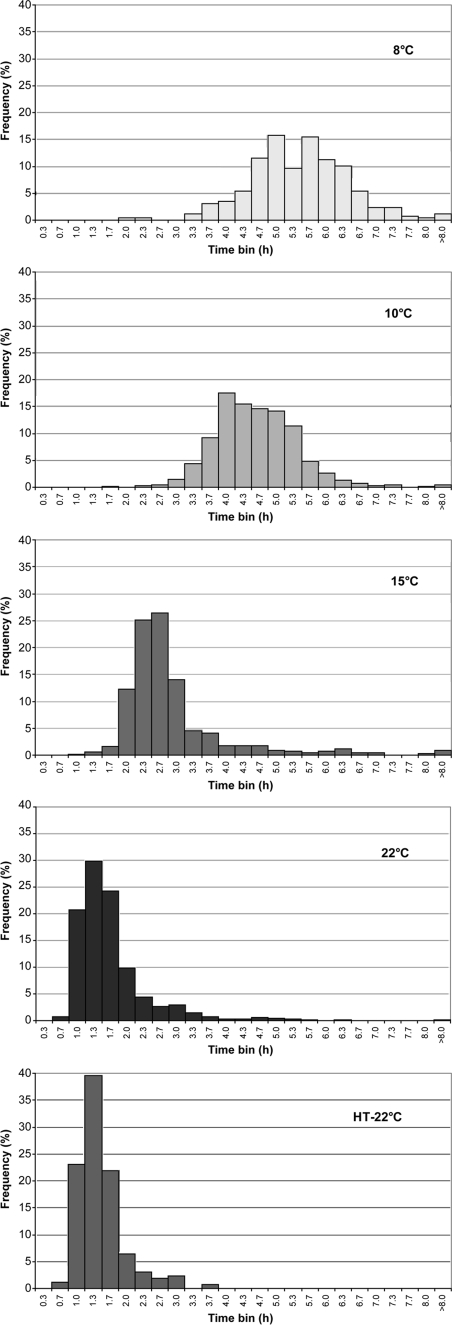
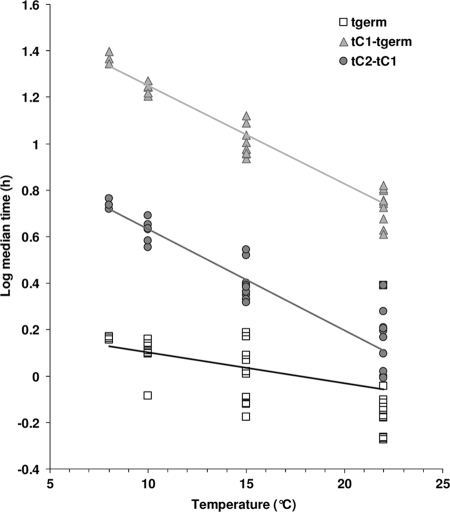
In this study, we determined the effects of incubation temperature and prior heat treatment on the lag-phase kinetics of individual spores of nonproteolytic Clostridium botulinum Eklund 17B. The times to germination (t(germ)), one mature cell (t(C1)), and two mature cells (t(C2)) were measured for individual unheated spores incubated at 8, 10, 15, or 22 degrees C and used to calculate the t(germ), the outgrowth time (t(C1) - t(germ)), and the first doubling time (t(C2) - t(C1)). Measurements were also made at 22 degrees C of spores that had previously been heated at 80 degrees C for 20 s. For unheated spores, outgrowth made a greater contribution to the duration and variability of the lag phase than germination. Decreasing incubation temperature affected germination less than outgrowth; thus, the proportion of lag associated with germination was less at lower incubation temperatures. Heat treatment at 80 degrees C for 20 s increased the median germination time of surviving spores 16-fold and greatly increased the variability of spore germination times. The shape of the lag-time (t(C1)) and outgrowth (t(C1) - t(germ)) distributions were the same for unheated spores, but heat treatment altered the shape of the lag-time distribution, so it was no longer homogeneous with the outgrowth distribution. Although heat treatment mainly extended germination, there is also evidence of damage to systems required for outgrowth. However, this damage was quickly repaired and was not evident by the time the cells started to double. The results presented here combined with previous findings show that the stage of lag most affected, and the extent of any effect in terms of duration or variability, differs with both historical treatment and the growth conditions.
Figures
References
-
- Alberto, F., V. Broussolle, D. R. Mason, F. Carlin, and M. W. Peck. 2003. Variability in spore germination response by strains of proteolytic Clostridium botulinum types A, B, and F. Lett. Appl. Microbiol. 36:41-45. - PubMed
-
- Ando, Y., and H. Iida. 1970. Factors affecting the germination of spores of Clostridium botulinum type E. Jpn. J. Microbiol. 14:361-370. - PubMed
-
- Baranyi, J. 1998. Comparison of stochastic and deterministic concepts of bacterial lag. J. Theor. Biol. 192:403-408. - PubMed
-
- Billon, C. M. P., C. J. McKirgan, P. J. McClure, and C. Adair. 1997. The effect of temperature on the germination of single spores of Clostridium botulinum 62A. J. Appl. Microbiol. 82:48-56. - PubMed
-
- Chea, F. P., Y. H. Chen, T. J. Montville, and D. W. Schaffner. 2000. Modeling the germination kinetics of Clostridium botulinum 56A spores as affected by temperature, pH, and sodium chloride. J. Food Prot. 63:1071-1079. - PubMed
Publication types
MeSH terms
Grants and funding
LinkOut - more resources
Full Text Sources
Miscellaneous
