


Targeting mTOR with rapamycin: one dose does not fit all
- PMID: 19270529
- PMCID: PMC2778016
- DOI: 10.4161/cc.8.7.8044
Targeting mTOR with rapamycin: one dose does not fit all
Abstract
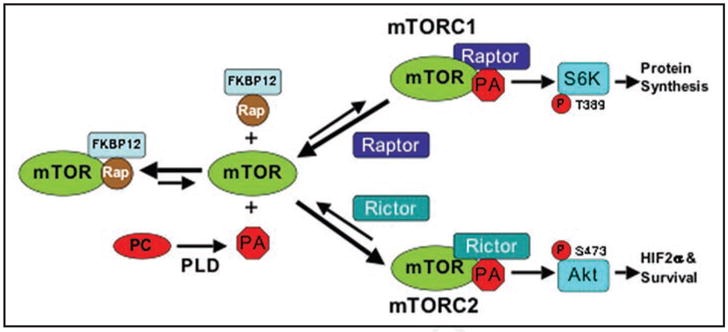
A puzzling aspect of rapamycin-based therapeutic strategies is the wide disparity in the doses needed to suppress mTOR under different circumstances. A recent study revealing mechanistically how rapamycin suppresses mTOR provides two explanations for the differential sensitivities to rapamycin. First, mTOR exists as two functionally distinct complexes (mTORC1 and mTORC2), and while rapamycin suppresses both, it does so at very different concentrations. Whereas mTORC1 is suppressed by concentrations of rapamycin in the low nM range, mTORC2 generally requires low muM concentrations. Second, the efficacy of rapamycin is dependent on the level of phosphatidic acid (PA), which is required for the assembly of both mTORC1 and mTORC2 complexes. Rapamycin interacts with mTOR in a manner that is competitive with PA. Therefore, elevated levels of PA, which is common in cancer cells, increases the level of rapamycin needed to suppress both mTORC1 and mTORC2. A practical outcome of the recent study is that if PA levels are suppressed, mTORC2 becomes sensitive to concentrations of rapamycin that can be achieved clinically. Since mTORC2 is likely more critical for survival signals in cancer cells, the recent findings suggest new strategies for enhancing the efficacy of rapamycin-based therapeutic approaches in cancer cells.
Figures
References
-
- Chen Y, Zheng Y, Foster DA. Phospholipase D confers rapamycin resistance in human breast cancer cells. Oncogene. 2003;22:3937–42. - PubMed
-
- Yu K, Toral-Barza L, Discafani C, Zhang WG, Skotnicki J, Frost P, et al. mTOR, a novel target in breast cancer: the effect of CCI-779, an mTOR inhibitor, in preclinical models of breast cancer. Endocr Relat Cancer. 2001;8:249–58. - PubMed
-
- Chen Y, Rodrik V, Foster DA. Alternative phospholipase D/mTOR survival signal in human breast cancer cells. Oncogene. 2005;24:672–9. - PubMed
-
- Fang Y, Vilella-Bach M, Bachmann R, Flanigan A, Chen J. Phosphatidic acid-mediated mitogenic activation of mTOR signaling. Science. 2001;294:1942–5. - PubMed
Publication types
MeSH terms
Substances
Grants and funding
LinkOut - more resources
Full Text Sources
Miscellaneous
