. 2009 Apr;15(4):447-54.
doi: 10.1038/nm.1933. Epub 2009 Mar 8.

Molecular therapy of obesity and diabetes by a physiological autoregulatory approach

Affiliations

Molecular therapy of obesity and diabetes by a physiological autoregulatory approach

Lei Cao et al. Nat Med. 2009 Apr.

Abstract

Hypothalamic brain-derived neurotrophic factor (BDNF) is a key element in the regulation of energy balance. Here we investigated the therapeutic efficacy of BDNF by gene transfer in mouse models of obesity and diabetes. Gene transfer of BDNF led to marked weight loss and alleviation of obesity-associated insulin resistance. To facilitate clinical translation and ensure that BDNF protein expression was appropriately decreased as weight loss progressed, thus preventing cachexia, we developed a molecular autoregulatory system involving a single recombinant adeno-associated virus vector harboring two expression cassettes, one constitutively driving BDNF and the other driving a specific microRNA targeting BDNF. The microRNA element was controlled by a promoter (that controlling the Agrp gene encoding agouti-related peptide) responsive to BDNF-induced physiological changes. Hence, as body weight decreased and agouti-related protein is induced, microRNA expression was activated, inhibiting transgene expression. In contrast to the progressive weight loss associated with a nonregulated approach, this microRNA-approach led to a sustainable plateau of body weight after notable weight loss was achieved. This strategy mimics the body's endogenous physiological feedback mechanisms, thereby resetting the hypothalamic set point to reverse obesity and metabolic syndrome.


Figures
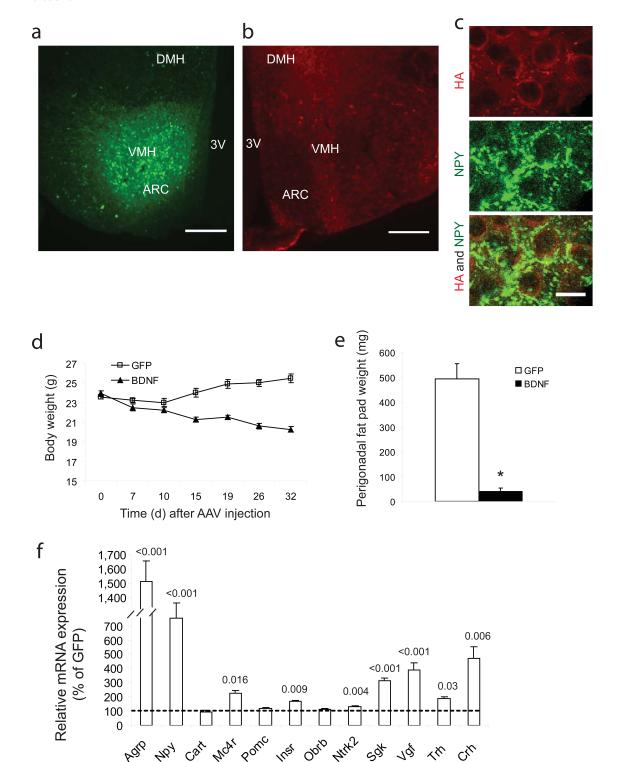
Figure 1
Figure 1
Hypothalamic gene delivery of BDNF leads to weight loss, changes in serum biomarkers and hypothalamic gene expression in mice fed with standard diet. (a) EGFP fluorescence. Scale bar, 200 μm. (b) Immunoreactivity to HA tag. Scale bar, 200 μm. (c) Colocalization of HA (red) with NPY (green) in Arc. Scale bar, 10 μm. (d) Body weight (n = 10 GFP, n = 14 BDNF, P < 0.0001). (e) Perigonadal white adipose tissue weight (n = 8 GFP, n = 10 BDNF, * P < 0.001). (f) Gene expression in hypothalamus (n = 4 per group, P values are shown on the bars).
Figure 2
Figure 2
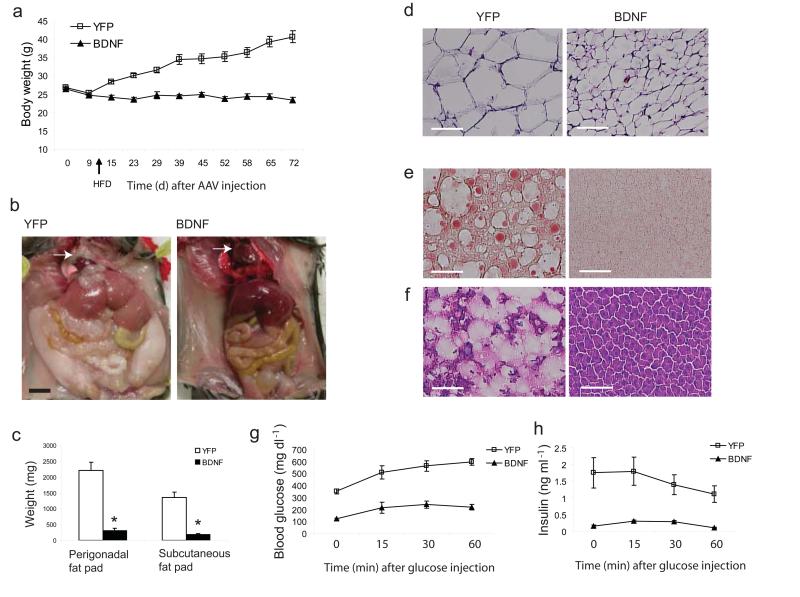
Hypothalamic gene delivery of BDNF prevents diet-induced obesity. (a) Body weight (n = 9 GFP, n = 10 BDNF, P < 0.0001). Diet was switched from standard chow diet to high fat diet on d 10 after AAV injection. (b) 2 months HFD feeding led to abdominal obesity in YFP mice but not in BDNF mice. Arrow shows pericardial fat absent in BDNF mouse. Scale bar: 1 cm. (c) Fat pad weight 72 d after AAV injection and fed on HFD for 2 months (n = 8 per group, * P < 0.0001). (d) H&E stained WAT section showed the shrink of adipose cell in BDNF mice compared to YFP mice. Scale bar: 300 μm. (e–f) Hepatic steatosis was prevented by BDNF treatment shown by Oil Red-O and H&E staining. Scale bar: 300 μm. (g–h) Glucose tolerance test after overnight fast (n = 4 per group, P < 0.0001 for both glucose and insulin concentration).
Figure 3
Figure 3
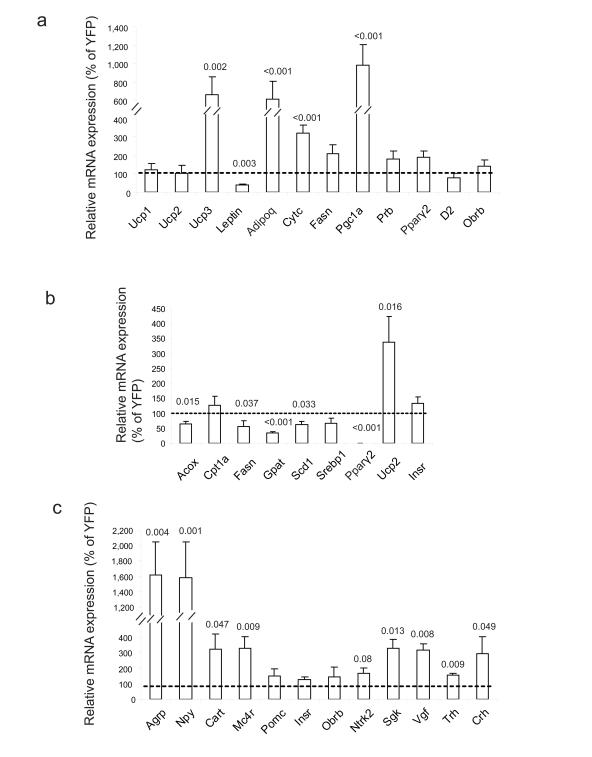
Gene expression profiles of HFD-fed mice. Relative mRNA expression levels of the indicated genes in (a) WAT (b) liver and (c) hypothalamus (n = 6 per group). Bars show the relative expression levels of BDNF mice as the percentage of YFP mice. P values are shown on the bars.
Figure 4
Figure 4
Autoregulatory BDNF vector to treat db/db mice. (a) rAAV vectors. The autoregulatory vector contains two expression cassettes, one to express BDNF under a constitutive promoter, the other to express a microRNA targeting the same transgene driven by a promoter responsive to BDNF-induced physiological changes. (b) Body weight of db/db mice (n = 8 YFP, n = 7 BDNF-miR-scr, n = 9 BDNF-miR-Bdnf, P < 0.0001 comparisons between each pair of groups). (c) Mice receiving BDNF-miR-Bdnf remained lean 3 months after AAV injection. Scale bar: 1 cm. (d) Food intake was reduced in BDNF treated mice compared to YFP mice. P values are shown on the bars. (e) Liver weight and fat pad weight were reduced in BDNF-miR-Bdnf mice (n = 8 each group, P < 0.001). (f–g) Glucose tolerance test on mice after overnight fast (n = 6 YFP, n = 5 BDNF-miR-Bdnf, P < 0.05 for glucose concentration, P < 0.0001 for insulin concentration). (h) Biomarkers in serum 1 month after AAV injection (n = 8 YFP, n = 4 BDNF-miR-scr, n = 9 BDNF-miR-Bdnf, * P < 0.001, + P < 0.05, # P = 0.06).
Figure 5
Figure 5
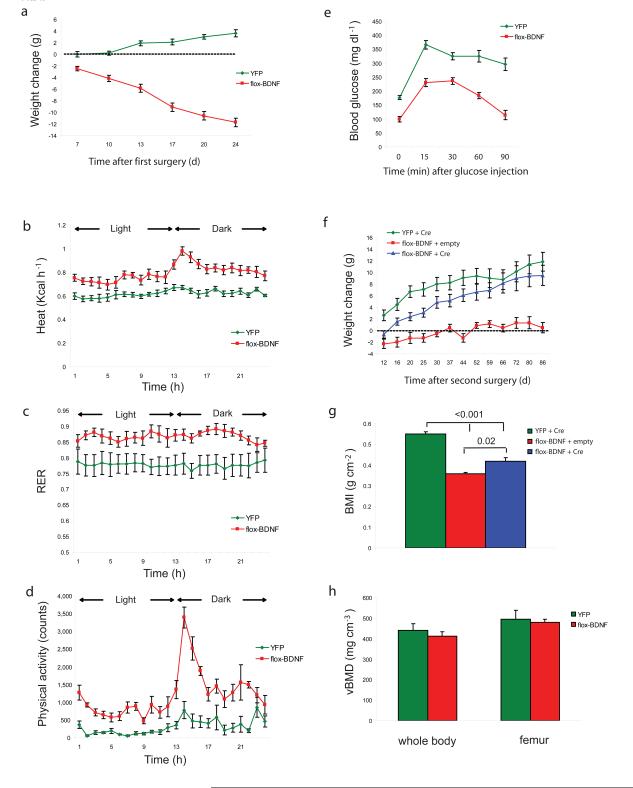
BDNF induced weight loss is reversible by Cre-loxP knockout of transgene. (a) Body weight of mice after first AAV injection (n = 10 YFP, n = 24 flox-BDNF, P < 0.01). (b–d) Effect of BDNF treatment on energy expenditure. Energy expenditure (Heat), respiratory exchange ratio (RER) and physical activity were significantly increased in BDNF mice (n = 5 YFP, n = 6 flox-BDNF, P < 0.05) during both light and dark cycles. (e) Glucose tolerance test on mice after overnight fast (n = 7 YFP, n = 9 flox-BDNF, 3 weeks after first AAV injection P < 0.05). (f) Weight change of mice since second AAV injection (n = 10 YFP + Cre, n = 7 flox-BDNF + empty vector, n = 14 flox-BDNF + Cre, P < 0.05 flox-BDNF + Cre vs flox-BDNF + empty). (g) Body mass index of mice 4 months after the first surgery (n = 5 YFP + Cre, n = 4 flox-BDNF + empty vector, n = 6 flox-BDNF + Cre, P values are shown on the bars). (h) Bone mineral density of whole body (excluding skull) and right femur were measured by microCT scan (n = 3 YFP, n = 4 flox-BDNF).

References

    1. McMillan DC, Sattar N, McArdle CS. ABC of obesity. Obesity and cancer. BMJ. 2006;333:1109–1111. - PMC - PubMed
    1. Batsis JA, Nieto-Martinez RE, Lopez-Jimenez F. Metabolic syndrome: from global epidemiology to individualized medicine. Clin. Pharmacol. Ther. 2007;82:509–524. - PubMed
    1. Anghel SI, Wahli W. Fat poetry: a kingdom for PPARgamma. Cell Res. 2007;17:486–511. - PubMed
    1. During MJ, Cao L. VEGF, a mediator of the effect of experience on hippocampal neurogenesis. Curr. Alzheimer Res. 2006;3:29–33. - PubMed
    1. Young D, Lawlor PA, Leone P, Dragunow M, During MJ. Environmental enrichment inhibits spontaneous apoptosis, prevents seizures and is neuroprotective. Nat. Med. 1999;5:448–453. - PubMed

Publication types

Substances