. 2009;4(3):e4740.
doi: 10.1371/journal.pone.0004740. Epub 2009 Mar 9.

Morphological diversity and the roles of contingency, chance and determinism in african cichlid radiations

Affiliations

Morphological diversity and the roles of contingency, chance and determinism in african cichlid radiations

Kyle A Young et al. PLoS One. 2009.

Abstract

Background: Deterministic evolution, phylogenetic contingency and evolutionary chance each can influence patterns of morphological diversification during adaptive radiation. In comparative studies of replicate radiations, convergence in a common morphospace implicates determinism, whereas non-convergence suggests the importance of contingency or chance.

Methodology/principal findings: The endemic cichlid fish assemblages of the three African great lakes have evolved similar sets of ecomorphs but show evidence of non-convergence when compared in a common morphospace, suggesting the importance of contingency and/or chance. We then analyzed the morphological diversity of each assemblage independently and compared their axes of diversification in the unconstrained global morphospace. We find that despite differences in phylogenetic composition, invasion history, and ecological setting, the three assemblages are diversifying along parallel axes through morphospace and have nearly identical variance-covariance structures among morphological elements.

Conclusions/significance: By demonstrating that replicate adaptive radiations are diverging along parallel axes, we have shown that non-convergence in the common morphospace is associated with convergence in the global morphospace. Applying these complimentary analyses to future comparative studies will improve our understanding of the relationship between morphological convergence and non-convergence, and the roles of contingency, chance and determinism in driving morphological diversification.


Conflict of interest statement

Competing Interests: The authors have declared that no competing interests exist.

Figures

Figure 1
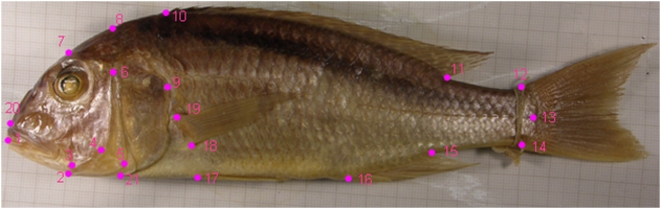
Figure 1. Locations of landmarks used in morphometric analyses.
(1) anterior tip of lower jaw, (2) posterior tip of lower jaw , (3) posterior hinge of lower jaw, (4) ventral-posterior extreme of mandible plate, (5) ventral-posterior extreme of preopercle, (6) dorsal end of preopercle just below the pterotics, (7) dorsal margin of the head directly above the centre of the eye, (8) dorsal margin of the head directly above (6), (9) posterior extreme of gill-cover at opercular blotch, (10) anterior insertion of dorsal fin, (11) posterior insertion of dorsal fin, (12) dorsal insertion of caudal fin, (13) caudal border of hypural plate at the lateral line, (14) ventral insertion of caudal fin, (15) posterior insertion of anal fin, (16) anterior insertion of anal fin, (17) anterior/dorsal insertion of pelvic fin, (18) ventral insertion of pectoral fin, (19) dorsal insertion of pectoral fine, (20) anterior extreme of snout bone, (21) end of opercular membrane ventrally.
Figure 2
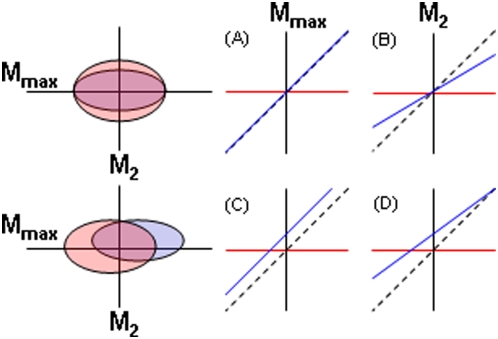
Figure 2. Comparing morphological diversity using ordered-axis plots.
Ordered-axis plots discriminate between different patterns of morphological diversity along axes of a multidimensional morphospace. In this example species of two adaptive radiations with the same number of observations are represented by clouds of red (older, more diverse) and blue (younger, less diverse) points in two dimensional morphospaces defined by Mmax and M2. When their values along an axis are independently ordered from smallest to largest then combined to form a set of x-y points, the slope and intercept (int.) of the linear regression of y (blue) on x (red) discriminate between four possible arrangements along that axis. The dotted line is slope = 1. Top: (A) along Mmax the radiations are centered at the same point (i.e. convergent) so the int. = 0, and equally diverse, so the slope = 1; (B) along M2 the radiations are again centered at the same point (convergent, int. = 0) but the older radiation is more diverse so the slope of the regression of y on x is <1. Bottom: (C) along Mmax the radiations are centered at different points along the axis (non-convergent, int.≠0) but have equal levels of diversity (slope = 1); (D) along M2 the radiations are non-convergent (int.≠0) and the older radiation is more diverse (slope<1).
Figure 3
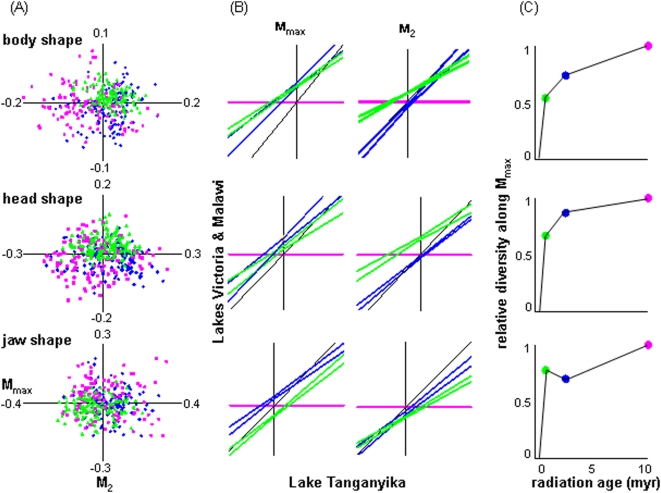
Figure 3. Morphological diversity in the common morphospace.
Variation in body, head and jaw shape diversity in common morphospaces among the cichlid assemblages from Lakes Victoria (LV-green), Malawi (LM-blue) and Tanganyika (LT-pink). (A) Locations of species of the three assemblages in the three morphospaces. (B) Ordered-axis plots along Mmax and M2 (with LT along the x-axis) showing the 99.99% confidence intervals of linear regressions of LV and LM on LT. Non-equal intercepts show assemblages are centered at different locations along the axis. Non-equal slopes indicate the assemblages have different levels of diversity along the axis. See Table 1 for tests of equality for the intercepts and slopes. (C) The relationship between assemblage age and relative morphological diversity (slopes of the regression of LV and LM on LT from the ordered-axis plots, with LT = 1 ) along the three Mmax axes. For these plots the approximate ages of the assemblages are: LV-0.1 myr., LM-2 myr., LT-10 myr. Note that the lines connecting the points are included for comparison, not to imply temporal trends in diversity of a single radiation.
Figure 4
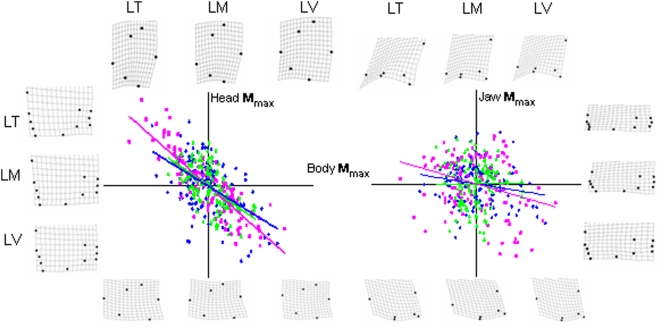
Figure 4. Morphological diversity in the global morphospace.
Each element of shape (body, head, jaw) was analyzed separately for each assemblage (colors as in Figure 2); the three assemblages are plotted along common axes for comparison. The images show for each assemblage the shape corresponding to the most extreme positive and negative value along each Mmax axis. See Table 2 for statistical tests of parallel divergence. Linear regression lines highlight the similar patterns of covariation between body, head and jaw shape among the assemblages.
Figure 5
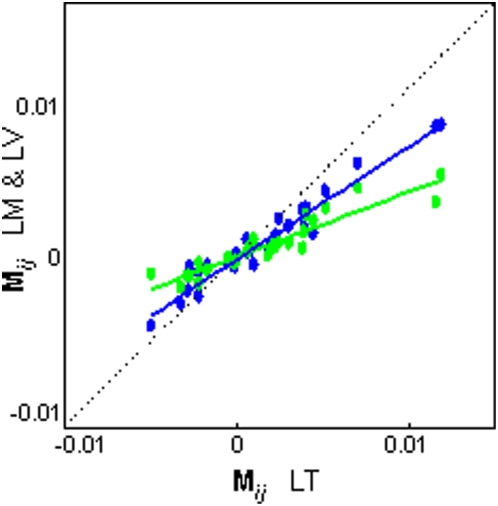
Figure 5. Morphological variance-covariance structures.
Matrix correlation plot of the elements (Mij) from the morphological variance-covariance matrices of the three assemblages (colors as in Fig. 2). The near perfect linear relationships show the assemblages have similar variance-covariance structures across shape elements (LT-v-LM, r = 0.97, P<0.0001; LT-v-LV, r = 0.93, P<0.0001; LM-v-LV, r = 0.91, P<0.0001). The magnitudes of the matrix elements are age-ordered (linear regression slopes of LM Mij and LV Mij on LT Mij: LM = 0.67 (SE = 0.03), LV = 0.38 (SE = 0.03).

References

    1. Schluter D. The ecology of adaptive radiation. Oxford: Oxford University Press.; 2000. p. 288.
    1. Schluter D. Ecological speciation in postglacial fishes. Phil Trans R Soc Ldn B. 1996;351:807–814.
    1. Losos JB, Jackman TR, Larson A, De Queiroz K, Rodriguez-Schettino L. Contingency and determinism in replicated adaptive radiation of island lizards. Science. 1998;279:2115–2118. - PubMed
    1. Rainey PB, Travisano M. Adaptive radiation in a heterogeneous environment. Nature. 1998;394:69–72. - PubMed
    1. Lenski RE, Travisano M. Dynamics of adaptation and diversification: a 10,000-generation experiment with bacterial populations. Proc Natl Acad Sci USA. 1994;91:6808–6814. - PMC - PubMed

Publication types