. 2009 Feb;117(2):190-6.
doi: 10.1289/ehp.11236. Epub 2008 Sep 3.

Cadmium levels in urine and mortality among U.S. adults

Affiliations

Cadmium levels in urine and mortality among U.S. adults

Andy Menke et al. Environ Health Perspect. 2009 Feb.

Abstract

Background: Cadmium exposure has been associated with increased all-cause, cancer, and cardiovascular disease mortality. However, studies investigating this association have included participants with considerably higher levels of cadmium than those found in the general population.

Objective: We aimed to evaluate the association of creatinine-corrected urinary cadmium levels with all-cause and cause-specific mortality in the U.S. general population.

Methods: We analyzed the relationship between cadmium measured in 13,958 adults who participated in the Third National Health and Nutrition Examination Survey in 1988-1994 and were followed through 31 December 2000, and all-cause, cancer, cardiovascular disease, and coronary heart disease mortality.

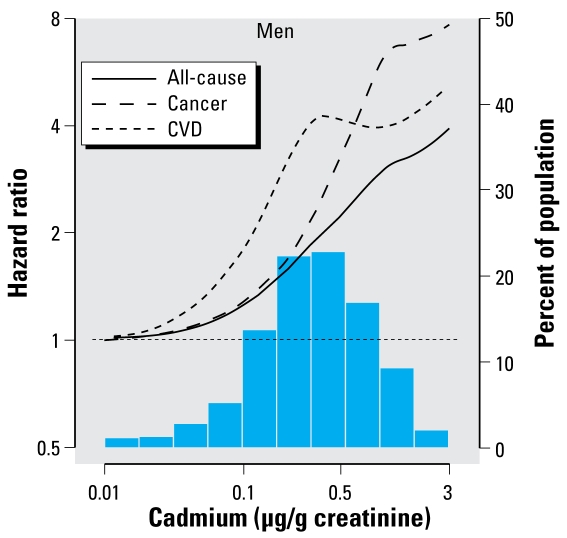
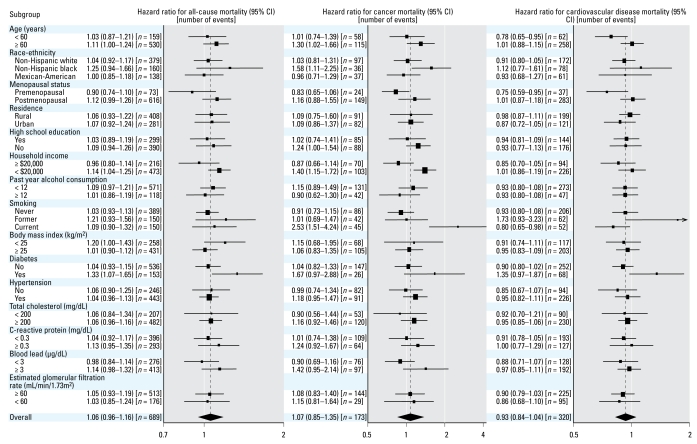
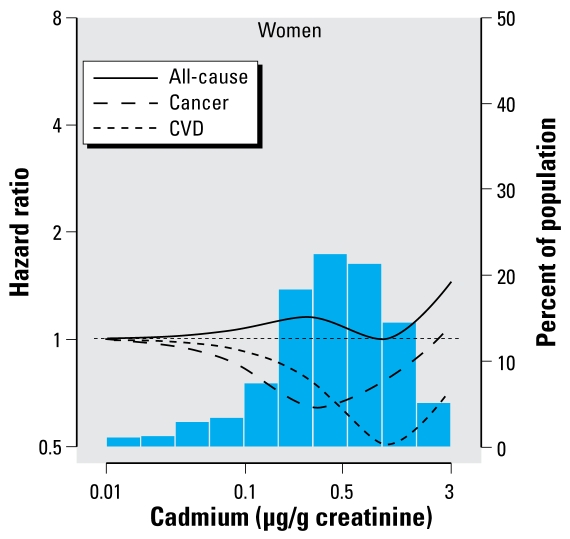
Results: The geometric mean levels of urinary cadmium per gram of urinary creatinine in study participants were 0.28 and 0.40 microg/g for men and women, respectively (p < 0.001). After multivariable adjustment, including smoking, a major source of cadmium exposure in nonoccupationally exposed populations, the hazard ratios [95% confidence interval (CI)] for all-cause, cancer, cardiovascular disease, and coronary heart disease mortality associated with a 2-fold higher creatinine-corrected urinary cadmium were, respectively, 1.28 (95% CI, 1.15-1.43), 1.55 (95% CI, 1.21-1.98), 1.21 (95% CI, 1.07-1.36), and 1.36 (95% CI, 1.11-1.66) for men and 1.06 (95% CI, 0.96-1.16), 1.07 (95% CI, 0.85-1.35), 0.93 (95% CI, 0.84-1.04), and 0.82 (95% CI, 0.76-0.89) for women.

Conclusions: Environmental cadmium exposure was associated with an increased risk of all-cause, cancer, and cardiovascular disease mortality among men, but not among women. Additional efforts are warranted to fully explain gender differences on the impact of environmental cadmium exposure.

Keywords: NHANES III; cadmium exposure; cancer; cardiovascular disease; epidemiology; human; mortality.


Figures
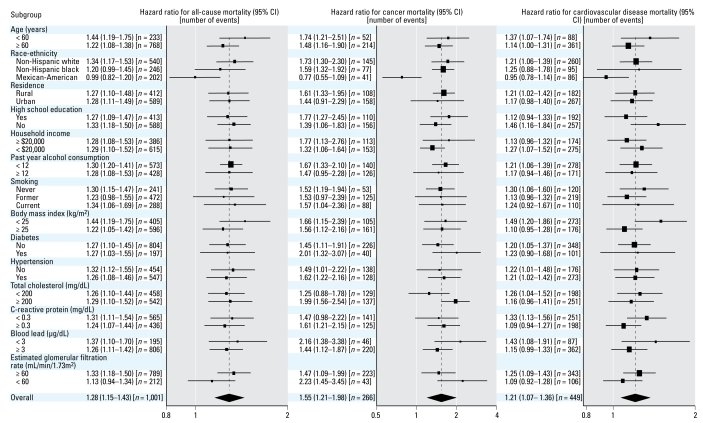
Figure 1
Figure 1
Multivariable-adjusted hazard ratio (95% CI) for all-cause, cancer, and cardiovascular disease mortality associated with a 2-fold increase in creatinine-corrected urinary cadmium overall, and by important subgroups among men. Adjustment included age (restricted quadratic spline with knots at the 10th, 50th, and 90th percentile of the overall study sample), race/ethnicity (non-Hispanic white, non-Hispanic black, Mexican American, other), urban residence (urban, rural), annual household income (< $20,000, ≥ $20,000), high school education, smoking category (never, former who quit ≥ 4 years ago, former who quit < 4 years ago, current), tertile of pack-years (< 9.0, 9.0–28.2, ≥ 28.2), physical activity (none, 1–2, ≥ 3 times a week), diabetes, BMI (continuous), alcohol consumption (< 12, ≥ 12 drinks in the past year), CRP (not detectable, 0.3–0.9, ≥ 1.0 mg/dL), total cholesterol (continuous), systolic blood pressure (continuous), blood pressure–lowering medication, blood lead (log-transformed), and eGFR (< 60, 60–89, ≥ 90 mL/min, 1.73 m2). A 2-fold increase in urinary cadmium corresponds approximately to the difference between the 75th and 50th percentiles of the cadmium distribution (0.61 μg/g and 0.32 μg/g, respectively). The sizes of the boxes are inversely related to the variance of the point estimate.
Figure 2
Figure 2
Multivariable-adjusted relative hazard of all-cause, cardiovascular disease, and cancer mortality associated with creatinine-corrected urinary cadmium using restricted quadratic splines among men (adjusted as listed for Figure 1).
Figure 3
Figure 3
Multivariable-adjusted hazard ratio (95% CI) for all-cause, cancer, and cardiovascular disease mortality associated with a 2-fold increase in creatinine-corrected urinary cadmium overall, and by important subgroups among women. Adjustment included age (restricted quadratic spline with knots at the 10th, 50th, and 90th percentile of the overall study sample), race/ethnicity (non-Hispanic white, non-Hispanic black, Mexican American, other), postmenopausal status, urban residence (urban, rural), annual household income (< $20,000, ≥ $20,000), high school education, smoking category (never, former who quit ≥ 4 years ago, former who quit < 4 years ago, current), tertile of pack-years (< 9.0, 9.0–28.2, ≥ 28.2), physical activity (none, 1–2, ≥ 3 times a week), diabetes, BMI (continuous), alcohol consumption (< 12/≥ 12 drinks in the past year), CRP (not detectable, 0.3–0.9, ≥ 1.0 mg/dL), total cholesterol (continuous), systolic blood pressure (continuous), blood pressure lowering medication, blood lead (log-transformed), and eGFR (< 60, 60–89, ≥ 90 mL/min/1.73 m2). A 2-fold increase in urinary cadmium corresponds approximately to the difference between the 75th and 50th percentiles of the cadmium distribution (0.86 μg/g and 0.44 μg/g, respectively). The sizes of the boxes are inversely related to the variance of the point estimate.
Figure 4
Figure 4
Multivariable-adjusted relative hazard of all-cause, cardiovascular disease, and cancer mortality associated with creatinine-corrected urinary cadmium using restricted quadratic splines among women (adjusted as listed for Figure 3).

References

    1. Ades AE, Kazantzis G. Lung cancer in a non-ferrous smelter: the role of cadmium. Br J Ind Med. 1988;45:435–442. - PMC - PubMed
    1. Agency for Toxic Substances and Disease Registry. Toxicological Profile for Cadmium. Atlanta, GA: Agency for Toxic Substances and Disease Registry; 1999.
    1. Arisawa K, Nakano A, Saito H, Liu XJ, Yokoo M, Soda M, et al. Mortality and cancer incidence among a population previously exposed to environmental cadmium. Int Arch Occup Environ Health. 2001;74:255–262. - PubMed
    1. Benedetti JL, Samuel O, Dewailly E, Gingras S, Lefebvre MA. Levels of cadmium in kidney and liver tissues among a Canadian population (province of Quebec) J Toxicol Environ Health A. 1999;56:145–163. - PubMed
    1. Bernard A. Renal dysfunction induced by cadmium: bio-markers of critical effects. Biometals. 2004;17:519–523. - PubMed

LinkOut - more resources