. 2009 Jul;56(7):1791-802.
doi: 10.1109/TBME.2009.2016349. Epub 2009 Mar 4.

Assessment of autonomic control and respiratory sinus arrhythmia using point process models of human heart beat dynamics

Affiliations

Assessment of autonomic control and respiratory sinus arrhythmia using point process models of human heart beat dynamics

Zhe Chen et al. IEEE Trans Biomed Eng. 2009 Jul.

Abstract

Tracking the autonomic control and respiratory sinus arrhythmia (RSA) from electrocardiogram and respiratory measurements is an important problem in cardiovascular control. We propose a point process adaptive filter algorithm based on an inverse Gaussian model to track heart beat intervals that incorporates respiratory measurements as a covariate and provides an analytic form for computing a dynamic estimate of RSA gain. We use Kolmogorov-Smirnov tests and autocorrelation function analyses to assess model goodness-of-fit. We illustrate the properties of the new dynamic estimate of RSA in the analysis of simulated heart beat data and actual heart beat data recorded from subjects in a four-state postural study of heart beat dynamics: control, sympathetic blockade, parasympathetic blockade, and combined sympathetic and parasympathetic blockade. In addition to giving an accurate description of the heart beat data, our adaptive filter algorithm confirms established findings pointing at a vagally mediated RSA and provides a new dynamic RSA estimate that can be used to track cardiovascular control between and within a broad range of postural, pharmacological, and age conditions. Our paradigm suggests a possible framework for designing a device for ambulatory monitoring and assessment of autonomic control in both laboratory research and clinical practice.


Figures

Figure 1
Figure 1
Estimated time courses of μRR, σRR, μRR (instantaneous HR), σHR (instantaneous HRV), and RSA gain statistics for one Monte Carlo realization of the simulated heart beat data. In the first panel, the superimposed curve is the original R-R interval time series.
Figure 2
Figure 2
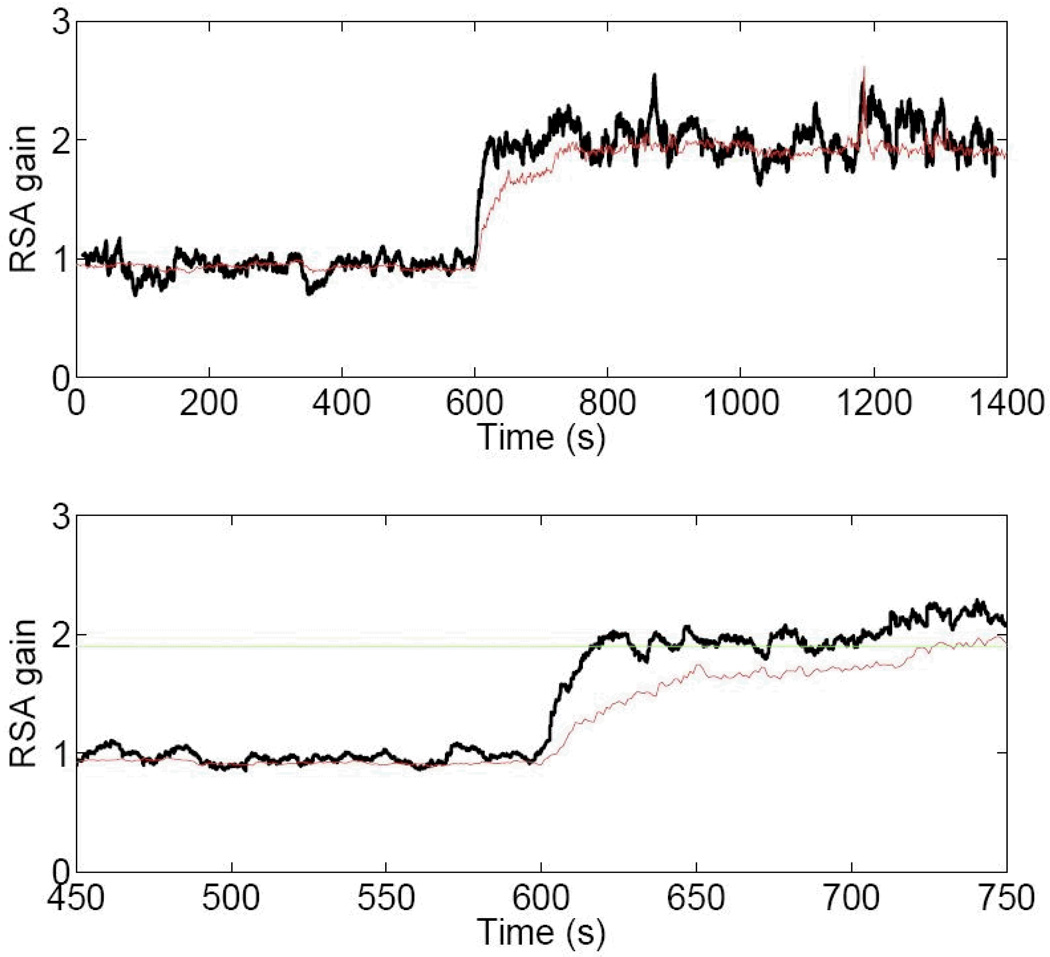
The comparison between the adaptive point process filter (dark black trace) and RLS filter (red trace) in the estimated RSA curve (averaged over multiple independent Monte Carlo runs). Top panel: the complete trace. Bottom panel: the zoom-in trace from 450 to 750 seconds. The RSA unit is ms/l.
Figure 3
Figure 3
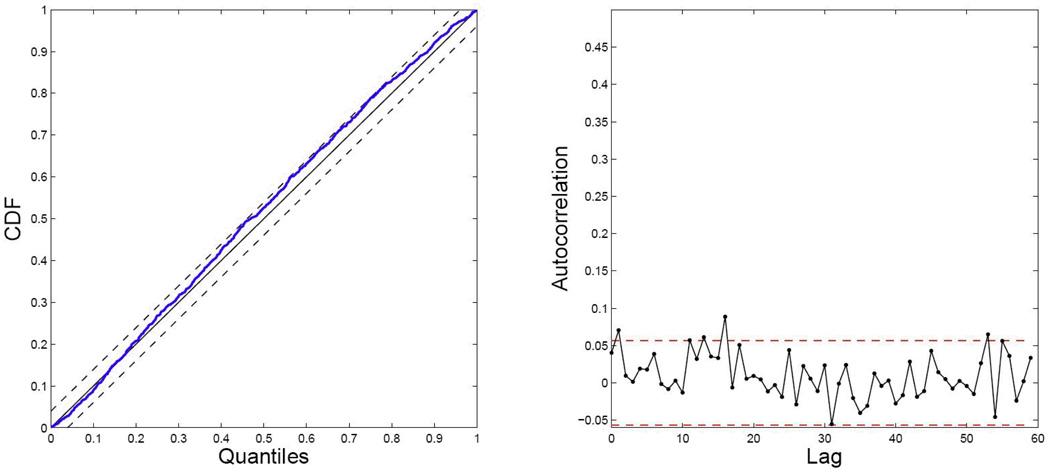
The KS plot and the autocorrelation plot for the simulated heart beat data
Figure 4
Figure 4
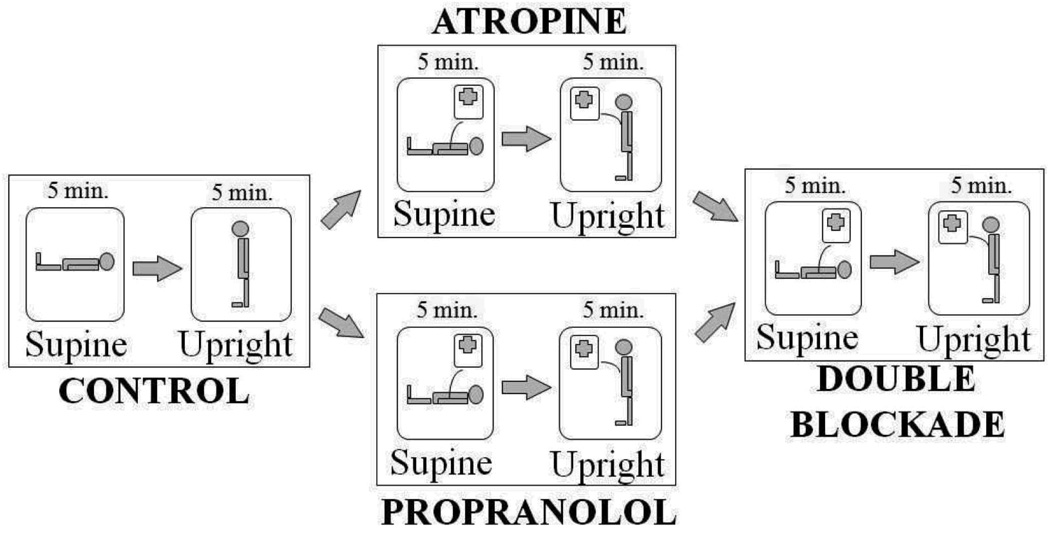
Diagram of the autonomic blockade protocol.
Figure 5
Figure 5
A snapshot of R-R intervals (in msec) and lung volume respiration measures (RP, calibrated and zero mean) under 6 different conditions (subject 20). Top 6 panels: supine posture. Bottom 6 panels: upright posture. Note that all RR (as well as all RP) plots are visualized within the same scales.
Figure 6
Figure 6
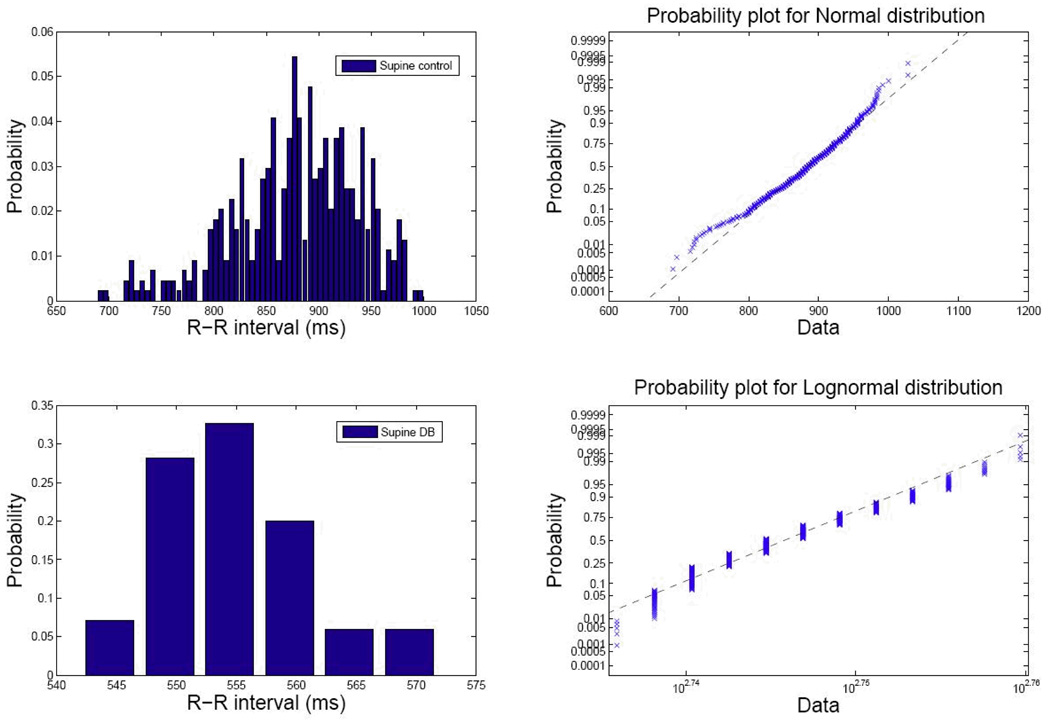
Histogram analysis and probability fit for the control and double blockdade conditions in supine position (subject 20, see Fig. 2). In the probability fit plots, if the data fit the tested probability distribution, the data points will match the straight dashed line.
Figure 7
Figure 7
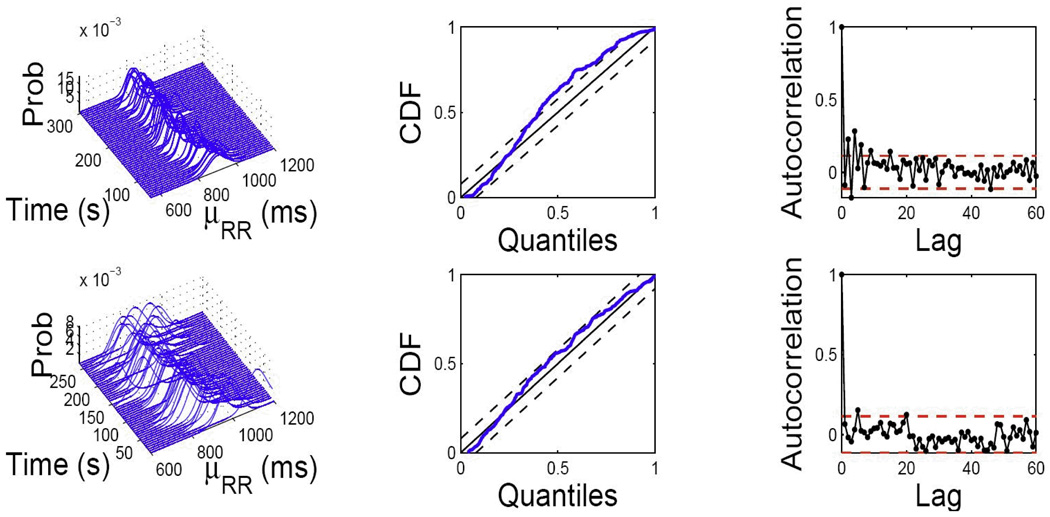
Comparison of inverse Gaussian models with the mean as the univariate (top row) and bivariate (bottom row) AR models for subject 20 (upright, PROP). Left panel: estimated time-varying probability density function of the instantaneous μRR(t). Middle panel: KS plot. Right panel: autocorrelation function. (Dashed lines indicate the 95% confidence bounds)
Figure 8
Figure 8
The R-R interval, lung volume respiration (RP) measure ((adjusted to zero mean), and estimated dynamic RSA mean gain (0.15-0.5 Hz) in 3 consecutive epochs (subject 25). From control supine to control upright, RR decreases and RP increases signficantly, and RSA decreases. From control upright to PROP upright, RR increases and RP decreases, and RSA increases significantly.
Figure 9
Figure 9
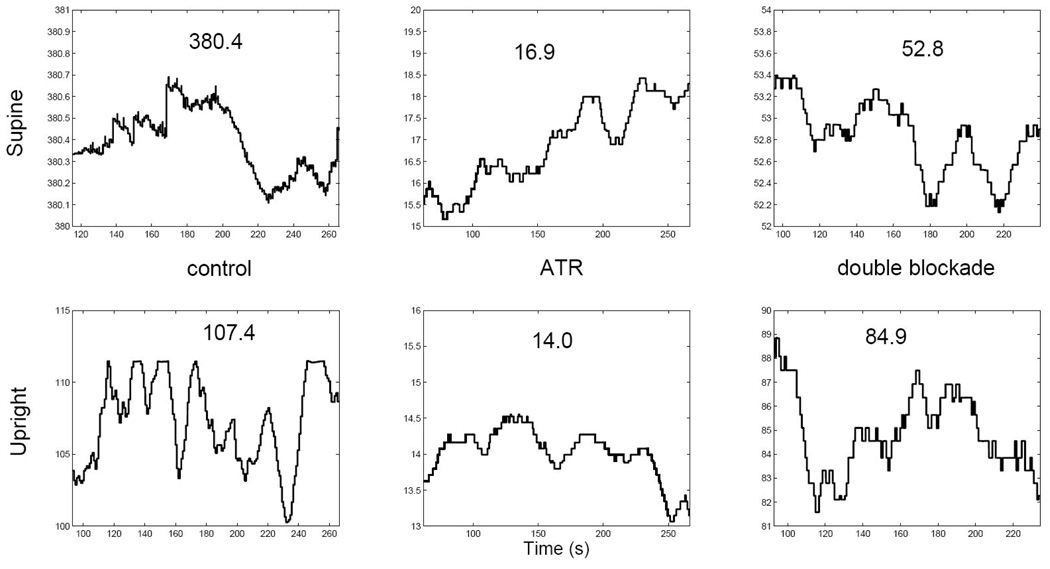
The estimated instantaneous RSA gain (unit: ms/l) in the HF (0.15-0.5 Hz) range (subject 14 from the old/ATR group). The number in each subplot indicates the mean value of the RSA gain averaged over the entire recording (which is computed using the unnormalized RP measure), all RSA units are ms/l. In this case, the following RSA mean gain relationship holds: supine>upright (except DB), control>ATR, control>DB.
Figure 10
Figure 10
The estimated instantaneous RSA gain (unit: ms/l) in the HF (0.15-0.5 Hz) range (subject 20 from the young/PROP group). The number in each subplot indicates the mean value of the RSA gain averaged over the entire recording (which is computed using the unnormalized RP measure), all RSA units are ms/l. In this case, the following mean RSA gain relationship holds: supine>upright, control>DB, PROP>DB.

References

    1. Task Force of the European Society of Cardiology and the North American Society of Pacing and Electrophysiology, “Heart rate variability”. Circulation. 1996;vol. 93(no 5):1043–1065. - PubMed
    1. Barbieri R, Matten EC, Alabi AA, Brown EN. A point-process model of human heartbeat intervals: new definitions of heart rate and heart rate variability. Am J. Physiol. Heart Cicr. Physiol. 2005;vol. 288:424–435. - PubMed
    1. Barbieri R, Brown EN. Analysis of heart beat dynamics by point process adaptive filtering. IEEE Trans. Biomed. Eng. 2006;vol.53(no 1):4–12. - PubMed
    1. Barbieri R, Waldmann RA, Di Virgilio V, Triedman JK, Bianchi AM, Cerutti S, Saul JP. Continuous quantification of baroreflex and respiratory control of heart rate by use of bivariate autoregressive techniques. Annals of Noninvasive Electrocardiology. 1996;vol. 3:264–277.
    1. Barbieri R, Bianchi AM, Triedman JK, Mainardi LT, Gerutti S, Saul JP. Model dependency of multivariate autoregressive spectral analysis. IEEE Mag. Engr. Med. Biol. 1997;vol. 16(no 5):74–85. - PubMed

Publication types