. 2009 May;29(9):2346-58.
doi: 10.1128/MCB.01233-08. Epub 2009 Mar 9.

Role of the histone variant H2A.Z/Htz1p in TBP recruitment, chromatin dynamics, and regulated expression of oleate-responsive genes

Affiliations

Role of the histone variant H2A.Z/Htz1p in TBP recruitment, chromatin dynamics, and regulated expression of oleate-responsive genes

Yakun Wan et al. Mol Cell Biol. 2009 May.

Abstract

The histone variant H2A.Z (Htz1p) has been implicated in transcriptional regulation in numerous organisms, including Saccharomyces cerevisiae. Genome-wide transcriptome profiling and chromatin immunoprecipitation studies identified a role for Htz1p in the rapid and robust activation of many oleate-responsive genes encoding peroxisomal proteins, in particular POT1, POX1, FOX2, and CTA1. The Swr1p-, Gcn5p-, and Chz1p-dependent association of Htz1p with these promoters in their repressed states appears to establish an epigenetic marker for the rapid and strong expression of these highly inducible promoters. Isw2p also plays a role in establishing the nucleosome state of these promoters and associates stably in the absence of Htz1p. An analysis of the nucleosome dynamics and Htz1p association with these promoters suggests a complex mechanism in which Htz1p-containing nucleosomes at fatty acid-responsive promoters are disassembled upon initial exposure to oleic acid leading to the loss of Htz1p from the promoter. These nucleosomes reassemble at later stages of gene expression. While these new nucleosomes do not incorporate Htz1p, the initial presence of Htz1p appears to mark the promoter for sustained gene expression and the recruitment of TATA-binding protein.


Figures
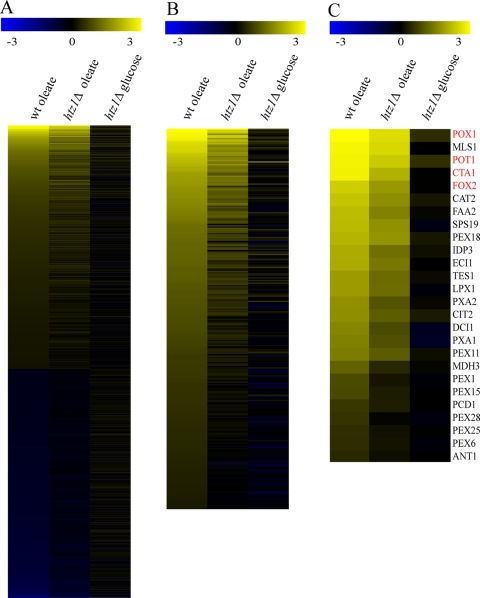
FIG. 1.
FIG. 1.
The robust expression of oleate-responsive genes expression is dependent on HTZ1. (A) Comparison of changes in the mRNA levels of all yeast genes in WT (left column) and htz1Δ cells (middle column) after induction in oleate medium for 6 h. Shown are the relative expression levels (log10) of genes that were determined to be significantly (λ ≥ 100) altered in cells on oleate (compared to WT cells on glucose). Relative expression levels are shown using the scale of the yellow-blue heat map (top). Genes are ordered top to bottom based on relative expression in WT cells on oleate. Approximately 1,000 genes were significantly induced, and 1,000 genes were repressed and changed in expression at least twofold. Genes that were reduced in expression were significantly enriched for functions related to ribosomal biogenesis (hypergeometric distribution analysis of gene ontology terms, P ≈ 10−50). Induced genes were enriched for oxidative phosphorylation, the electron transport chain, and aerobic respiration (P ≈ 10−10); components of the mitochondrial respiratory chain (P ≈ 10−13); fatty acid oxidation and peroxisome organization and biogenesis (P ≈ 10−6); and the peroxisomal compartment (P ≈ 10−12). For comparison, the relative expression of each gene in htz1Δ cells in oleate (middle column) and glucose (right column) is shown. (B) The same as described for panel A, but shown are the relative expression levels of 292 genes significantly (λ ≥ 100) altered in WT cells on oleate and expressed at least twofold less than their expression levels in WT cells. This list is enriched for genes linked to fatty acid and lipid oxidation (P ≈ 4.0 × 10⁻¹²) and peroxisomes (P ≈ 9 ×10⁻²⁰). (C) The same as described for panel B, but shown are genes encoding peroxisomal proteins significantly (λ ≥ 100) altered in WT cells on oleate and expressed at least twofold less in htz1Δ cells.
FIG. 2.
FIG. 2.
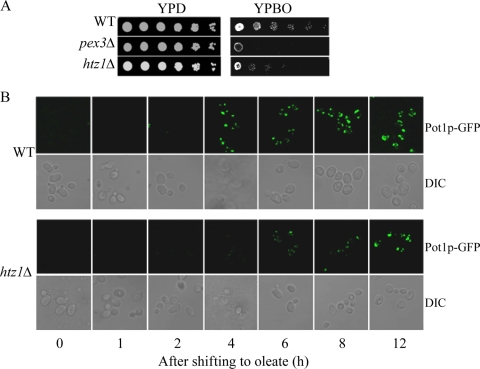
The deletion of HTZ1 leads to delayed peroxisome biogenesis. (A) The deletion of HTZ1 impairs cell growth on oleate-containing medium. Strains were grown to mid-logarithmic phase in liquid YPD medium, and equal amounts of cells were serially diluted 10-fold onto YPD and incubated at 30°C for 3 days and onto oleate-containing YPBO and incubated at 30°C for 5 days. (B) The fluorescent images of WT and htz1Δ cells shown are expressing the peroxisomal matrix protein Pot1p fused with GFP (Pot1p-GFP) at different time points of oleate incubation and were captured on a TCS SP2 laser scanning spectral confocal microscope.
FIG. 3.
FIG. 3.
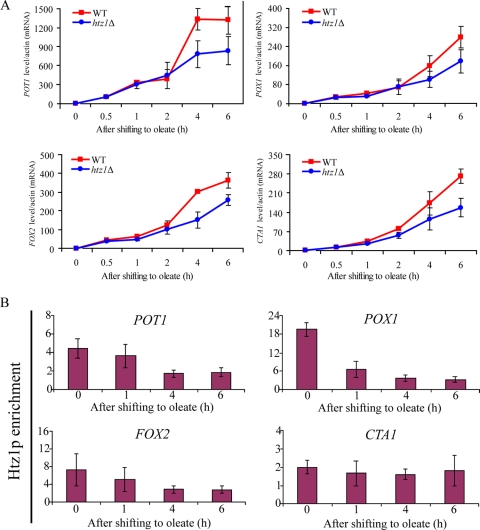
Htz1p dynamically dissociates from oleate-responsive promoters upon induction. (A) POT1, POX1, FOX2, and CTA1 mRNA levels were determined by RT-PCR in WT and htz1Δ strains over a time course of oleate induction. The signal obtained from ACT1 mRNA was used as a loading control for normalization. Error bars represent standard deviations from the means of three independent experimental values. (B) Htz1p enrichment at four promoters was determined by qPCR during oleate induction. Relative enrichment values (y axes) are the averages of the results from three independent ChIPs with qPCR determination performed twice per biological replicate. Nonpromoter IGRi YMR325W was used as an internal control to normalize signals of promoter enrichment. In response to oleate induction, Htz1p was lost from the POT1, POX1, FOX2, and CTA1 promoters.
FIG. 4.
FIG. 4.
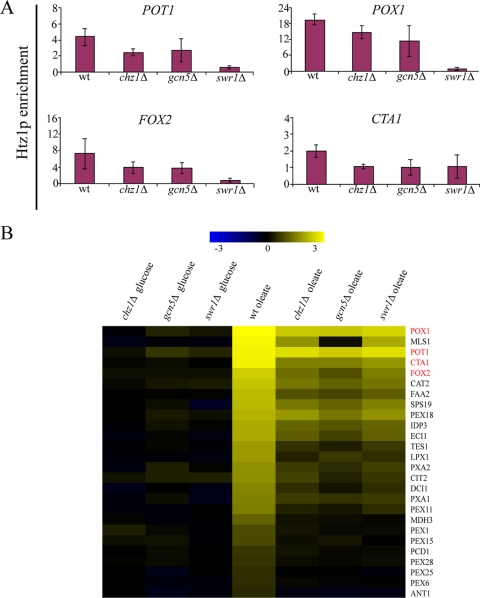
Swr1p-, Chz1p-, and Gcn5p-dependent association of Htz1p with promoters. (A) In vivo association of Htz1p with the POT1, POX1, FOX2, and CTA1 promoters was measured by ChIP in the WT, chz1Δ, gcn5Δ, and swr1Δ strains in 2% glucose medium. ChIP was performed in glucose-containing medium. Error bars represent standard deviations from the means of three independent experimental values and two technical replicates of each. (B) Comparison of changes in the mRNA levels of all yeast genes in WT, chz1Δ, gcn5Δ, and swr1Δ strains after induction in oleate medium for 6 h. As described in the legend to Fig. 1C, genes encoding peroxisomal proteins significantly (λ ≥ 100) altered in WT cells on oleate and expressed at least twofold less in htz1Δ cells are shown.
FIG. 5.
FIG. 5.
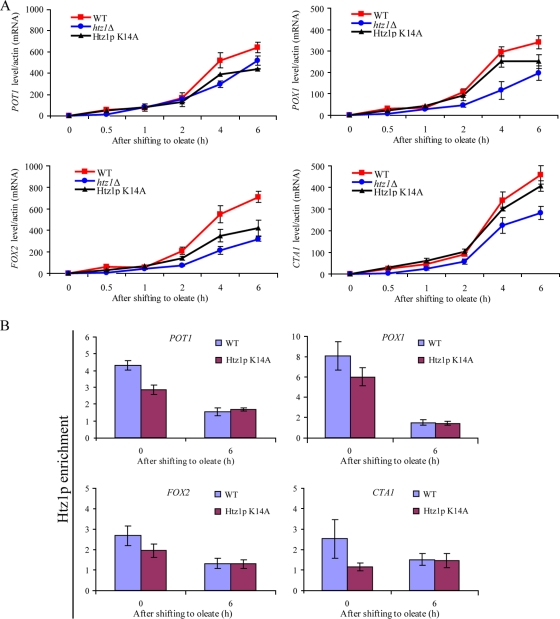
The acetylation of Htz1p is required for efficient transcriptional induction. (A) POT1, POX1, FOX2, and CTA1 mRNA levels were determined by RT-PCR in the WT, htz1Δ, and Htz1p K14A mutant strains over a time course of oleate induction. The signal obtained from ACT1 mRNA was used as a loading control for normalization. Error bars represent standard deviations from the means of three independent experimental values. (B) Enrichment of WT Htz1p and the Htz1p K14A mutant at four promoters was determined by qPCR during glucose and oleate induction for 6 h. Relative enrichment values (y axes) are the averages of the results from three independent ChIP experiments with two technical replicates of each. Nonpromoter IGRi YMR325W was used as an internal control to normalize signals of promoter enrichment.
FIG. 6.
FIG. 6.
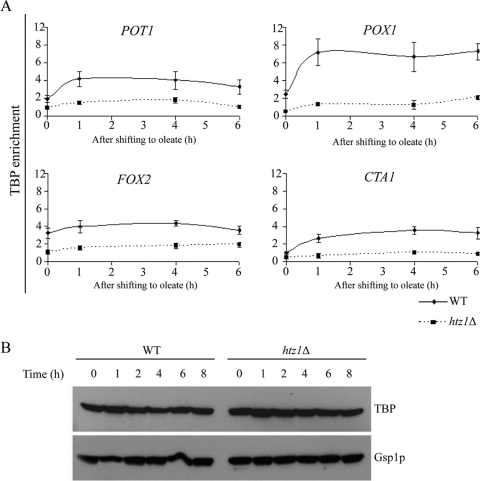
Recruitment of TBP during oleate induction requires Htz1p. (A) The association of TBP with the POT1, POX1, FOX2, and CTA1 promoters was determined by ChIP using anti-Myc antibodies, followed by gene-specific PCR. The relative enrichment ratio is plotted at four time points (0, 1, 4, and 6 h) of induction in oleate. ACT1 was used as an internal control to normalize signals of promoter enrichment. Error bars show the standard deviation from three independent experimental values with two technical replicates of each. (B) Deletion of HTZ1 did not affect TBP expression during oleate induction. The WT strain and htz1Δ strains expressing genomically integrated TBP were grown in 2% glucose overnight and then transferred to oleate-containing SCIM medium at the indicated time points. Samples containing equal amounts of protein were analyzed by Western blotting with anti-Myc antibody to visualize TBP expression. A polyclonal antibody directed against Gsp1p was used as a loading control.
FIG. 7.
FIG. 7.
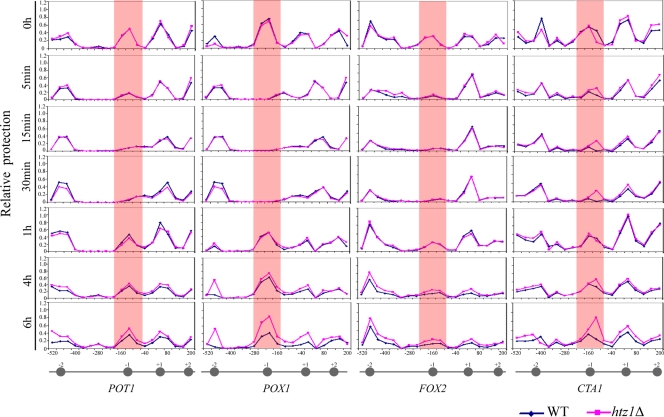
Htz1p regulates the occupancy of specific nucleosomes on the POT1, POX1, FOX2, and CTA1 promoters. The NuSA was used to determine the nucleosome positioning and density at the POT1, POX1, FOX2, and CTA1 promoters during oleate induction (the time of induction is indicated on the left) in the WT and HTZ1 deletion strains. Each point represents the relative protection of each PCR amplicon, quantified by real-time PCR and normalized to a centromeric control. The position of each amplicon (referenced to the middle of each amplicon) within the promoter is shown on the x axis. The approximate location of a nucleosome is represented by a gray circle with the nucleosome number referred to in the text shown above the circle.
FIG. 8.
FIG. 8.
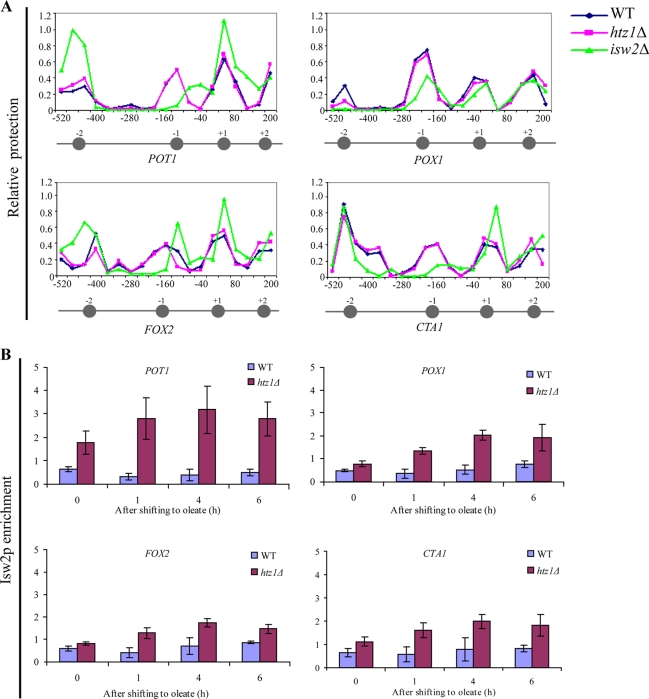
Isw2p can associate with oleate-responsive promoters in the absence of Htz1p. (A) The NuSA was used to determine the nucleosome positioning and density at the POT1, POX1, FOX2, and CTA1 promoters during repression (2% glucose) in WT, htz1Δ, and isw2Δ strains. Each point represents the relative protection of each PCR amplicon, quantified by real-time PCR and normalized to a centromeric control. The approximate location of a nucleosome is represented by a gray circle with the nucleosome number referred to in the text shown above the circle. (B) The association of Isw2p (as a C-terminal myc fusion) with the POT1, POX1, FOX2, and CTA1 promoters was determined by ChIP using anti-Myc antibodies, followed by gene-specific PCR. The relative enrichment ratio is plotted at four time points (0, 1, 4, and 6 h) of induction in oleate. ACT1 was used as an internal control to normalize the signals of promoter enrichment. Error bars show the standard deviations from three independent experimental values with two technical replicates of each.

References

    1. Adam, M., F. Robert, M. Larochelle, and L. Gaudreau. 2001. H2A.Z is required for global chromatin integrity and for recruitment of RNA polymerase II under specific conditions. Mol. Cell. Biol. 216270-6279. - PMC - PubMed
    1. Aitchison, J. D., M. P. Rout, M. Marelli, G. Blobel, and R. W. Wozniak. 1995. Two novel related yeast nucleoporins Nup170p and Nup157p: complementation with the vertebrate homologue Nup155p and functional interactions with the yeast nuclear pore-membrane protein Pom152p. J. Cell Biol. 1311133-1148. - PMC - PubMed
    1. Albert, I., T. N. Mavrich, L. P. Tomsho, J. Qi, S. J. Zanton, S. C. Schuster, and B. F. Pugh. 2007. Translational and rotational settings of H2A.Z nucleosomes across the Saccharomyces cerevisiae genome. Nature 446572-576. - PubMed
    1. Bensinger, S. J., and P. Tontonoz. 2008. Integration of metabolism and inflammation by lipid-activated nuclear receptors. Nature 454470-477. - PubMed
    1. Berger, J., and D. E. Moller. 2002. The mechanisms of action of PPARs. Annu. Rev. Med. 53409-435. - PubMed

Publication types

MeSH terms