


Use of number by fish
- PMID: 19274079
- PMCID: PMC2650784
- DOI: 10.1371/journal.pone.0004786
Use of number by fish
Abstract
Background: Research on human infants, mammals, birds and fish has demonstrated that rudimentary numerical abilities pre-date the evolution of human language. Yet there is controversy as to whether animals represent numbers mentally or rather base their judgments on non-numerical perceptual variables that co-vary with numerosity. To date, mental representation of number has been convincingly documented only for a few mammals.
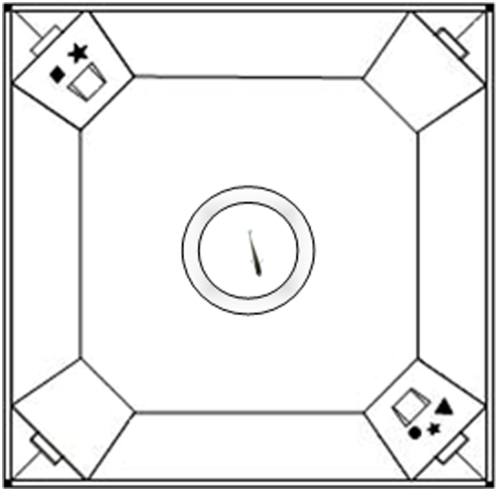
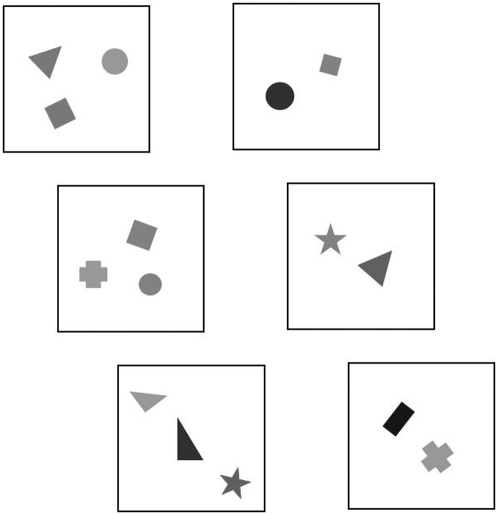
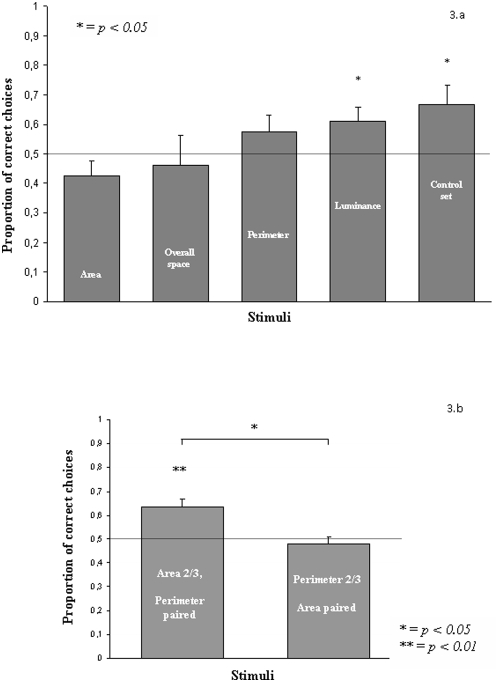
Methodology/principal findings: Here we used a training procedure to investigate whether mosquitofish could learn to discriminate between two and three objects even when denied access to non-numerical information. In the first experiment, fish were trained to discriminate between two sets of geometric figures. These varied in shape, size, brightness and distance, but no control for non-numerical variables was made. Subjects were then re-tested while controlling for one non-numerical variable at a time. Total luminance of the stimuli and the sum of perimeter of figures appeared irrelevant, but performance dropped to chance level when stimuli were matched for the cumulative surface area or for the overall space occupied by the arrays, indicating that these latter cues had been spontaneously used by the fish during the learning process. In a second experiment, where the task consisted of discriminating 2 vs 3 elements with all non-numerical variables simultaneously controlled for, all subjects proved able to learn the discrimination, and interestingly they did not make more errors than the fish in Experiment 1 that could access non-numerical information in order to accomplish the task.
Conclusions/significance: Mosquitofish can learn to discriminate small quantities, even when non-numerical indicators of quantity are unavailable, hence providing the first evidence that fish, like primates, can use numbers. As in humans and non-human primates, genuine counting appears to be a 'last resort' strategy in fish, when no other perceptual mechanism may suggest the quantity of the elements. However, our data suggest that, at least in fish, the priority of perceptual over numerical information is not related to a greater cognitive load imposed by direct numerical computation.
Conflict of interest statement
Figures
References
-
- Lyon BE. Egg recognition and counting reduce costs of avian conspecific brood parasitism. Nature. 2003;422:495–499. - PubMed
-
- McComb K, Packer C, Pusey A. Roaring and numerical assessment in contests between groups of female lions, Panthera leo. Animal Behaviour. 1994;47:379–387.
-
- Brannon EM, Terrace HS. Ordering of the numerosities 1 to 9 by monkeys. Science. 1998;282:746–749. - PubMed
-
- Matsuzawa T. Use of numbers by a chimpanzee. Nature. 1985;315:57–59. - PubMed
Publication types
MeSH terms
LinkOut - more resources
Full Text Sources
