Mutagenicity of an aged gasworks soil during bioslurry treatment
- PMID: 19274766
- PMCID: PMC2909460
- DOI: 10.1002/em.20473
Mutagenicity of an aged gasworks soil during bioslurry treatment
Abstract
This study investigated changes in the mutagenic activity of organic fractions from soil contaminated with polycyclic aromatic hydrocarbons (PAHs) during pilot-scale bioslurry remediation. Slurry samples were previously analyzed for changes in PAH and polycyclic aromatic compound content, and this study examined the correspondence between the chemical and toxicological metrics. Nonpolar neutral and semipolar aromatic fractions of samples obtained on days 0, 3, 7, 24, and 29 of treatment were assayed for mutagenicity using the Salmonella mutation assay. Most samples elicited a significant positive response on Salmonella strains TA98, YG1041, and YG1042 with and without S9 metabolic activation; however, TA100 failed to detect mutagenicity in any sample. Changes in the mutagenic activity of the fractions across treatment time and metabolic activation conditions suggests a pattern of formation and transformation of mutagenic compounds that may include a wide range of PAH derivatives such as aromatic amines, oxygenated PAHs, and S-heterocyclic compounds. The prior chemical analyses documented the formation of oxygenated PAHs during the treatment (e.g., 4-oxapyrene-5-one), and the mutagenicity analyses showed high corresponding activity in the semipolar fraction with and without metabolic activation. However, it could not be verified that these specific compounds were the underlying cause of the observed changes in mutagenic activity. The results highlight the need for concurrent chemical and toxicological profiling of contaminated sites undergoing remediation to ensure elimination of priority contaminants as well as a reduction in toxicological hazard. Moreover, the results imply that remediation efficacy and utility be evaluated using both chemical and toxicological metrics.
Figures
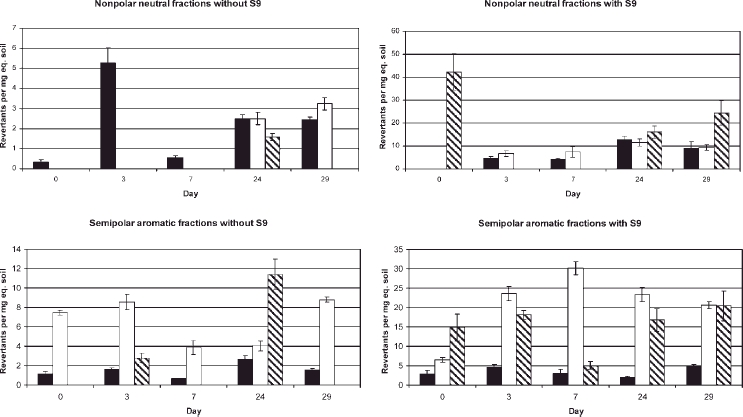
 ), YG1041 (
 ), and YG1042 (
 ). Note that TA100 did not detect any mutagenic activity in any samples on any days.
References
-
- Aeschbacher HU, Turesky RJ. Mammalian cell mutagenicity and metabolism of heterocyclic aromatic amines. Mutat Res. 1991;259:235–250. - PubMed
-
- Alexander RR, Alexander M. Genotoxicity of two polycyclic aromatic hydrocarbons declines as they age in soil. Environ Toxicol Chem. 1999;18:1140–1143.
-
- Alexander RR, Tang J, Alexander M. Genotoxicity is unrelated to total concentration of priority carcinogenic polycyclic aromatic hydrocarbons in soils undergoing biological treatment. J Environ Qual. 2002;31:150–154. - PubMed
-
- Andersson B, Lundstedt S, Tornberg K, Schnurer Y, Öberg L, Mattiasson B. Incomplete degradation of polycyclic aromatic hydrocarbons in soil inoculated with wood-rotting fungi and their effect on the indigenous soil bacteria. Environ Toxicol Chem. 2003;22:1238–1243. - PubMed
-
- Aprill W, Sims RC, Sims JL, Matthews JE. Assessing detoxification and degradation of wood preserving and petroleum wastes in contaminated soil. Waste Manage Res. 1990;8:45–65.
Publication types
MeSH terms
Substances
LinkOut - more resources
Full Text Sources