


Clearance of amyloid-beta peptide across the blood-brain barrier: implication for therapies in Alzheimer's disease
- PMID: 19275634
- PMCID: PMC2872930
- DOI: 10.2174/187152709787601867
Clearance of amyloid-beta peptide across the blood-brain barrier: implication for therapies in Alzheimer's disease
Abstract
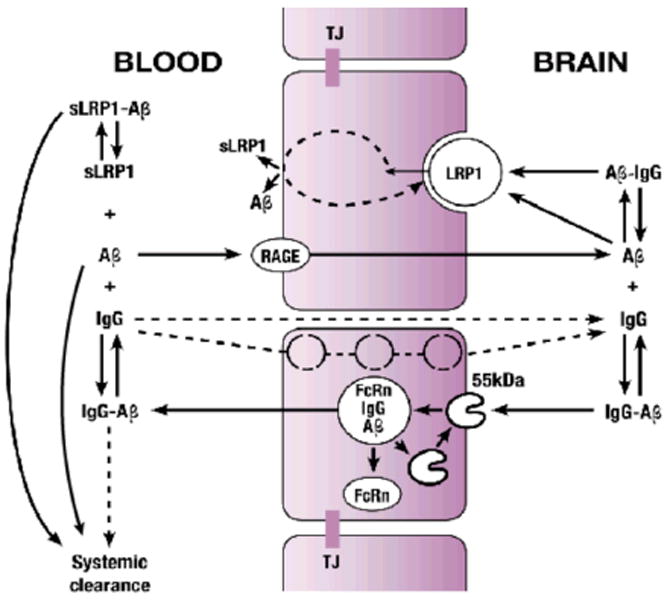
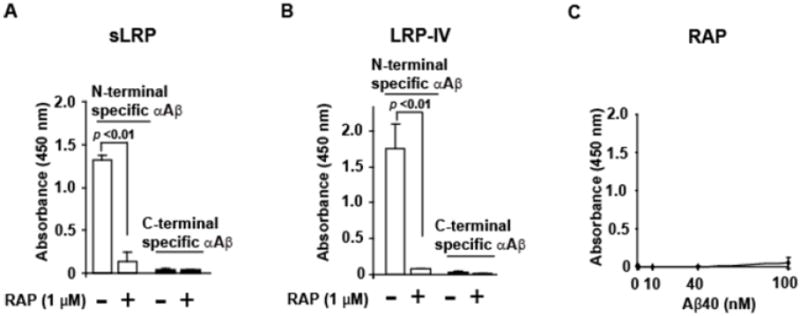
The main receptors for amyloid-beta peptide (Abeta) transport across the blood-brain barrier (BBB) from brain to blood and blood to brain are low-density lipoprotein receptor related protein-1 (LRP1) and receptor for advanced glycation end products (RAGE), respectively. In normal human plasma a soluble form of LRP1 (sLRP1) is a major endogenous brain Abeta 'sinker' that sequesters some 70 to 90 % of plasma Abeta peptides. In Alzheimer's disease (AD), the levels of sLRP1 and its capacity to bind Abeta are reduced which increases free Abeta fraction in plasma. This in turn may increase brain Abeta burden through decreased Abeta efflux and/or increased Abeta influx across the BBB. In Abeta immunotherapy, anti-Abeta antibody sequestration of plasma Abeta enhances the peripheral Abeta 'sink action'. However, in contrast to endogenous sLRP1 which does not penetrate the BBB, some anti-Abeta antibodies may slowly enter the brain which reduces the effectiveness of their sink action and may contribute to neuroinflammation and intracerebral hemorrhage. Anti-Abeta antibody/Abeta immune complexes are rapidly cleared from brain to blood via FcRn (neonatal Fc receptor) across the BBB. In a mouse model of AD, restoring plasma sLRP1 with recombinant LRP-IV cluster reduces brain Abeta burden and improves functional changes in cerebral blood flow (CBF) and behavioral responses, without causing neuroinflammation and/or hemorrhage. The C-terminal sequence of Abeta is required for its direct interaction with sLRP and LRP-IV cluster which is completely blocked by the receptor-associated protein (RAP) that does not directly bind Abeta. Therapies to increase LRP1 expression or reduce RAGE activity at the BBB and/or restore the peripheral Abeta 'sink' action, hold potential to reduce brain Abeta and inflammation, and improve CBF and functional recovery in AD models, and by extension in AD patients.
Figures
References
-
- Alzheimer A, Stelzmann RA, Schnitzlein HN, Murtagh FR. An English translation of Alzheimer’s 1907 paper, “Uber eine eigenartige Erkankung der Hirnrinde”. Clin Anat. 1995;8(6):429–31. - PubMed
-
- Alzheimer’s Association. Alzheimer’s disease Facts and Figures. 2008. [Jan 16, 2009]. http://www.alz.org/national/documents/report_alzfactsfigures2008.pdf. - PubMed
-
- Kayed R, Head E, Thompson JL, McIntire TM, Milton SC, Cotman CW, Glabe CG. Common structure of soluble amyloid oligomers implies common mechanism of pathogenesis. Science. 2003;300(5618):486–9. - PubMed
-
- Walsh DM, Klyubin I, Shankar GM, Townsend M, Fadeeva JV, Betts V, Podlisny MB, Cleary JP, Ashe KH, Rowan MJ, Selkoe DJ. The role of cell-derived oligomers of Abeta in Alzheimer’s disease and avenues for therapeutic intervention. Biochem Soc Trans. 2005;33(Pt 5):1087–90. - PubMed
-
- Lesne S, Koh MT, Kotilinek L, Kayed R, Glabe CG, Yang A, Gallagher M, Ashe KH. A specific amyloid-beta protein assembly in the brain impairs memory. Nature. 2006;440(7082):352–7. - PubMed
Publication types
MeSH terms
Substances
Grants and funding
LinkOut - more resources
Full Text Sources
Other Literature Sources
Medical
Molecular Biology Databases
Research Materials
Miscellaneous