


Brief intervention addressing excessive cannabis use in young people consulting their GP: a pilot study
- PMID: 19275832
- PMCID: PMC2648914
- DOI: 10.3399/bjgp09X419529
Brief intervention addressing excessive cannabis use in young people consulting their GP: a pilot study
Abstract
Background: When excessive cannabis consumption occurs in adolescence, the adverse consequences extend into adulthood. Interventions by GPs are effective in preventing harm associated with alcohol use. Similar interventions have potential in addressing cannabis use.
Aim: To develop and pilot test a brief intervention targeting excessive cannabis use (defined as > or = 1x/week) in young people in primary care.
Design of the study: Pilot intervention trial.
Setting: Seven family practices in Switzerland.
Method: The team collaborated with GPs and young people to develop the intervention. Seven GPs piloted its use in their consultations. Patients aged 15 to 24 years consulting for any health problem were recruited before the consultation. Cannabis use, other substance use, and their psychosocial correlates were assessed with a short confidential questionnaire administered before the consultation and 1 month later. GPs, staff, and patients were asked to comment on the study and its feasibility.
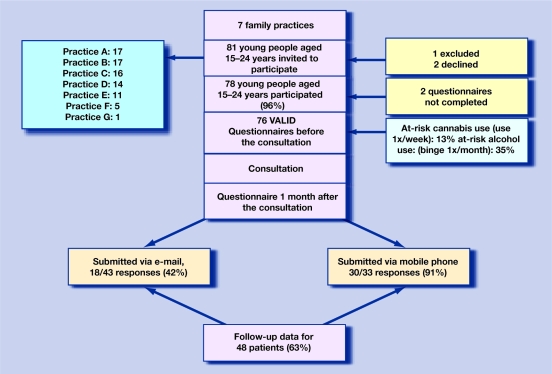
Results: Of 81 young people invited to participate, 78 (70% female) agreed (participation rate: 96%). One in seven (13.2%, 95% confidence interval = 7.5% to 18.9%) used cannabis at least once a week. Data at 1 month were available for 42% who had provided email contact details and 91% of those who had provided their mobile phone number (63% overall). In most cases, the intervention lasted no more than 5 minutes. Comments from participants added favourable data towards the feasibility of the study.
Conclusion: This pilot study provides a solid base on which to build a randomised trial of a brief intervention addressing cannabis use in young people consulting in family practice.
Figures
Comment in
-
Cannabis and risk.Br J Gen Pract. 2009 Mar;59(560):157-8. doi: 10.3399/bjgp09X419501. Br J Gen Pract. 2009. PMID: 19275831 Free PMC article. No abstract available.
References
-
- Hall W, Solowij N. Adverse effects of cannabis. Lancet. 1998;352(9140):1611–1616. - PubMed
-
- Fergusson DM, Horwood LJ, Swain-Campbell N. Cannabis use and psychosocial adjustment in adolescence and young adulthood. Addiction. 2002;97(9):1123–1135. - PubMed
-
- Lynskey M, Hall W. The effects of adolescent cannabis use on educational attainment: a review. Addiction. 2000;95(11):1621–1630. - PubMed
-
- Moore TH, Zammit S, Lingford-Hughes A, et al. Cannabis use and risk of psychotic or affective mental health outcomes: a systematic review. Lancet. 2007;370(9584):319–328. - PubMed
Publication types
MeSH terms
LinkOut - more resources
Full Text Sources
Medical
Research Materials
