. 2009 Jul;167(1):47-54.
doi: 10.1016/j.jsb.2009.03.001. Epub 2009 Mar 9.

Collagen insulated from tensile damage by domains that unfold reversibly: in situ X-ray investigation of mechanical yield and damage repair in the mussel byssus

Affiliations

Collagen insulated from tensile damage by domains that unfold reversibly: in situ X-ray investigation of mechanical yield and damage repair in the mussel byssus

Matthew J Harrington et al. J Struct Biol. 2009 Jul.

Abstract

The byssal threads of the California mussel, Mytilus californianus, are highly hysteretic, elastomeric fibers that collectively perform a holdfast function in wave-swept rocky seashore habitats. Following cyclic loading past the mechanical yield point, threads exhibit a damage-dependent reduction in mechanical performance. However, the distal portion of the byssal thread is capable of recovering initial material properties through a time-dependent healing process in the absence of active cellular metabolism. Byssal threads are composed almost exclusively of multi-domain hybrid collagens known as preCols, which largely determine the mechanical properties of the thread. Here, the structure-property relationships that govern thread mechanical performance are further probed. The molecular rearrangements that occur during yield and damage repair were investigated using time-resolved in situ wide-angle X-ray diffraction (WAXD) coupled with cyclic tensile loading of threads and through thermally enhanced damage-repair studies. Results indicate that the collagen domains in byssal preCols are mechanically protected by the unfolding of sacrificial non-collagenous domains that refold on a slower time-scale. Time-dependent healing is primarily attributed to stochastic recoupling of broken histidine-metal coordination complexes.


Figures
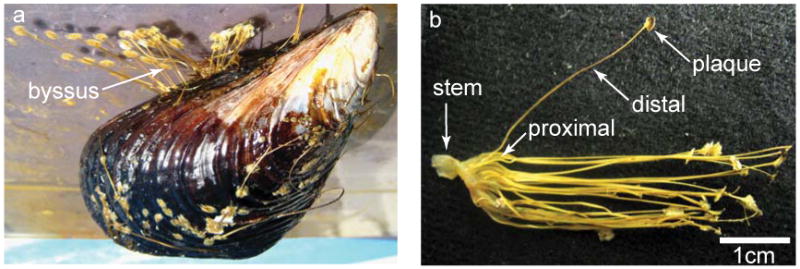
Figure 1
Figure 1. Mussel byssal threads
a) Marine mussels attach to available surfaces in rocky seashore habitats with a fibrous holdfast known as a byssus. b) Each byssal thread is individually formed from a mesogenic protein secretion and merged with the growing stem, which provides the linkage between the soft mussel tissue and the byssus. The threads adhere to surfaces via an adhesive plaque made up of numerous dopa-containing proteins. The thread itself is further divided into two morphologically, mechanically, and compositionally distinct regions known as the proximal and distal portions, with a gradual transition from one to the other.
Figure 2
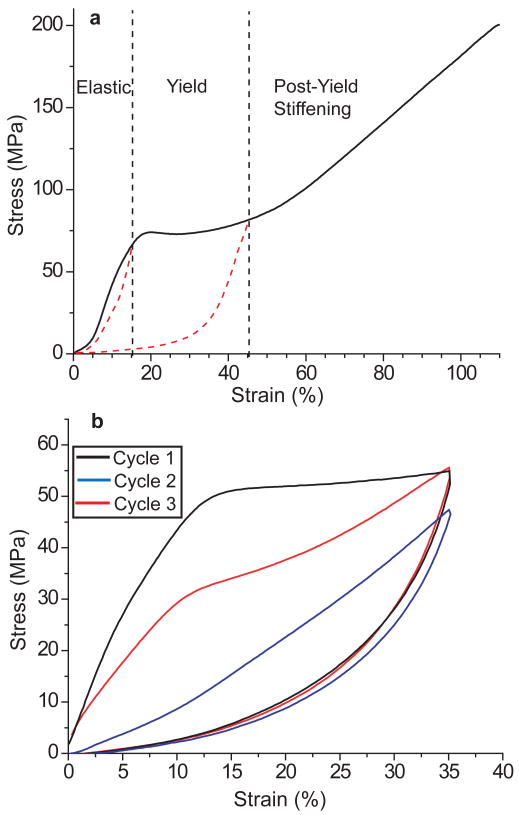
Figure 2. Mechanical performance of the distal portion of byssal threads under tensile load
a) Threads exhibit three well-defined mechanical regimes during loading. At low strain (<15%), threads behave quasi-elastically, similar to tendon, with a Young's modulus of 500-900 MPa and a resilience of nearly 90%. Between ∼15-45% strain, threads undergo mechanical yield at nearly constant load. After yield, stress increases dramatically until catastrophic failure at ∼100% strain. Red dashed lines represent typical return curves of threads cycled within the elastic and yield regimes. b) A single thread cyclically loaded three times with no rest after the first cycle and 1 h rest after the second. The second cycle illustrates the loss of stiffness and strain energy associated with yield, and the third cycle depicts the time-dependent self-healing of byssal threads.
Figure 3
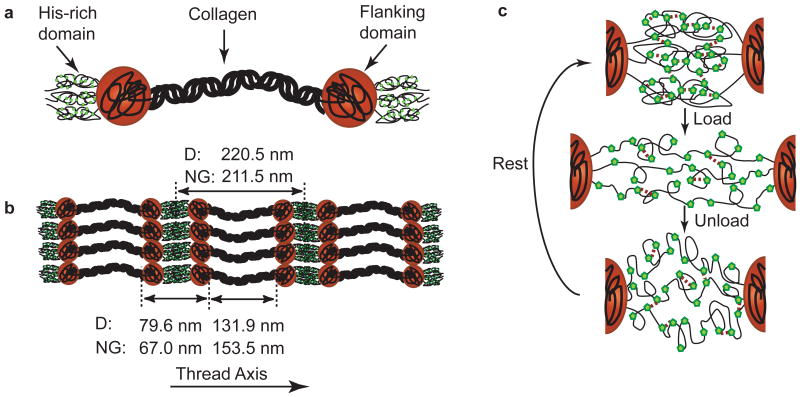
Figure 3. Schematic of preCol morphology, assembly, and behavior under load
a) PreCols are block co-polymer-like proteins with clearly defined modules including a central bent-core collagen domain, adjacent flanking domains, and terminal histidine-rich domains. The rigid rod-like collagen domains have a well-defined triple helical structure and make up about half of the protein by amino acid quantity. The flanking domains of preCol-D are reminiscent of dragline-silk and are likely more tightly folded than the glycine-rich domains of preCol-NG. His-rich domains at the N- and C-termini of preCols form coordination complexes with transition metals, which are believed to stabilize the domains. PreCol-D and -NG domain lengths were calculated based on sequence data and AFM measurements. b) PreCols are observed to assemble into highly ordered smectic arrays in series with C2 symmetry (Hassenkam et al., 2004). When tensile load is applied to threads, it is transferred along the long axial filaments of preCol. (c) illustrates a molecular level schematic model of His-dependent healing in threads. Green pentagons represent “sticky” His residues interspersed in the amorphous chains of the His-rich domains between two adjacent preCol triple helices. For simplicity of representation in the schematic, a cross-link is formed between two His residues; however, in reality a coordination cross-link would require 3-4 histidines as ligands. In the virgin state prior to applied yield, the His-rich domains are folded in such a way as to supply the largest amount of resistance under tensile load (highest stiffness). When extended past yield, many of the cross-links are ruptured, allowing the folded chains to extend and reveal hidden contour length. The sacrificial breaking of these bonds prevents catastrophic failure of the thread and provides the characteristic hysteretic behavior of the distal portion of byssal threads. When the load is removed, the His-rich domain returns to its initial length, but is not immediately refolded to the “ideal” state. Through stochastic vibrations of the His-rich chains, the His-residues eventually form stable cross-links and over time will recover to a stiff conformation.
Figure 4
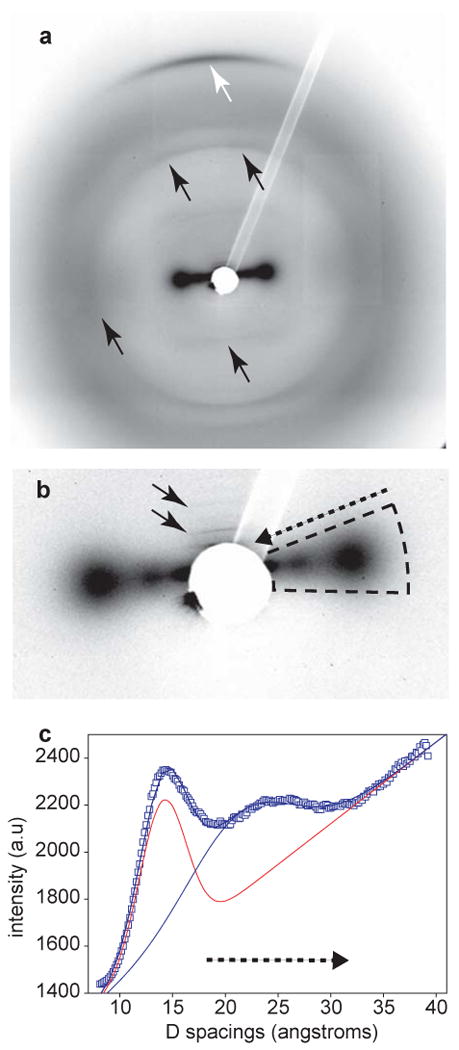
Figure 4. Typical WAXD pattern of thread at rest
a) 2D CCD X-ray image showing the helical reflection due to collagen (white arrow) and the reflections due to silk-like β-sheet structure (black arrows). To show the contributions from both collagen and silk-like structure more clearly, the small angle region is magnified in (b), where two distinct reflections along the equatorial (horizontal) direction are seen in the indicated sector. Solid black arrows indicate the meridional small angle X-ray scattering (SAXS) reflections. The equatorial features are shown quantitatively in (c), where integrated intensity profiles in the sector show two distinct peaks, one due to the intermolecular (wet) collagen spacing at ∼ 14 Å (Misof et al., 1997), and a second, broader one at ∼ 21 Å, which we tentatively identify as corresponding to the width of the micellar units in the silk like structure (Geddes et al., 1968).
Figure 5
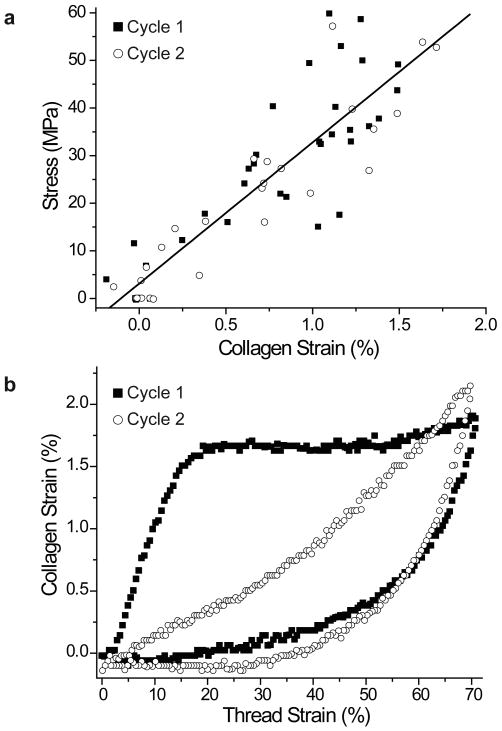
Figure 5. Collagen molecular strain during cyclic loading of byssal threads
a) Collagen strain values from both cycles of five thread specimens are plotted against thread stress. The black line indicates a linear regression curve of the data points (N=65, R2=0.80) and reveals that the collagen behaves elastically at thread strain values up to 70%. The Young's modulus of the collagen domain was determined from this plot to be 2.97±0.19 GPa (mean±s.e.m), and this value was used to convert thread stress values to derived instantaneous collagen strain values as seen in the representative sample in (b). Cycle 2 follows cycle 1 with little rest between.
Figure 6
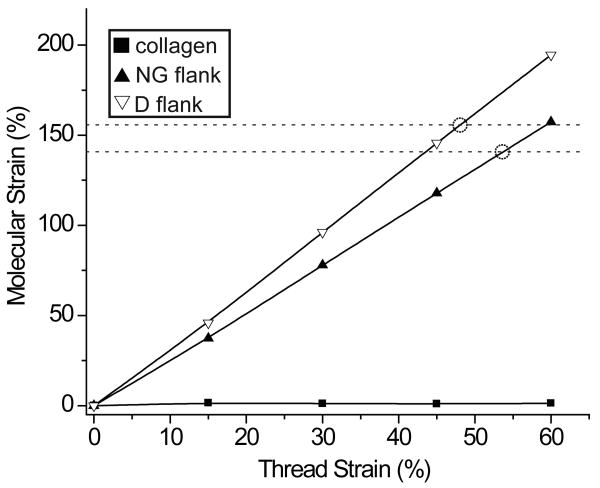
Figure 6. Calculated strain of preCol domains during thread elongation
This graph illustrates the predicted strain of the combined flanking and His-rich domains of a single preCol-NG or -D molecule during thread extension assuming a series model of preCol alignment and based on the calculated resting length of each. Horizontal dashed lines represent calculated maximal extension strains for the flanking/His-rich domains of preCol-NG and -D. The thread strain value at which the calculated molecular strain crosses the respective dashed line (indicated by a dashed circle) denotes the maximum possible thread strain following unraveling of the folded flank/His-rich domain of each particular preCol variant. Since threads are extensible to ∼100% strain, these calculations indicate that the extension of preCol domains can account half of this value. This suggests that higher order hierarchical structures must also play a role. The collagen strain calculated from the WAXD results is also included in the figure.
Figure 7
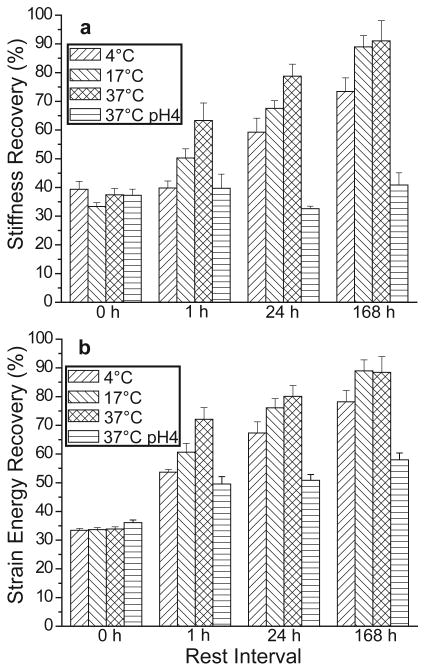
Figure 7. Percent recovery of stiffness and strain energy in threads rested at different temperatures/pH and different time intervals
Temperature has a significant effect on (a) stiffness and (b) strain energy healing rates after 1 h of rest that becomes less apparent at later time points. Treatment of threads at pH 4 largely inhibits recovery. (Values represent mean ± s.e.m.; n ranged from 17-20 threads for each time point).

References

    1. Aldred N, Wills T, Williams DN, Clare AS. Tensile and dynamic mechanical analysis of the distal portion of mussel (Mytilus edulis) byssal threads. J Roy Soc Interface. 2007;4:1159–1167. - PMC - PubMed
    1. Auld DS. Zinc coordination sphere in biochemical zinc sites. Biometals. 2001;14:271–313. - PubMed
    1. Bairati A, Zuccarello LV. The ultrastructure of the byssal apparatus of Mytilus galloprovincialis IV. Observation by transmission elctron microscopy. Cell Tiss Res. 1976;166:219–234. - PubMed
    1. Bell E, Gosline J. Mechanical design of mussel byssus: material yield enhances attachment strength. J Exp Biol. 1996;199:1005–1017. - PubMed
    1. Broomell CC, Mattoni MA, Zok FW, Waite JH. Critical role of zinc in hardening of Nereis jaws. J Exp Biol. 2006;209:3219–3225. - PMC - PubMed

Publication types