


ABO blood group and the risk of pancreatic cancer
- PMID: 19276450
- PMCID: PMC2657095
- DOI: 10.1093/jnci/djp020
ABO blood group and the risk of pancreatic cancer
Abstract
Background: Other than several rare, highly penetrant familial syndromes, genetic risk factors for sporadic pancreatic cancer are largely unknown. ABO blood type is an inherited characteristic that in previous small studies has been associated with the risk of gastrointestinal malignancies.
Methods: We separately examined the relationship between ABO blood type and the risk of incident pancreatic cancer in two large, independent, prospective cohort studies (the Nurses' Health Study and Health Professionals Follow-up Study) that collected blood group data on 107 503 US health professionals. Hazard ratios for pancreatic cancer by ABO blood type were calculated using Cox proportional hazards models with adjustment for other known risk factors, including age, tobacco use, body mass index, physical activity, and history of diabetes mellitus. All statistical tests were two-sided.
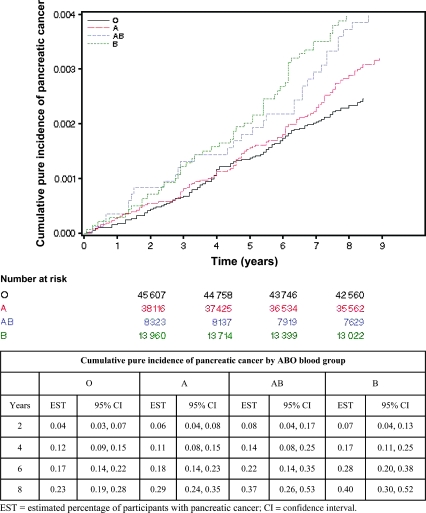
Results: During 927 995 person-years of follow-up, 316 participants developed pancreatic cancer. ABO blood type was associated with the risk of developing pancreatic cancer (P = .004; log-rank test). Compared with participants with blood group O, those with blood groups A, AB, or B were more likely to develop pancreatic cancer (adjusted hazard ratios for incident pancreatic cancer were 1.32 [95% confidence interval {CI} = 1.02 to 1.72], 1.51 [95% CI = 1.02 to 2.23], and 1.72 [95% CI = 1.25 to 2.38], respectively). The association between blood type and pancreatic cancer risk was nearly identical in the two cohorts (P(interaction) = .97). Overall, 17% of the pancreatic cancer cases were attributable to inheriting a non-O blood group (blood group A, B, or AB). The age-adjusted incidence rates for pancreatic cancer per 100 000 person-years were 27 (95% CI = 23 to 33) for participants with blood type O, 36 (95% CI = 26 to 50) for those with blood type A, 41 (95% CI = 31 to 56) for those with blood type AB, and 46 (95% CI = 32 to 68) for those with blood type B.
Conclusions: In two large, independent populations, ABO blood type was statistically significantly associated with the risk of pancreatic cancer. Further studies are necessary to define the mechanisms by which ABO blood type or closely linked genetic variants may influence pancreatic cancer risk.
Figures
Comment in
-
Re: ABO blood group and the risk of pancreatic cancer.J Natl Cancer Inst. 2009 Aug 19;101(16):1156; author reply 1156-7. doi: 10.1093/jnci/djp198. Epub 2009 Jul 10. J Natl Cancer Inst. 2009. PMID: 19592664 No abstract available.
-
Re: ABO blood group and the risk of pancreatic cancer.J Natl Cancer Inst. 2009 Sep 16;101(18):1285-6; author reply 1286-7. doi: 10.1093/jnci/djp249. Epub 2009 Aug 11. J Natl Cancer Inst. 2009. PMID: 19671773 No abstract available.
-
Re: ABO blood group and the risk of pancreatic cancer.J Natl Cancer Inst. 2010 Jan 20;102(2):135-7; author reply 137. doi: 10.1093/jnci/djp447. Epub 2009 Dec 17. J Natl Cancer Inst. 2010. PMID: 20019335 No abstract available.
References
-
- Jemal A, Siegel R, Ward E, et al. Cancer statistics, 2008. CA Cancer J Clin. 2008;58(2):71–96. - PubMed
-
- Fuchs CS, Colditz GA, Stampfer MJ, et al. A prospective study of cigarette smoking and the risk of pancreatic cancer. Arch Intern Med. 1996;156(19):2255–2260. - PubMed
-
- Li D, Xie K, Wolff R, Abbruzzese JL. Pancreatic cancer. Lancet. 2004;363(9414):1049–1057. - PubMed
-
- Schenk M, Schwartz AG, O’Neal E, et al. Familial risk of pancreatic cancer. J Natl Cancer Inst. 2001;93(8):640–644. - PubMed
-
- McWilliams RR, Rabe KG, Olswold C, De Andrade M, Petersen GM. Risk of malignancy in first-degree relatives of patients with pancreatic carcinoma. Cancer. 2005;104(2):388–394. - PubMed
Publication types
MeSH terms
Substances
Grants and funding
LinkOut - more resources
Full Text Sources
Medical
