


Using biological networks to search for interacting loci in genome-wide association studies
- PMID: 19277065
- PMCID: PMC2986645
- DOI: 10.1038/ejhg.2009.15
Using biological networks to search for interacting loci in genome-wide association studies
Abstract
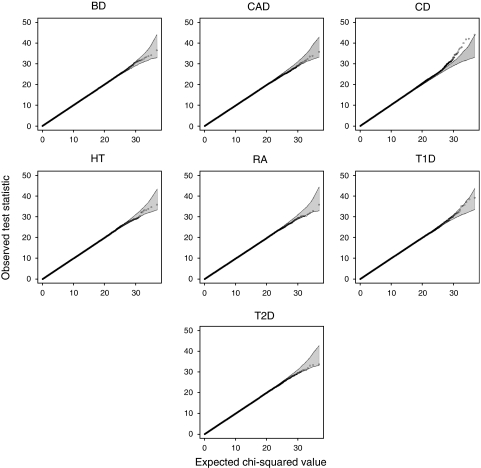
Genome-wide association studies have identified a large number of single-nucleotide polymorphisms (SNPs) that individually predispose to diseases. However, many genetic risk factors remain unaccounted for. Proteins coded by genes interact in the cell, and it is most likely that certain variants mainly affect the phenotype in combination with other variants, termed epistasis. An exhaustive search for epistatic effects is computationally demanding, as several billions of SNP pairs exist for typical genotyping chips. In this study, the experimental knowledge on biological networks is used to narrow the search for two-locus epistasis. We provide evidence that this approach is computationally feasible and statistically powerful. By applying this method to the Wellcome Trust Case-Control Consortium data sets, we report four significant cases of epistasis between unlinked loci, in susceptibility to Crohn's disease, bipolar disorder, hypertension and rheumatoid arthritis.
Figures

Comment in
-
From genotypes to genometypes: putting the genome back in genome-wide association studies.Eur J Hum Genet. 2009 Oct;17(10):1205-6. doi: 10.1038/ejhg.2009.39. Epub 2009 Mar 11. Eur J Hum Genet. 2009. PMID: 19277066 Free PMC article. No abstract available.
References
-
- Consortium International Human Genome Sequencing Initial sequencing and analysis of the human genome. Nature. 2001;409:860–921. - PubMed
-
- HapMap The International HapMap Project. Nature. 2003;426:789–796. - PubMed
-
- Marchini J, Donnelly P, Cardon LR. Genome-wide strategies for detecting multiple loci that influence complex diseases. Nat Genet. 2005;37:413–417. - PubMed
Publication types
MeSH terms
LinkOut - more resources
Full Text Sources
Other Literature Sources
