. 2009 May;296(5):F976-82.
doi: 10.1152/ajprenal.90391.2008. Epub 2009 Mar 11.

Renal NMDA receptors independently stimulate proximal reabsorption and glomerular filtration

Affiliations

Renal NMDA receptors independently stimulate proximal reabsorption and glomerular filtration

Aihua Deng et al. Am J Physiol Renal Physiol. 2009 May.

Abstract

N-methyl-D-aspartate receptors (NMDA) are expressed in the kidney, where little is known of their functional role. Several series of micropuncture experiments were performed in hydropenic rats using the NMDA channel blocker, MK801, and the NMDA coagonist, L-glycine, to probe NMDA for effects on single-nephron glomerular filtration rate (SNGFR) and proximal reabsorption (J(prox)). During intravenous infusion of MK801 or L-glycine, Henle's loop was perfused to manipulate SNGFR via tubuloglomerular feedback (TGF), thereby facilitating analysis of glomerulotubular balance. To confirm local actions on the kidney, MK801 was delivered to the glomerulus by microperfusion past the macula densa and to the proximal tubule by microperfusion into the early S1 segment. By all measures, MK801 acted on the glomerulus to reduce SNGFR, and acted on the proximal tubule to suppress J(prox), while having no effect on the responsiveness of TGF. L-Glycine raised SNGFR, dampened the TGF response, and could not be proved to independently stimulate proximal reabsorption. NMDA exerts a tonic vasodilatory influence on the glomerulus and a proreabsorptive effect on the proximal tubule. These combined effects allow NMDA to modulate SNGFR with minimal impact on late proximal flow. The full effects of L-glycine infusion on proximal tubule and TGF response do not extrapolate from the response to NMDA blockade.


Figures
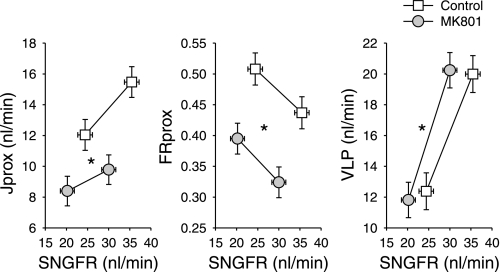
Fig. 1.
Fig. 1.
Effects of systemically infused MK801 on single-nephron glomerular filtration rate (SNGFR; abcissa) and net proximal reabsorption (Jprox; ordinate). This representation is designed to reveal effects on the tubule that are independent of SNGFR. Such effects are “primary tubular effects” and represented by a vertical displacement in the relationship between a given variable and SNGFR. Primary tubular effects are confirmed using ANCOVA with SNGFR and state of tubuloglomerular feedback (TGF) activation as covariates. To test the tubule over a range of SNGFR in each nephron, SNGFR was manipulated by perfusing Henle's loop at 0 or 40 nl/min to activate TGF. FRprox, fractional proximal reabsorption; VLP, late proximal flow. *P < 0.0005 for a “primary effect” of MK801 on Jprox, FRprox, or VLP.
Fig. 2.
Fig. 2.
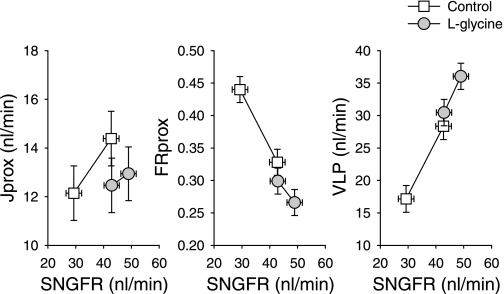
Effects of l-glycine infusion on the proximal tubule. The purpose of this representation is to reveal primary effects on Jprox, which appear as vertical shifts in the relationship between SNGFR and some index of Jprox. Most of the increase in VLP during glycine infusion appears to result from the increase in SNGFR. But the minor component due to owing to the primary decrease in Jprox was statistically significant (P < 0.001).
Fig. 3.
Fig. 3.
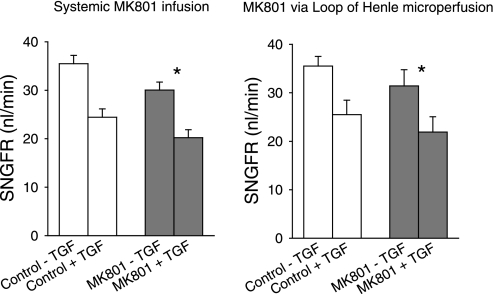
Effect of MK801 on SNGFR. Left: MK801 was delivered intravenously and the loop of Henle was perfused with artificial tubular fluid at 0 or 40 nl/min to probe the extremes of TGF. Right: MK801 was delivered by orthograde microperfusion of Henle's loop at 8 or 40 nl/min. MK801 reduced SNGFR by similar amounts regardless of its route of administration and regardless of the state of TGF activation. MK801 had no effect on the maximum TGF response. *P < 0.05 for the effect of MK801 on SNGFR.
Fig. 4.
Fig. 4.
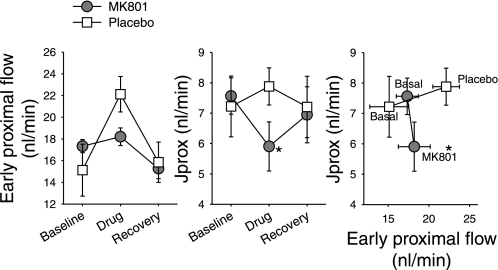
Effect of MK801 on early proximal flow rate and Jprox when added to free flowing early S1 segment at 5 nl/min. Three collections were done in each nephron: baseline, drug perfusion (MK801 or placebo), and recovery. MK801 decreased SNGFR so adding it at 5 nl/min had no effect on early proximal flow. Therefore, we can conclude that MK801 suppresses Jprox independent of the early proximal flow rate. Right: only the first 2 collections. *P < 0.008 for effect of MK801 on Jprox by repeated-measures ANOVA.
Fig. 5.
Fig. 5.
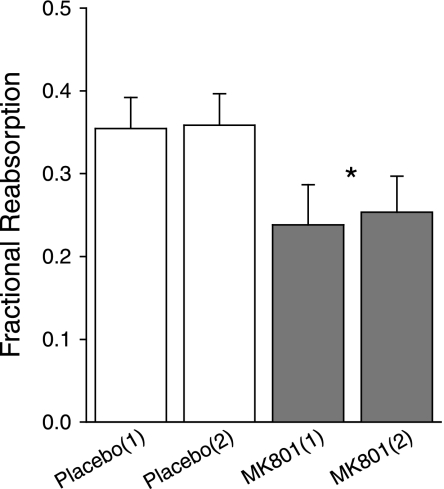
Controlled perfusion from the early S1 segment at 20 nl/min with late proximal collection. Four collections were made from each nephron. The first 2 collections were made during perfusion with placebo and the last 2 with MK801 (1 μM). MK801 suppressed reabsorption while stability of repeated collections serves as time control (*P < 0.001 for effect of MK801 by repeated-measures ANOVA; n = 18 nephrons in 5 rats).
Fig. 6.
Fig. 6.
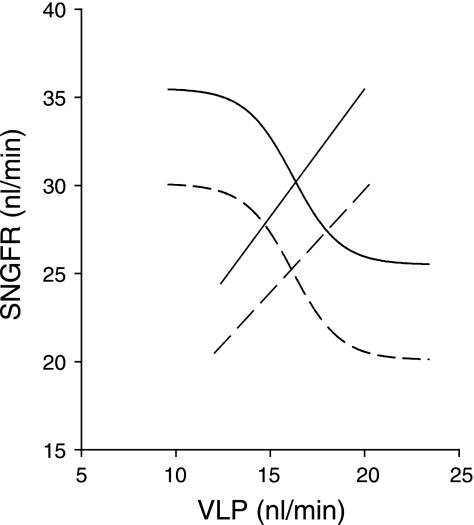
Hypothetical effect of N-methyl-d-aspartate receptor (NMDA-R) on operating point of the nephron. Solid, control; dashed, systemic NMDA-R blockade. Rightward shift in glomerulotubular balance (GTB) relationship reflects the primary effect of MK801 on the tubule. Downward shift in the TGF curve reflects primary effect of MK801 on SNGFR. Computed using GTB relationships and the minima and maxima for the TGF curves from the present data. Other features of the TGF curve computed assuming open loop gain of 2 for the TGF system and that operating point aligns with TGF inflection point (24). Accounting for dual primary effects of MK801 on glomerulus and proximal tubule reveals that the combination allows SNGFR to change while ambient VLP remains nearly constant.

References

    1. Blantz RC, Tucker BJ. Measurements of glomerular dynamics. In: Methods in Pharmacology, edited by Martinez-Maldonado M. New York: Plenum, 1978, p. 141–163.
    1. Deng A, Valdivielso JM, Munger KA, Blantz RC, Thomson SC. Vasodilatory N-methyl-d-aspartate receptors are constitutively expressed in rat kidney. J Am Soc Nephrol 13: 1381–1384, 2002. - PubMed
    1. De Nicola L, Blantz RC, Gabbai FB. Nitric oxide and angiotensin II. Glomerular and tubular interaction in the rat. J Clin Invest 89: 1248–1256, 1992. - PMC - PubMed
    1. De Nicola L, Blantz RC, Gabbai FB. Renal functional reserve in the early stage of experimental diabetes. Diabetes 41: 267–273, 1992. - PubMed
    1. De Nicola L, Blantz RC, Gabbai FB. Renal functional reserve in treated and untreated hypertensive rats. Kidney Int 40: 406–412, 1991. - PubMed

Publication types

MeSH terms

Substances

LinkOut - more resources