. 2009 Mar 31;106(13):5181-6.
doi: 10.1073/pnas.0812889106. Epub 2009 Mar 11.

An embryonic stem cell chromatin remodeling complex, esBAF, is essential for embryonic stem cell self-renewal and pluripotency

Affiliations

An embryonic stem cell chromatin remodeling complex, esBAF, is essential for embryonic stem cell self-renewal and pluripotency

Lena Ho et al. Proc Natl Acad Sci U S A. .

Abstract

Mammalian SWI/SNF [also called BAF (Brg/Brahma-associated factors)] ATP-dependent chromatin remodeling complexes are essential for formation of the totipotent and pluripotent cells of the early embryo. In addition, subunits of this complex have been recovered in screens for genes required for nuclear reprogramming in Xenopus and mouse embryonic stem cell (ES) morphology. However, the mechanism underlying the roles of these complexes is unclear. Here, we show that BAF complexes are required for the self-renewal and pluripotency of mouse ES cells but not for the proliferation of fibroblasts or other cells. Proteomic studies reveal that ES cells express distinctive complexes (esBAF) defined by the presence of Brg (Brahma-related gene), BAF155, and BAF60A, and the absence of Brm (Brahma), BAF170, and BAF60C. We show that this specialized subunit composition is required for ES cell maintenance and pluripotency. Our proteomic analysis also reveals that esBAF complexes interact directly with key regulators of pluripotency, suggesting that esBAF complexes are specialized to interact with ES cell-specific regulators, providing a potential explanation for the requirement of BAF complexes in pluripotency.


Conflict of interest statement

The authors declare no conflict of interest.

Figures
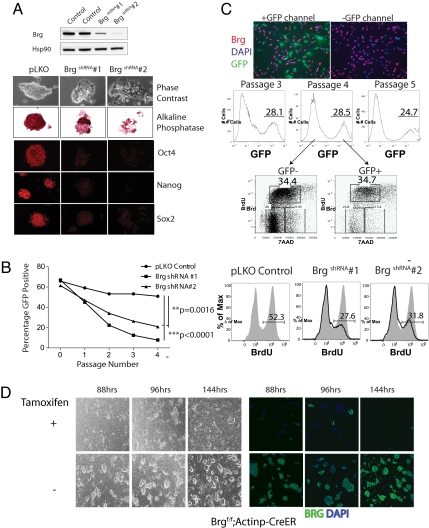
Fig. 1.
Fig. 1.
Brg is essential for ES cell self-renewal and proliferation. (A) Immunoblotting of Brg and housekeeping gene Hsp90 protein levels 96 h after transduction of E14 ES cells with shRNA constructs (BrgshRNA#1 and Brg shRNA#2) compared with pLKO control. Colony morphology and alkaline phosphatase, Oct4, Nanog, and Sox staining of BrgshRNA ES cells 10 days following transduction of shRNA contructs. (B Left) Day 3- transduced ES cells (GFP+) were mixed with non-transduced ES cells at a 3:2 ratio. The co-cultures were passaged every 2 d, and the percentage of GFP+ cells (mean value ± SD; p-values by student's t test) was determined by flow cytometry. (Right) BrdU incorporation 96 h following transduction in (A). (C) Brglox/lox primary MEFs were transfected with Cre to mediate deletion of Brg. GFP+ marks transfected and deleted MEF cells (Top). Immunofluorescence for Brg protein. (Middle) Mixed cultures (GFP±) then were passaged serially over 5 d, and BrdU incorporation was performed on passage 4 MEFs (Bottom). (D) Colony morphology of Brglox/lox;Actinp-CreER+ ES cells over a timecourse after addition of either tamoxifen or ethanol vehicle control. (Left) Brightfield and (Right) immunofluorescence for Brg.
Fig. 2.
Fig. 2.
Endogenous BAF complexes in ES cells have a distinctive subunit composition. (A) Endogenous BAF complexes were affinity purified from E14 ES cells and primary MEFs with an anti-Brg/Brm antibody (J1) and were subjected to tandem mass spectrometry. (Left) Immunoblotting of whole nuclear extracts using J1 antibody; (Right) silver stain analysis of purified complexes. (B) Summary of numbers of common and cell-type specific proteins that co-purified with Brg/Brm in ES cells, MEFs, and P0 mouse brain (neurons/neuronal progenitors). Proteins detected in all 3 samples include novel and known components of BAF complexes. A protein is considered specific to a cell type only if it has a probability of 0 in all other cell types. (C) Heatmap of the relative abundance of each BAF component across the 3 cell types, as measured by spectral quantitation. N/Np = neurons/neuronal progenitors; yellow = most abundant of 3 cell types; blue = least abundant. (D) Subunit composition of esBAF from analysis in (C). Numbers indicate BAF subunits (i.e., 155 = BAF155).
Fig. 3.
Fig. 3.
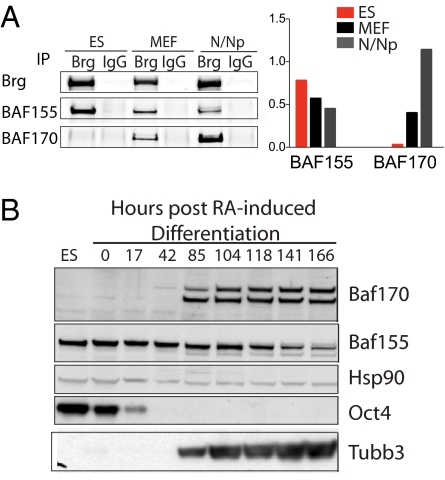
BAF155 and BAF170 developmental switch. (A) Quantitative immunoblotting of J1-purified complexes from ES cells, MEFs, and P0 brain (N/Np) for BAF155 and BAF170 (Left). Levels of 2 proteins were normalized to levels of Brg for comparison between the 3 cell types (Right). (B) Immunoblotting of whole-cell extracts from ES cells treated with RA under nonadherent growth conditions without leukemia inhibitory factor for the indicated time points.
Fig. 4.
Fig. 4.
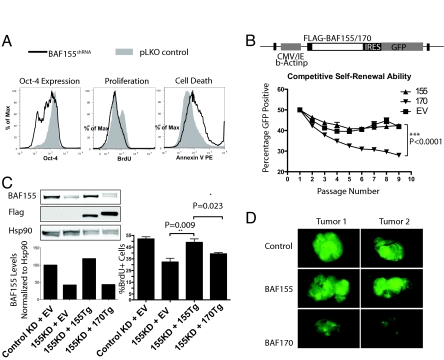
ES cells require a specific esBAF composition with respect to BAF155 and BAF170. (A) ES cells were transfected with BAF155 shRNA or pLKO control constructs. After 96 h, Oct4 protein levels, cell cycle status, and cell death were determined by flow cytometry. (B) BAF155 (155), flag-BAF170 (170), or control EV-transduced GFP+ cells were mixed with nontransduced E14 ES cells at a 1:1 ratio and were passaged every 2 d. The percentage of GFP+ cells (mean ± SD, p value from Student's t test) was determined by flow cytometry. (C) ES cells first were transduced with BAF155 transgene (Tg), BAF170 Tg, or EV controls as in (B). Stable cell lines were then transfected or transduced with control shRNA construct or shRNA construct targeting the 3′ UTR of endogenous BAF155 (BAF155KD) but not BAF155Tg. (Left) Resulting levels of BAF155 protein were normalized to Hsp90. (Right) Proliferation subsequently was assayed by BrdU incorporation (mean ± SD, indicated p-values from t test). (D) Teratomas from BAF155, BAF170, or EV-transduced GFP+ ES cells formed for 30 d in SCID mice.
Fig. 5.
Fig. 5.
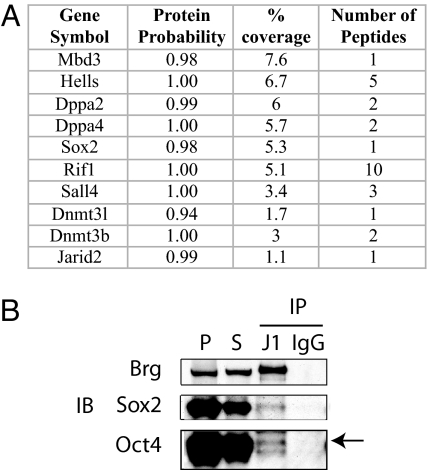
esBAF interacting proteins. (A) Examples of proteins detected to interact with esBAF complexes. (B) Co-immunoprecipitation of Brg (J1 IP and control IgG IP) with Oct4 and Sox2 on chromatin. P = positive control; S = input. The arrow indicates the band for Oct4 protein.

References

    1. Kim J, Chu J, Shen X, Wang J, Orkin SH. An extended transcriptional network for pluripotency of embryonic stem cells. Cell. 2008;132(6):1049–1061. - PMC - PubMed
    1. Boyer LA, et al. Core transcriptional regulatory circuitry in human embryonic stem cells. Cell. 2005;122(6):947–956. - PMC - PubMed
    1. Jiang J, et al. A core Klf circuitry regulates self-renewal of embryonic stem cells. Nat Cell Biol. 2008;10(3):353–360. - PubMed
    1. Boyer L, et al. Polycomb complexes repress developmental regulators in murine embryonic stem cells. Nature. 2006;441(7091):349–353. - PubMed
    1. Chamberlain SJ, Yee D, Magnuson T. Polycomb repressive complex 2 is dispensable for maintenance of embryonic stem cell pluripotency. Stem Cells. 2008;26:1496–1505. - PMC - PubMed

Publication types

MeSH terms