


C-reactive protein correlates with tissue oxygen availability in patients with stable COPD
- PMID: 19281089
- PMCID: PMC2650602
- DOI: 10.2147/copd.s3819
C-reactive protein correlates with tissue oxygen availability in patients with stable COPD
Abstract
Background: Arterial oxygen tension, oxygen delivery to tissue, and systemic inflammation are recognized as pivotal factors in the progression of chronic obstructive pulmonary disease (COPD). However, interconnections between systemic inflammation and tissue oxygen availability are scantly investigated. Tissue oxygen availability depends on arterial PaO2, oxygen concentration, hemoglobin oxygen affinity (P50), and hemoglobin oxygen binding capacity (ceHb). As the integrated changes of those indices are summarized by oxygen extraction tension (PaO2x), the objective of this study was to explore the association between C-reactive protein (CRP) blood levels and either PaO2x or each of its determinants, in stable COPD.
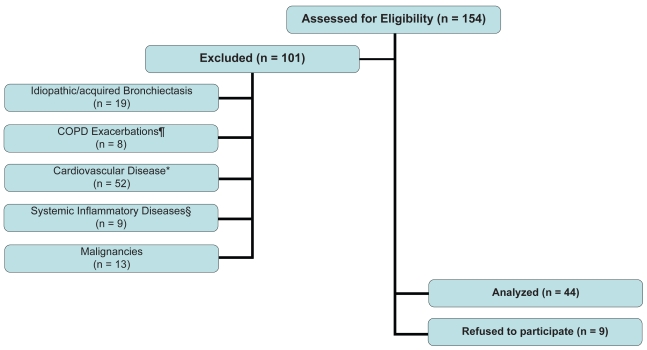
Materials and methods: Blood CRP and oxygen status of arterial blood were measured at rest while breathing room air in 44 moderate to severe stable COPD patients. PaO2x was calculated along the shape of oxygen binding curve as the oxygen tension resulting from removal of 2.3 mmol of oxygen per liter of blood. Multiple linear regression analysis was performed with PaO2, ceHb, and P50 as independent variables, and CRP as the dependent variable, adjusting for age and sex. The analysis was repeated using PaO2x as a sole independent variable.
Results: Multiple linear regression analysis indicated that ceHb, PaO2, and P50, were significant and independent predictors of CRP (R2 = 0.52, p < 0.0001). PaO2x alone was an even stronger predictor of CRP (R2 = 0.62, p < 0.0001).
Conclusions: These findings indicate that physiological determinants of tissue oxygen availability are independently associated with CRP blood levels. Thus, improvement of tissue oxygen availability is a central therapeutic option to modulate the severity of systemic inflammatory processes in patients with COPD.
Figures
References
-
- Agustí AGN, Noguera A, Sauleda J, et al. Systemic effects of chronic obstructive pulmonary disease. Eur Respir J. 2003;21:347–60. - PubMed
-
- [ATS] American Thoracic Society. Single-breath carbon monoxide diffusing capacity (transfer factor). Recommendations for a standard technique-1995 update. Am J Respir Crit Care Med. 1995;152:2185–98. - PubMed
-
- Burrows B, Kettel LJ, Niden AH, et al. Patterns of cardiovascular dysfunction in chronic obstructive lung disease. N Engl J Med. 1972;27:912–8. - PubMed
-
- Celli BR, Cote CG, Marin JM, et al. The body-mass index, airflow obstruction, dyspnea, and exercise capacity index in chronic obstructive pulmonary disease. N Engl J Med. 2004;350:1005–12. - PubMed
MeSH terms
Substances
LinkOut - more resources
Full Text Sources
Medical
Research Materials
Miscellaneous
