


Antiretroviral therapy adherence, virologic and immunologic outcomes in adolescents compared with adults in southern Africa
- PMID: 19282780
- PMCID: PMC2674125
- DOI: 10.1097/QAI.0b013e318199072e
Antiretroviral therapy adherence, virologic and immunologic outcomes in adolescents compared with adults in southern Africa
Abstract
Objective: To determine adherence to and effectiveness of antiretroviral therapy (ART) in adolescents vs. adults in southern Africa.
Design: Observational cohort study.
Setting: Aid for AIDS, a private sector disease management program in southern Africa.
Subjects: Adolescents (age 11-19 years; n = 154) and adults (n = 7622) initiating ART between 1999 and 2006 and having a viral load measurement within 1 year after ART initiation.
Main outcome measures: Primary: virologic suppression (HIV viral load < or = 400 copies/mL), viral rebound, and CD4 T-cell count at 6, 12, 18, and 24 months after ART initiation. Secondary: adherence assessed by pharmacy refills at 6, 12, and 24 months. Multivariate analyses: loglinear regression and Cox proportional hazards.
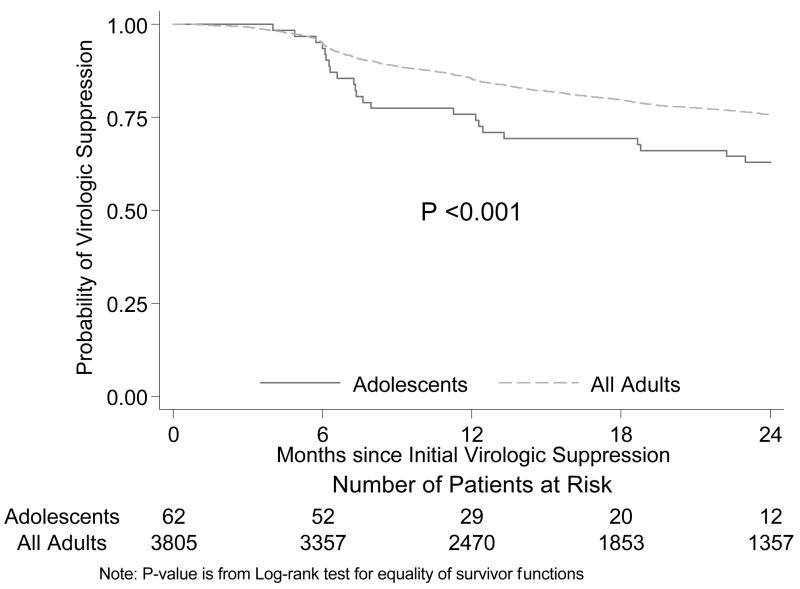
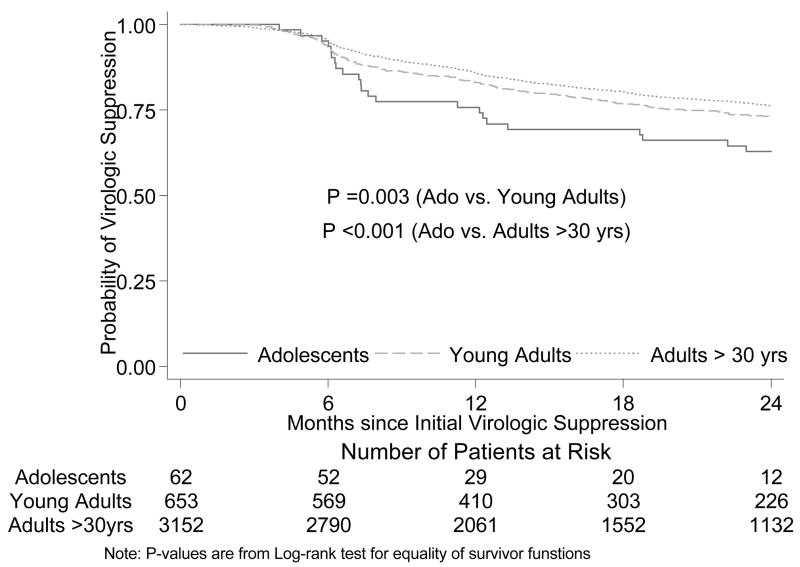
Results: A significantly smaller proportion of adolescents achieved 100% adherence at each time point (adolescents: 20.7% at 6 months, 14.3% at 12 months, and 6.6% at 24 months; adults: 40.5%, 27.9%, and 20.6% at each time point, respectively; P < 0.01). Patients achieving 100% 12-month adherence were significantly more likely to exhibit virologic suppression at 12 months, regardless of age. However, adolescents achieving virologic suppression had significantly shorter time to viral rebound (adjusted hazard ratio 2.03; 95% confidence interval: 1.31 to 3.13; P < 0.003). Adolescents were less likely to experience long-term immunologic recovery despite initial CD4 T-cell counts comparable to adults.
Conclusions: Compared with adults, adolescents in southern Africa are less adherent to ART and have lower rates of virologic suppression and immunologic recovery and a higher rate of virologic rebound after initial suppression. Studies must determine specific barriers to adherence in this population and develop appropriate interventions.
Conflict of interest statement
Conflict of interest
Figures
References
-
- Markowitz M, Conant M, Hurley A, et al. A preliminary evaluation of nelfinavir mesylate, an inhibitor of human immunodeficiency virus (HIV)–1 protease, to treat HIV infection. J Infect Dis. 1998;177:1533–1540. - PubMed
-
- Markowitz M, Saag M, Powderly WG, et al. A preliminary study of ritonavir, an inhibitor of HIV-1 protease, to treat HIV-1 infection. N Engl J Med. 1995;333:1534–1539. - PubMed
-
- Hirsch M, Steigbigel R, Staszewski S, et al. A randomized, controlled trial of indinavir, zidovudine, and lamivudine in adults with advanced human immunodeficiency virus type 1 infection and prior antiretroviral therapy. J Infect Dis. 1999;180:659–665. - PubMed
-
- Staszewski S, Morales-Ramirez J, Tashima KT, et al. for the Study 006 Team. Efavirenz plus zidovudine and lamivudine, efavirenz plus indinavir, and indinavir plus zidovudine and lamivudine in the treatment of HIV-1 infection in adults. N Engl J Med. 1999;341:1865–1873. - PubMed
-
- Starr SE, Fletcher CV, Spector SA, et al. for the Pediatric AIDS Clinical Trials Group 382 Team. Combination therapy with efavirenz, nelfinavir, and nucleoside reverse-transcriptase inhibitors in children infected with human immunodeficiency virus type 1. N Engl J Med. 1999;341:1874–1881. - PubMed
Publication types
MeSH terms
Substances
Grants and funding
LinkOut - more resources
Full Text Sources
Medical
Research Materials
