. 2009 Mar;5(3):e1000305.
doi: 10.1371/journal.pcbi.1000305. Epub 2009 Mar 13.

Timing the emergence of resistance to anti-HIV drugs with large genetic barriers

Affiliations

Timing the emergence of resistance to anti-HIV drugs with large genetic barriers

Pankhuri Arora et al. PLoS Comput Biol. 2009 Mar.

Abstract

New antiretroviral drugs that offer large genetic barriers to resistance, such as the recently approved inhibitors of HIV-1 protease, tipranavir and darunavir, present promising weapons to avert the failure of current therapies for HIV infection. Optimal treatment strategies with the new drugs, however, are yet to be established. A key limitation is the poor understanding of the process by which HIV surmounts large genetic barriers to resistance. Extant models of HIV dynamics are predicated on the predominance of deterministic forces underlying the emergence of resistant genomes. In contrast, stochastic forces may dominate, especially when the genetic barrier is large, and delay the emergence of resistant genomes. We develop a mathematical model of HIV dynamics under the influence of an antiretroviral drug to predict the waiting time for the emergence of genomes that carry the requisite mutations to overcome the genetic barrier of the drug. We apply our model to describe the development of resistance to tipranavir in in vitro serial passage experiments. Model predictions of the times of emergence of different mutant genomes with increasing resistance to tipranavir are in quantitative agreement with experiments, indicating that our model captures the dynamics of the development of resistance to antiretroviral drugs accurately. Further, model predictions provide insights into the influence of underlying evolutionary processes such as recombination on the development of resistance, and suggest guidelines for drug design: drugs that offer large genetic barriers to resistance with resistance sites tightly localized on the viral genome and exhibiting positive epistatic interactions maximally inhibit the emergence of resistant genomes.


Conflict of interest statement

The authors have declared that no competing interests exist.

Figures
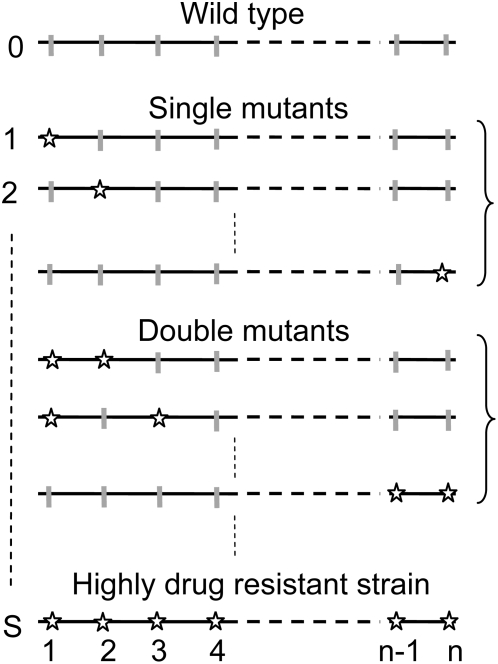
Figure 1
Figure 1. Schematic representation of the S viral genomes carrying different combinations of resistance mutations (stars) that emerge during the development of resistance to a drug with a genetic barrier n.
Figure 2
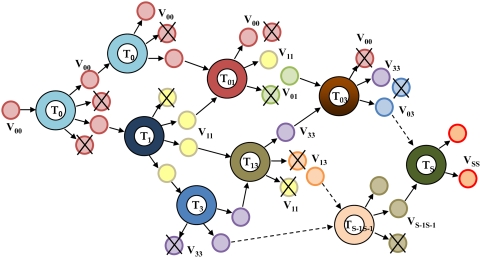
Figure 2. Schematic representation of the infection network indicating the various singly and doubly infected cells, Ti and Tij, and homozygous and heterozygous virions, Vii and Vij, respectively, that emerge during the development of drug resistance.
Non-infectious virions are crossed.
Figure 3
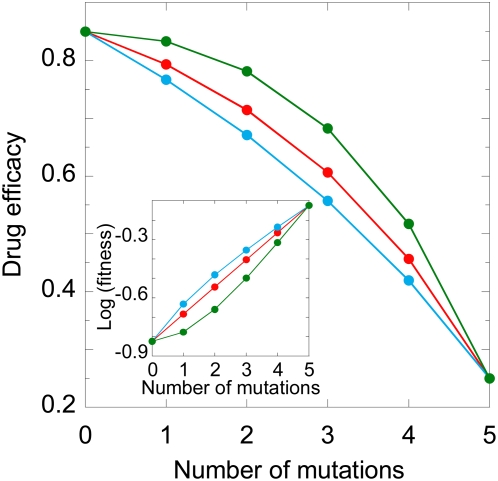
Figure 3. Efficacy, εm, of a genome carrying m (0≤mn) resistance mutations, when the genetic barrier n = 5, ε0 = 0.85, εn = 0.25, and the epistasis, E = 0.005 (green), 0 (red), and −0.005 (blue).
The inset shows the corresponding fitness ( = 1−εm) profiles.
Figure 4
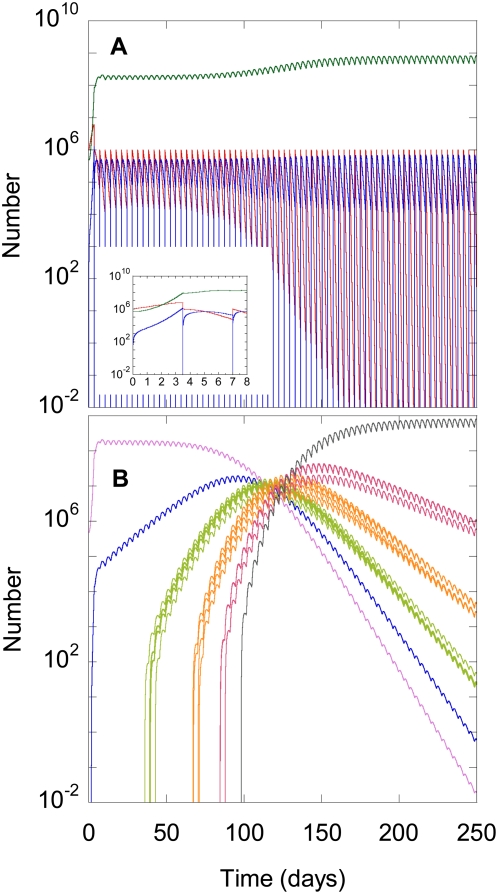
Figure 4. Model predictions of cell and viral dynamics.
The time evolution of (A) the number of uninfected cells (red), infected cells (blue), and infectious virions (green) and (B) homozygous virions carrying wild-type genomes (pink) and single (blue), double (green), triple (orange), quadruple (red), and quintuple (black) mutants, obtained by solving Eqs. (1)–(9) with the parameters T 0 = 106 cells, V 00 = 5×10⁵ virions, n = 5, l = 100 nucleotides, and εm from Figure 3 with E = 0. The remaining parameters are listed in Methods. The inset in (A) shows the evolution for the first two passages.
Figure 5
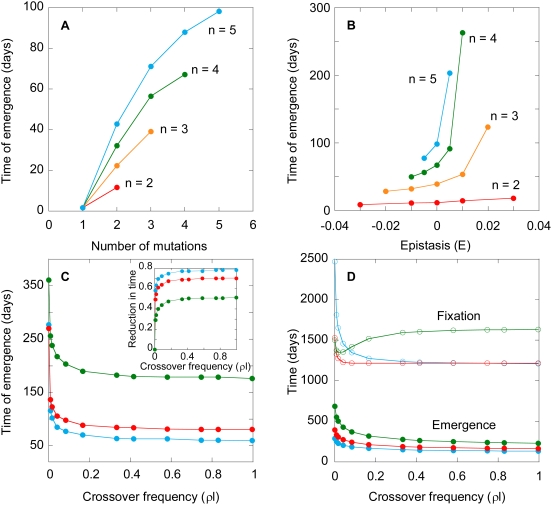
Figure 5. Model predictions of emergence and fixation times.
The expected waiting time for the emergence of (A) genomes with different numbers of resistance mutations for different n when E = 0, (B) the corresponding n th mutants as a function of E, (C) quintuple mutants when n = 5 as a function of the crossover frequency (ρl), for E = 0.005 (green), 0 (red), −0.005 (blue). The inset in (C) shows the corresponding reduction in the time of emergence, 1−W(ρl)/W(ρl = 0). (D) Model predictions of emergence (filled symbols) and fixation (open symbols) times of double mutants when n = 2 and E = 0.05 (green), 0 (red), −0.05 (blue). In (A) to (C), we let ε0 = 0.85 and εn = 0.25, whereas in (D) ε0 = 0.1 and εn = 0. All the other parameters are identical to those in Figure 4.
Figure 6
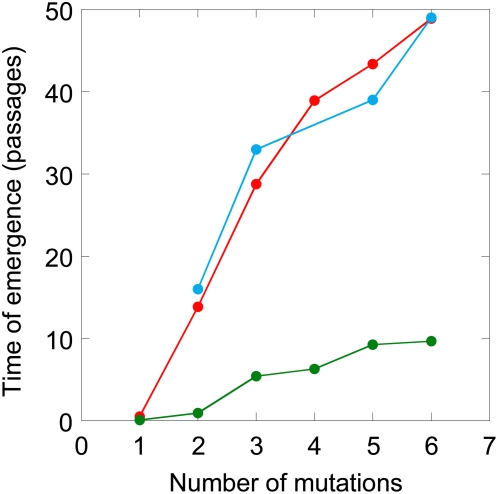
Figure 6. Comparison of model predictions (red) and the experimentally observed (blue) times of emergence of different mutants resistant to tipranavir.
The different mutants and the corresponding IC 50 values are listed in Table S1. Also shown are the times when the numbers of the different mutant proviruses first reach 1 (green) predicted by our model when, following current models ,, we assume that the waiting times wi = 0.

References

    1. Clavel F, Hance AJ. HIV drug resistance. N Engl J Med. 2004;350:1023–1035. - PubMed
    1. Johnson VA, Brun-Vezinet F, Clotet B, Gunthard HF, Kuritzkes DR, et al. Update of the drug resistance mutations in HIV-1: Spring 2008. Top HIV Med. 2008;16:62–68. - PubMed
    1. Perelson AS, Neumann AU, Markowitz M, Leonard JM, Ho DD. HIV-1 dynamics in vivo: virion clearance rate, infected cell life-span, and viral generation time. Science. 1996;271:1582–1586. - PubMed
    1. Mansky LM, Temin HM. Lower in-vivo mutation-rate of human-immunodeficiency-virus type-1 than that predicted from the fidelity of purified reverse-transcriptase. J Virol. 1995;69:5087–5094. - PMC - PubMed
    1. Jetzt AE, Yu H, Klarmann GJ, Ron Y, Preston BD, et al. High rate of recombination throughout the human immunodeficiency virus type 1 genome. J Virol. 2000;74:1234–1240. - PMC - PubMed

Publication types

Substances