


High-throughput mutational analysis of TOR1A in primary dystonia
- PMID: 19284587
- PMCID: PMC2661056
- DOI: 10.1186/1471-2350-10-24
High-throughput mutational analysis of TOR1A in primary dystonia
Abstract
Background: Although the c.904_906delGAG mutation in Exon 5 of TOR1A typically manifests as early-onset generalized dystonia, DYT1 dystonia is genetically and clinically heterogeneous. Recently, another Exon 5 mutation (c.863G>A) has been associated with early-onset generalized dystonia and some DeltaGAG mutation carriers present with late-onset focal dystonia. The aim of this study was to identify TOR1A Exon 5 mutations in a large cohort of subjects with mainly non-generalized primary dystonia.
Methods: High resolution melting (HRM) was used to examine the entire TOR1A Exon 5 coding sequence in 1014 subjects with primary dystonia (422 spasmodic dysphonia, 285 cervical dystonia, 67 blepharospasm, 41 writer's cramp, 16 oromandibular dystonia, 38 other primary focal dystonia, 112 segmental dystonia, 16 multifocal dystonia, and 17 generalized dystonia) and 250 controls (150 neurologically normal and 100 with other movement disorders). Diagnostic sensitivity and specificity were evaluated in an additional 8 subjects with known DeltaGAG DYT1 dystonia and 88 subjects with DeltaGAG-negative dystonia.
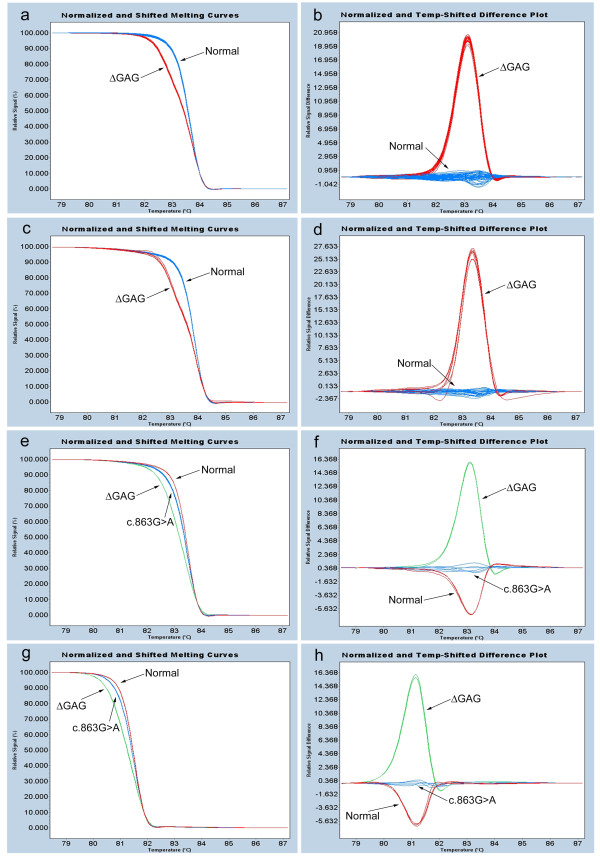
Results: HRM of TOR1A Exon 5 showed high (100%) diagnostic sensitivity and specificity. HRM was rapid and economical. HRM reliably differentiated the TOR1A DeltaGAG and c.863G>A mutations. Melting curves were normal in 250/250 controls and 1012/1014 subjects with primary dystonia. The two subjects with shifted melting curves were found to harbor the classic DeltaGAG deletion: 1) a non-Jewish Caucasian female with childhood-onset multifocal dystonia and 2) an Ashkenazi Jewish female with adolescent-onset spasmodic dysphonia.
Conclusion: First, HRM is an inexpensive, diagnostically sensitive and specific, high-throughput method for mutation discovery. Second, Exon 5 mutations in TOR1A are rarely associated with non-generalized primary dystonia.
Figures
References
-
- Fahn S, Marsden CD, Calne DB. Classification and investigation of dystonia. In: Marsden CD, Fahn S, editor. Movement disorders 2. London: Butterworths; 1987. pp. 332–358.
-
- Fahn S. Concept and classification of dystonia. Adv Neurol. 1988;50:1–8. - PubMed
-
- Fahn S, Bressman SB, Marsden CD. Classification of dystonia. Adv Neurol. 1998;78:1–10. - PubMed
-
- Duane DD. Spasmodic torticollis: clinical and biologic features and their implications for focal dystonia. Adv Neurol. 1988;50:473–492. - PubMed
Publication types
MeSH terms
Substances
Grants and funding
LinkOut - more resources
Full Text Sources
