Review
. 2009 Mar 13;380(3):431-6.
doi: 10.1016/j.bbrc.2009.01.136. Epub 2009 Jan 27.

Poly(C)-binding proteins as transcriptional regulators of gene expression

Affiliations
Review

Poly(C)-binding proteins as transcriptional regulators of gene expression

Hack Sun Choi et al. Biochem Biophys Res Commun. .

Abstract

Poly(C)-binding proteins (PCBPs) are generally known as RNA-binding proteins that interact in a sequence-specific fashion with single-stranded poly(C). They can be divided into two groups: hnRNP K and PCBP1-4. These proteins are involved mainly in various posttranscriptional regulations (e.g., mRNA stabilization or translational activation/silencing). In this review, we summarize and discuss how PCBPs act as transcriptional regulators by binding to specific elements in gene promoters that interact with the RNA polymerase II transcription machinery. Transcriptional regulation of PCBPs might itself be regulated by their localization within the cell. For example, activation by p21-activated kinase 1 induces increased nuclear retention of PCBP1, as well as increased promoter activity. PCBPs can function as a signal-dependent and coordinated regulator of transcription in eukaryotic cells. We address the molecular mechanisms by which PCBPs binding to single- and double-stranded DNA mediates gene expression.


Figures
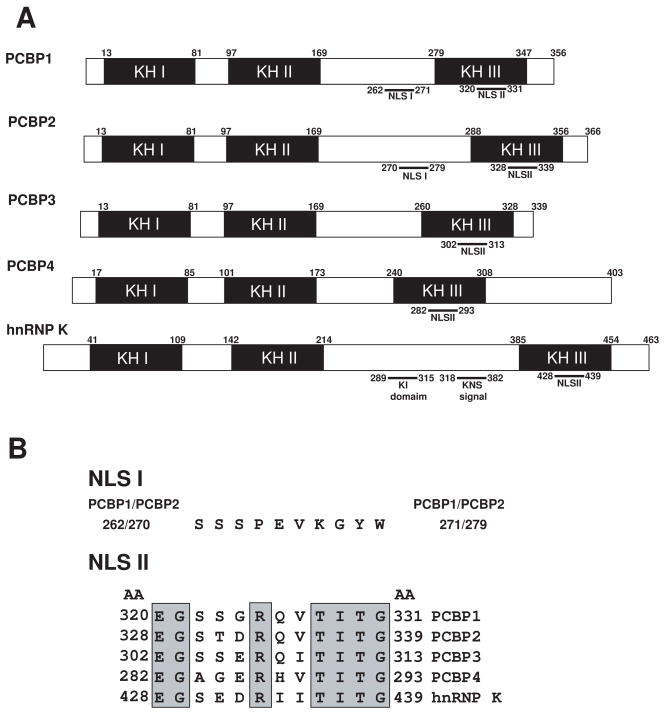
Fig. 1
Fig. 1
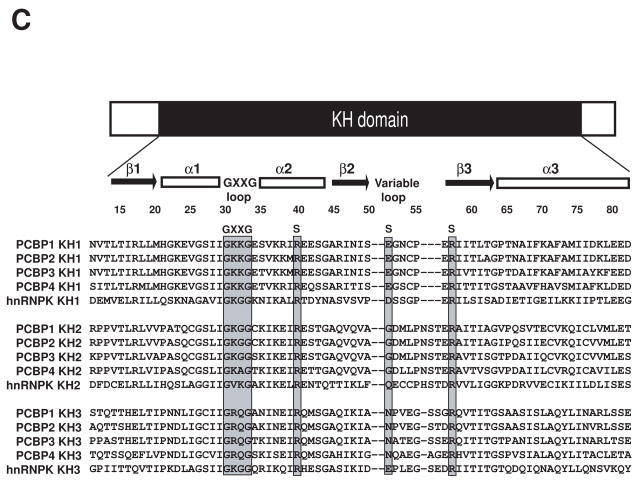
A, Schematic diagram of domain structure of PCBPs. The five members of the PCBP family are shown. Numbers indicate the respective human sequence. KH domains I–III (shaded boxes); SH-3 binding motif (KI domain); hnRNP K nuclear shuttling signal (KNS signal). Adapted from Makeyev and Liebhaber (2002) [1]. B, Sequence alignments of PCBPs at NLS I and NLS II. NLS I shows perfect conservation between PCBP1 and PCBP2. There is no NLS I region present in PCBP3, PCBP4, or hnRNP K. Conserved amino acids of NLS II are shaded. Adapted from Chkheidze and Liebhaber (2003) [7]. C, Sequence alignments of KH domains from PCBP1-4 and hnRNP K. The GXXG motif and the three amino acids involved in hydrogen bonding with polycytosine are indicated in grey; the residues involved in hydrogen bonds with DNA bases (i.e., side-chain base hydrogen bonds) are labeled “S”. Adapted from Du et al. (2005) [17].
Fig. 1
Fig. 1
A, Schematic diagram of domain structure of PCBPs. The five members of the PCBP family are shown. Numbers indicate the respective human sequence. KH domains I–III (shaded boxes); SH-3 binding motif (KI domain); hnRNP K nuclear shuttling signal (KNS signal). Adapted from Makeyev and Liebhaber (2002) [1]. B, Sequence alignments of PCBPs at NLS I and NLS II. NLS I shows perfect conservation between PCBP1 and PCBP2. There is no NLS I region present in PCBP3, PCBP4, or hnRNP K. Conserved amino acids of NLS II are shaded. Adapted from Chkheidze and Liebhaber (2003) [7]. C, Sequence alignments of KH domains from PCBP1-4 and hnRNP K. The GXXG motif and the three amino acids involved in hydrogen bonding with polycytosine are indicated in grey; the residues involved in hydrogen bonds with DNA bases (i.e., side-chain base hydrogen bonds) are labeled “S”. Adapted from Du et al. (2005) [17].
Fig. 2
Fig. 2
A, Proposed model for transcriptional regulation of human SRC1A protooncogene by hnRNP K. hnRNP K recognizes and bind specifically to double-stranded polypurine:polypyrimidine sequences in the TC regions (TC1 and TC2), followed by strand separation facilitated by hnRNP K’s increased affinity for single-stranded DNA. The resulting single-stranded “bubble” encompasses the entire TC-tract region. The ability of hnRNP K to bind TBP recruits TFIID to the TC3 region and aids in the assembly of a preinitiation complex. Adapted from Ritchie et al. (2003) [33]. B, Proposed model for transcriptional regulation of mouse MOR by hnRNP K, αCP1, αCP2, αCP2-KL, and αCP3. The hnRNP K, αCP1, αCP2, αCP2-KL, and αCP3 bind to the single strand DNA element essential for activity of the MOR gene promoter and regulate its promoter activity at the transcriptional level.
Fig. 3
Fig. 3
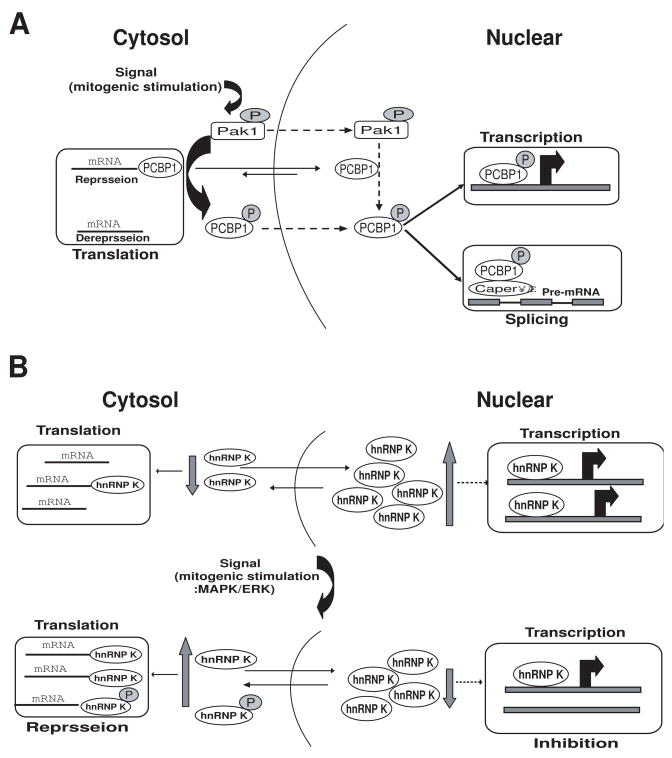
A, Proposed model for signal-dependent alterations in the nuclear and cytoplasmic activities of PCBP1. Upstream activators of the Pak1 pathway induce Pak1 kinase activity; active Pak1 has both cytoplasmic and nuclear functions. Pak1 phosphorylates cytoplasmic PCBP1, reducing its RNA-binding capabilities and thus releasing its translational repression of specific target mRNAs. Pak1 also phosphorylates PCBP1 in the nucleus (the mechanism by which phosphorylated PCBP1 moves from the cytoplasm to the nucleus is still not known). In the nucleus, PCBP1 is recruited to promoters on target genes and regulates their transcriptional activity. Phosphorylation also enhances PCBP1 binding to recently transcribed mRNA in the nucleus, influencing the splicing machinery via CAPER. Dashed lines represent the events that are not fully understood. Adapted from Meng et al., (2007) [23]. B, Proposed model for signal-dependent alterations of the nuclear and cytoplasmic activities of hnRNP K. MAPK/ERK efficiently phosphorylates hnRNP-K, increasing its accumulation in the cytoplasm and rendering the protein capable of regulating translation of mRNAs that have a DICE in the 3′UTR. Also, the quantity of hnRNP K in the can nucleus decrease, suggesting that the transcriptional activity of genes regulated by hnRNP K might also be changed. Dashed lines represent the events that are not fully understood. Adapted from Habelhah et al. (2001) [22].

References

    1. Makeyev AV, Liebhaber SA. The poly(C)-binding proteins: a multiplicity of functions and a search for mechanisms. RNA. 2002;8:265–278. - PMC - PubMed
    1. Leffers H, Dejgaard K, Celis JE. Characterisation of two major cellular poly(rC)-binding human proteins, each containing three K-homologous (KH) domains. Eur J Biochem. 1995;230:447–453. - PubMed
    1. Kiledjian M, Wang X, Liebhaber SA. Identification of two KH domain proteins in the alpha-globin mRNP stability complex. EMBO J. 1995;14:4357–4364. - PMC - PubMed
    1. Makeyev AV, Liebhaber SA. Identification of two novel mammalian genes establishes a subfamily of KH-domain RNA-binding proteins. Genomics. 2000;67:301–316. - PubMed
    1. Makeyev AV, Chkheidze AN, Liebhaber SA. A set of highly conserved RNA-binding proteins, alphaCP-1 and alphaCP-2, implicated in mRNA stabilization, are coexpressed from an intronless gene and its intron-containing paralog. J Biol Chem. 1999;274:24849–24857. - PubMed

Publication types