. 2009 Apr 10;34(1):47-57.
doi: 10.1016/j.molcel.2009.02.020. Epub 2009 Mar 12.

A conserved WD40 protein binds the Cajal body localization signal of scaRNP particles

Affiliations

A conserved WD40 protein binds the Cajal body localization signal of scaRNP particles

Kazimierz T Tycowski et al. Mol Cell. .

Abstract

Small Cajal body (CB)-specific RNPs (scaRNPs) function in posttranscriptional modification of small nuclear (sn)RNAs. An RNA element, the CAB box, facilitates CB localization of H/ACA scaRNPs. Using a related element in Drosophila C/D scaRNAs, we purified a fly WD40 repeat protein that UV crosslinks to RNA in a C/D CAB box-dependent manner and associates with C/D and mixed domain C/D-H/ACA scaRNAs. Its human homolog, WDR79, associates with C/D, H/ACA, and mixed domain scaRNAs, as well as with telomerase RNA. WDR79's binding to human H/ACA and mixed domain scaRNAs is CAB box dependent, and its association with mixed domain RNAs also requires the ACA motif, arguing for additional interactions of WDR79 with H/ACA core proteins. We demonstrate a requirement for WDR79 binding in the CB localization of a scaRNA. This and other recent reports establish WDR79 as a central player in the localization and processing of nuclear RNPs.


Figures
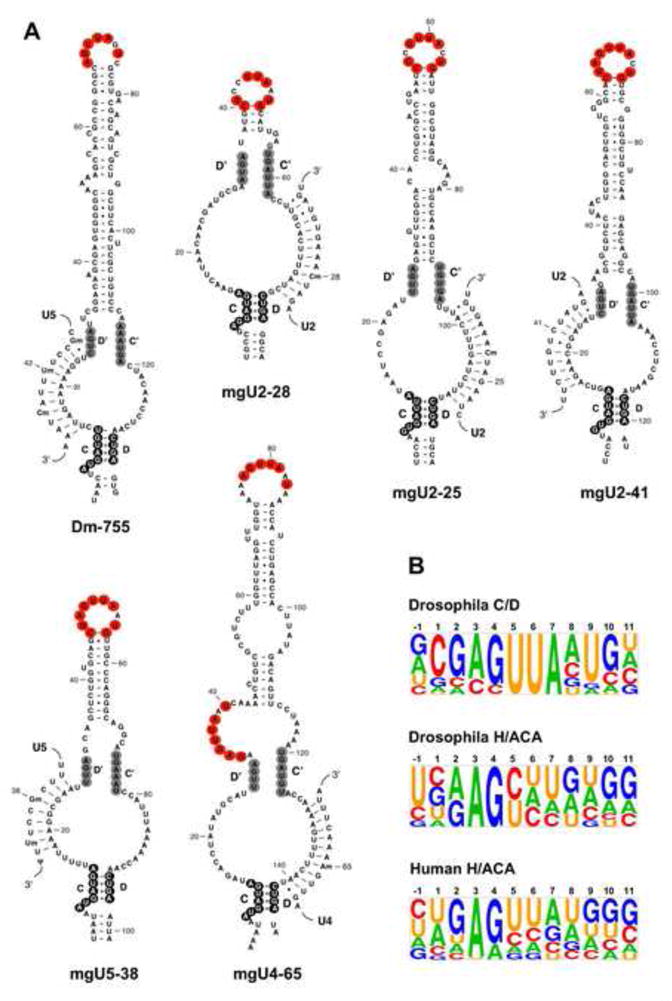
Figure 1
Figure 1
A CAB-like box in D. melanogaster box C/D scaRNAs. (A) Primary and predicted secondary structures of previously reported Dm-755 (Yuan et al. 2003) and mgU2-28 (Huang et al., 2005b) scaRNAs, as well as of scaRNAs described in this paper. The conserved loop residues that constitute the putative CAB box are in red circles. Boxes C and D nucleotides are in black, while C′ and D′ residues are in gray circles. The reported 2′-O-methyl groups in snRNAs (Huang et al., 2005b; Myslinski et al., 1984) are marked by “m”. (B) The Drosophila C/D CAB box compared to H/ACA CAB boxes of fly and human scaRNAs. (Top panel) 32 putative CAB box sequences (positions 1–10) and their flanking nucleotides from the scaRNAs shown in (A) from D. melanogaster, D. grimshawi, D. pseudoobscura, D. virillis, and D. willistoni were aligned manually and displayed using the Pictogram algorithm (Burge et al., 1998). (Middle panel) Pictogram representation of 9 CAB tetranucleotides (positions 1–4) and their flanking sequences from the H/ACA domain of U85 scaRNA from the five Drosophila species listed above. (Bottom panel) Pictogram representation of 27 CAB tetranucleotides (positions 1–4) and their flanking sequences from human H/ACA scaRNAs, H/ACA domains of C/D-H/ACA scaRNAs, and telomerase RNA. The relative frequencies of the four nucleotides are represented by the heights of the letters.
Figure 2
Figure 2
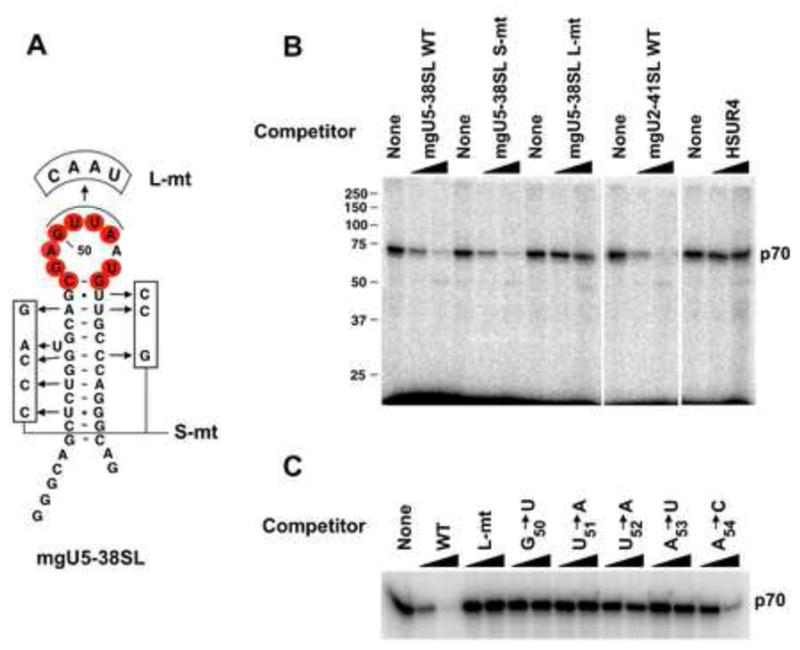
CAB box-containing stemloops (SLs) of Drosophila C/D scaRNAs UV-crosslink to a 70 kD protein in S2 cell extracts. (A) Sequence and predicted secondary structure of the mgU5-38 scaRNA SL (mgU5-38SL). The residues constituting a putative CAB box are in red circles. Nucleotide substitutions in the stem and loop mutant constructs (S-mt and L-mt, respectively) are boxed. The first two G residues are not present in mgU5-38 scaRNA but were added for efficient in vitro transcription. The nucleotide numbering follows that of mgU5-38 scaRNA (see Figure 1). (B and C) UV crosslinking of 32P-labeled mgU5-38SL RNA in S2 cell nuclear extract. Incubation at 30°C was in the presence of E. coli tRNA (see Experimental Procedures for details) either with (7- or 50-fold excess) or without an additional competitor RNA, indicated at the top. Upon subsequent UV irradiation and RNase One digestion, proteins were resolved by 10% SDS-PAGE. mgU2-41SL is a stemloop corresponding to nts 46–90 of mgU2-41 scaRNA (see Figure 1), while HSUR4 is a small RNA from Herpesvirus saimiri (Lee et al., 1988). In (C), the competitors indicated at the top were either wild-type (WT), L-mt, or individual point mutant mgU5-38SL RNAs.
Figure 3
Figure 3
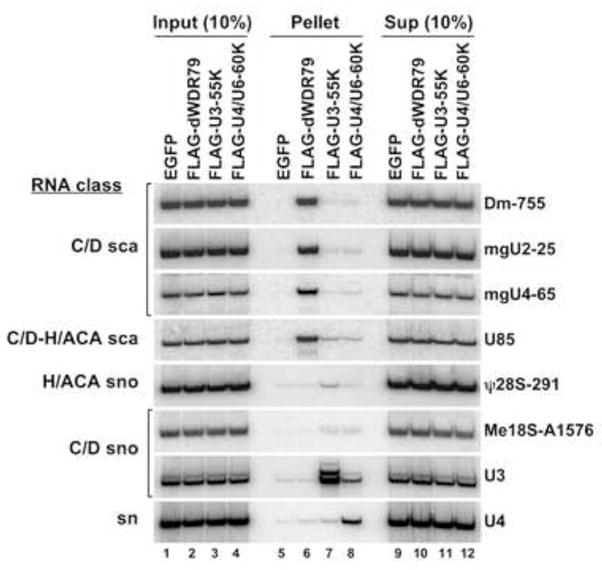
Drosophila WDR79 is associated with endogenous scaRNAs carrying either the C/D or H/ACA CAB box. S2 cells were transfected with FLAG-dWDR79, FLAG-U3-55K, FLAG-U4/U6-60K, or untagged EGFP construct. Whole cell extracts were precipitated with an anti-FLAG antibody and co-immunoprecipitated RNAs were fractionated by denaturing 7% PAGE alongside RNAs isolated from 10% of either input extract or IP supernatant (Sup). RNAs were analyzed by Northern blot hybridization using oligonucleotide probes (see Supplemental Data). The IP efficiency of scaRNAs ranged from 7% (mgU2-25) to 15% (mgU4-65).
Figure 4
Figure 4
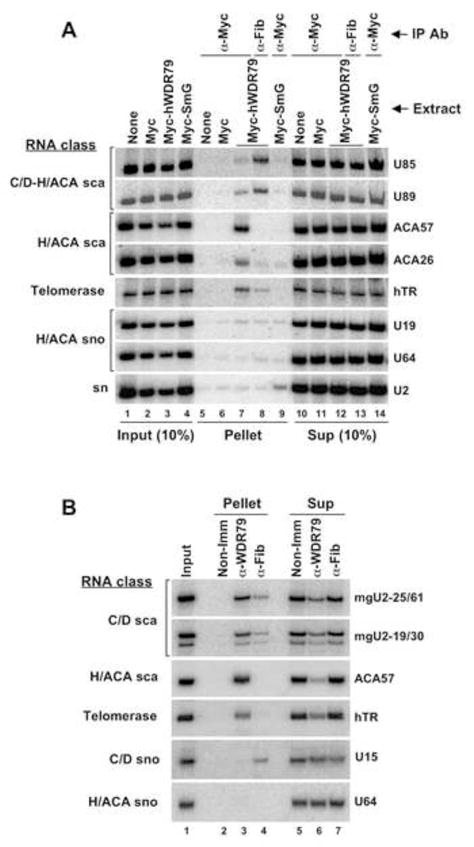
Human WDR79 protein associates with endogenous scaRNAs and telomerase RNA. (A) HEK293 cells were transfected with either Myc-hWDR79, Myc-SmG, or Myc tag construct. Whole cell extracts were exposed to either anti-Myc or anti-fibrillarin antibody as indicated at the top. The IP efficiency of scaRNAs and telomerase RNA by anti-Myc antibody ranged from 2% (U85) to 11% (ACA57). (B) HeLa nuclear extracts were immunoprecipitated with either anti-WDR79 or anti-fibrillarin antibody as indicated. The IP efficiency of scaRNAs and telomerase RNA by anti-WDR79 antibody ranged from 55% (mgU2-19/30) to 81% (ACA57). Co-precipitated RNAs were fractionated by 7% denaturing PAGE alongside the RNAs isolated from either 10% (A) or 100% (B) the amount of input extract or IP supernatant (Sup). RNAs were detected by Northern blot hybridization using oligonucleotide probes (see Supplemental Data).
Figure 5
Figure 5
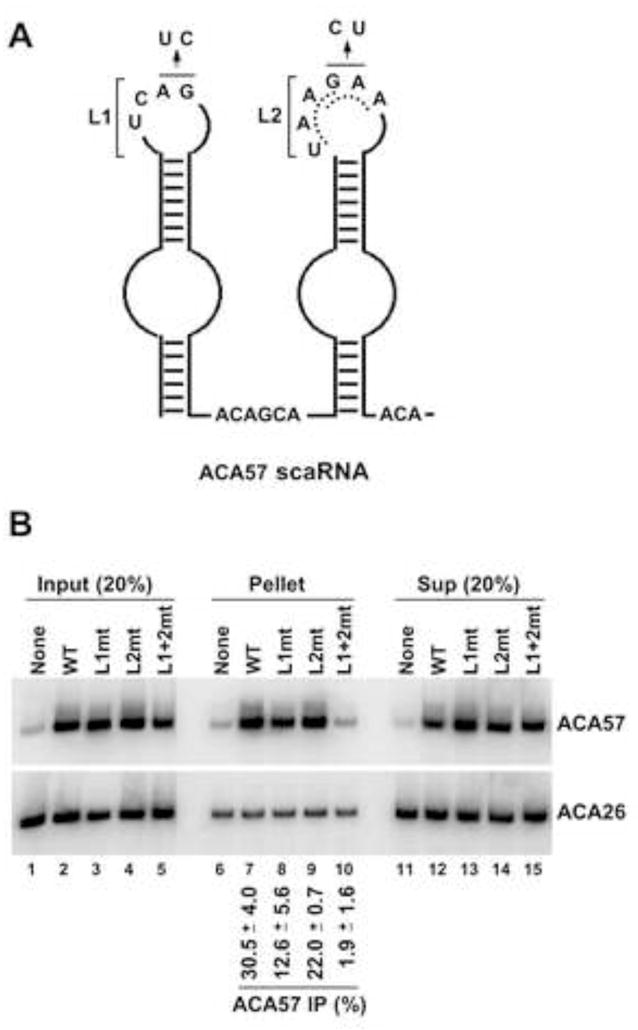
The CAB box is essential for association of an H/ACA scaRNA with WDR79 protein. (A) Secondary structure schematic of human ACA57 scaRNA. Putative CAB boxes in loop 1 (L1) and 2 (L2) as well as H (ACAGCA) and ACA box sequences are shown. Loop 2 contains two potential, overlapping CAB boxes indicated by dotted lines. The double nucleotide substitutions in L1mt and L2mt constructs are indicated. (B) Northern blot analysis of ACA57 scaRNA and its CAB mutants co-precipitating with Myc-hWDR79 fusion protein. Wild-type (WT) or mutated L1mt, L2mt, or combined (L1+2mt) RNAs were overexpressed in HEK293 cells together with Myc-tagged hWDR79. Anti-Myc precipitated RNAs were resolved by 7% denaturing PAGE and analyzed by Northern blot hybridization using oligonucleotide probes (see Supplemental Data). The endogenous ACA26 scaRNA served as an IP and gel loading control. The IP efficiency of the overexpressed wild-type or mutated ACA57 scaRNA represents an average value derived from three experiments with standard error shown (for details see Experimental Procedures).
Figure 6
Figure 6
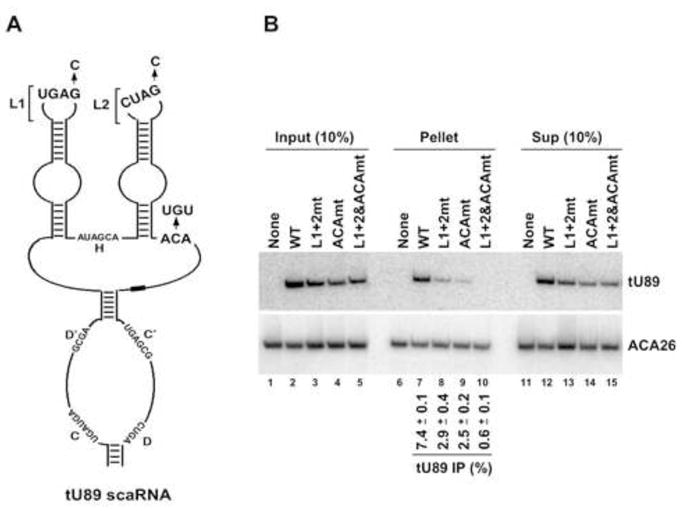
Both CAB and ACA boxes are required for the association of human U89 C/D-H/ACA scaRNA with WDR79 protein. (A) Secondary structure schematic of tagged human U89 (tU89) scaRNA. Putative CAB boxes in loops 1 (L1) and 2 (L2) as well as H, ACA, C, C′, D and D′ motifs, are indicated. Loop and box ACA substitutions in the mutant tU89 constructs are shown. A 6 nt-long tag generated by changing nucleotides 237–242 into complementary residues is represented by a bar. (B) Northern blot analysis of tU89 scaRNA and its mutants co-immunoprecipitated with Myc-hWDR79 protein. Either wild-type (WT), CAB-mutated (L1+2mt), box ACA-mutated (ACAmt), or combined CAB- and ACA-mutated (L1+2&ACAmt) tU89 scaRNA was co-expressed with Myc-hWDR79 in HEK293 cells. Anti-Myc precipitated RNAs were resolved by 7% denaturing PAGE and analyzed by Northern blot hybridization using oligonucleotide probes (see Supplemental Data). The IP efficiency of either wild-type or mutated tU89 scaRNA represents an average of two experiments with standard error shown (for details see Experimental Procedures).
Figure 7
Figure 7
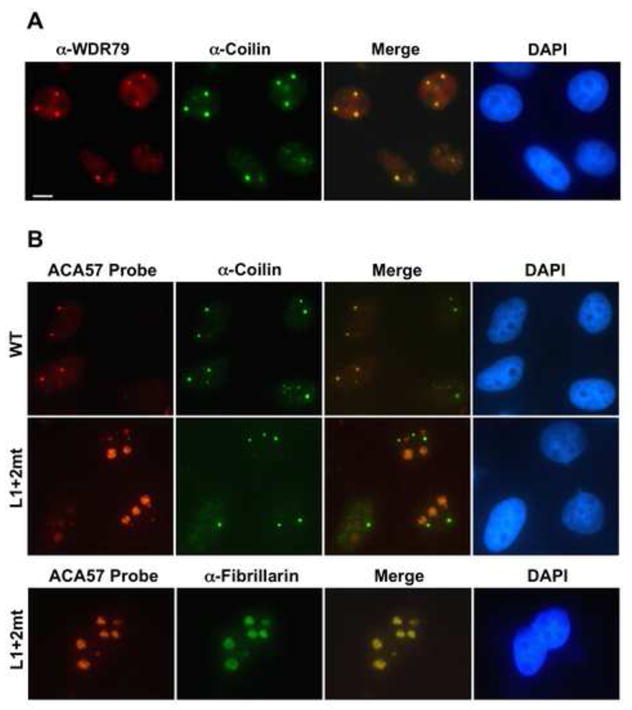
Association with hWDR79 is required for CB localization of a human scaRNA. (A) Subcellular localization of hWDR79 in HeLa cells using rabbit polyclonal antibody. (B) Mislocalization of a CAB box mutant ACA scaRNA. Either WT or L1+2mt ACA57 (see Figure 5A) was transiently overexpressed in HeLa cells and detected by FISH. CBs, nuclei, and nucleoli were visualized with anti-coilin, DAPI, and anti-fibrillarin staining, respectively. Scale bar; 10μm.

References

    1. Baker DL, Youssef OA, Chastkofsky MI, Dy DA, Terns RM, Terns MP. RNA-guided RNA modification: functional organization of the archaeal H/ACA RNP. Genes Dev. 2005;19:1238–1248. - PMC - PubMed
    1. Burge CB, Padgett RA, Sharp PA. Evolutionary fates and origins of U12-type introns. Mol Cell. 1998;2:773–785. - PubMed
    1. Carmo-Fonseca M. New clues to the function of the Cajal body. EMBO Rep. 2002;3:726–727. - PMC - PubMed
    1. Cioce M, Lamond AI. Cajal bodies: a long history of discovery. Annu Rev Cell Dev Biol. 2005;21:105–131. - PubMed
    1. Consortium IHGS. Finishing the euchromatic sequence of the human genome. Nature. 2004;431:931–945. - PubMed

Publication types

MeSH terms

Associated data