Review
. 2009 Jun;9(3):262-7.
doi: 10.1016/j.coph.2009.02.004. Epub 2009 Mar 13.

Purinergic receptors in airway epithelia

Affiliations
Review

Purinergic receptors in airway epithelia

Eduardo R Lazarowski et al. Curr Opin Pharmacol. 2009 Jun.

Abstract

Nucleotides and nucleosides within the airway surface liquid regulate mucociliary clearance (MCC) activities, the primary innate defense mechanism that removes foreign particles and pathogens from airway surfaces. Nucleotide and nucleoside actions in the airways are mediated mainly by two purinergic receptor subtypes, the Gq-coupled ATP/UTP-sensing P2Y2 receptor and the Gs-coupled A2b adenosine receptor. Activation of the A2b receptor results in cyclic AMP-dependent activation of the cystic fibrosis transmembrane regulator (CFTR) Cl- channel and stimulation of ciliary beat frequency. Agonist occupation of the P2Y2 receptor promotes inhibition of Na+ absorption as well as CFTR-dependent and CFTR-independent Cl- secretion, ciliary beating, and mucin secretion.


Figures
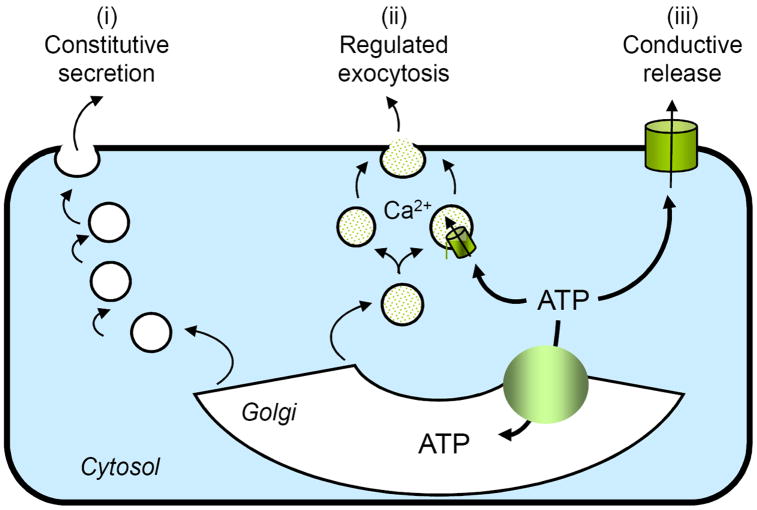
Figure 1
Figure 1. Pathways for ATP release
Several scenarios possibly account for the basal and stimulated release of nucleotides from airway epithelial cells. (i) ATP entering the Golgi lumen via specific transporters may be released as a residual cargo product of the constitutive secretory pathway. (ii) Secretory granules (e.g., mucin granules) containing ATP may be competent for Ca2+-regulated exocytosis. (iii) A not yet identified ATP conductance effluxes cytosolic ATP out of the cells.
Figure 2
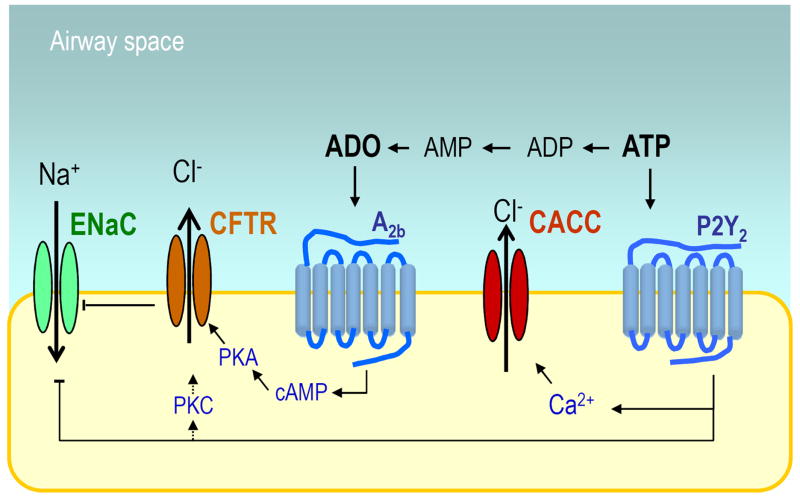
Figure 2. Purinergic regulation of ion transport
ASL ATP promotes P2Y2 receptor-mediated Ca2+-activated Cl- channel (CaCC) activity, and inhibition of the epithelial Na+ channel ENaC (via PIP2 depletion, not shown). Potentially, the P2Y2 receptor promotes PKC-mediated CFTR activation. ATP hydrolysis results in adenosine accumulation (ADO), which in turns activates the A2b receptor, leading to cyclic AMP (cAMP) and protein kinase A (PKA)-mediated CFTR activation. CFTR inhibits ENaC by mechanisms that are not well understood.

References

    1. Mason SJ, Paradiso AM, Boucher RC. Regulation of transepithelial ion transport and intracellular calcium by extracellular ATP in human normal and cystic fibrosis airway epithelium. Br J Pharmacol. 1991;103:1649–1656. - PMC - PubMed
    1. Burnstock G. Purinergic nerves. Pharmacol Rev. 1972;24:509–581. - PubMed
    1. Lazarowski ER, Mason SJ, Clarke L, Harden TK, Boucher RC. Adenosine receptors on human airway epithelia and their relationship to chloride secretion. Br J Pharmacol. 1992;106:774–782. - PMC - PubMed
    1. Lazarowski ER, Paradiso AM, Watt WC, Harden TK, Boucher RC. UDP activates a mucosal-restricted receptor on human nasal epithelial cells that is distinct from the P2Y(2) receptor. Proc Natl Acad Sci U S A. 1997;94:2599–2603. - PMC - PubMed
    1. Cobb BR, Fan LJ, Kovacs TE, Sorscher EJ, Clancy JP. Adenosine Receptors and Phosphodiesterase Inhibitors Stimulate Cl- Secretion in Calu-3 Cells. Am J Respir Cell Mol Biol. 2003;29:410–418. - PubMed

Publication types

MeSH terms