. 2009 May;46(8-9):1647-53.
doi: 10.1016/j.molimm.2009.02.021. Epub 2009 Mar 14.

A region of the N-terminal domain of meningococcal factor H-binding protein that elicits bactericidal antibody across antigenic variant groups

Affiliations

A region of the N-terminal domain of meningococcal factor H-binding protein that elicits bactericidal antibody across antigenic variant groups

Peter T Beernink et al. Mol Immunol. 2009 May.

Abstract

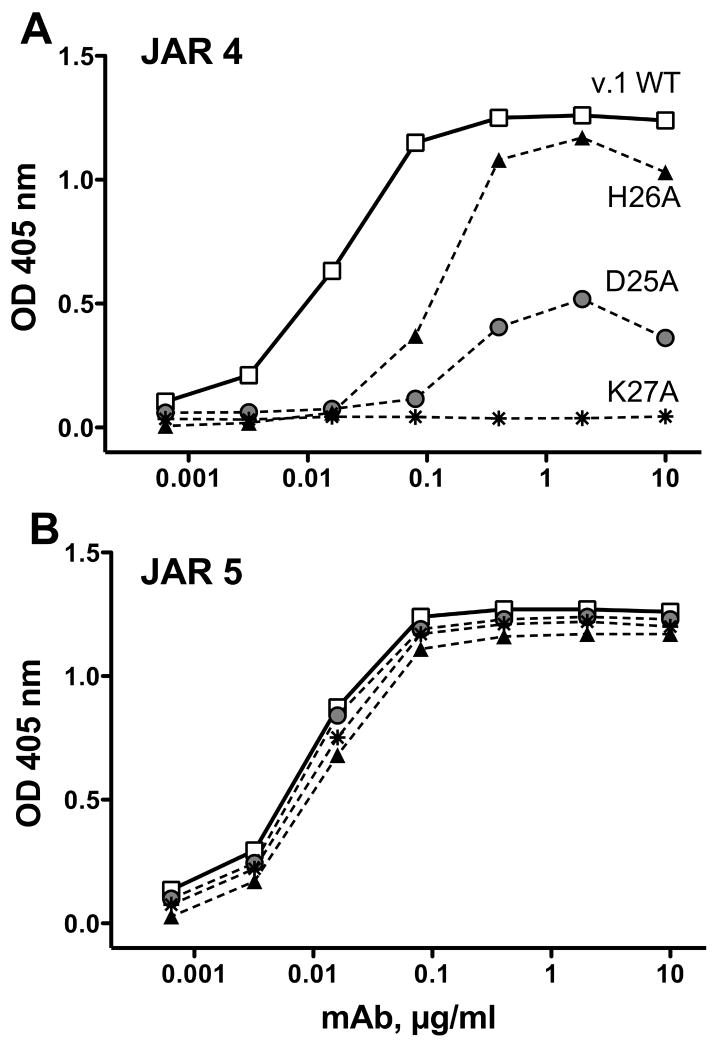
Meningococcal factor H-binding protein (fHbp) is a promising vaccine antigen. Previous studies described three fHbp antigenic variant groups and identified amino acid residues between 100 and 255 as important targets of variant-specific bactericidal antibodies. We investigated residues affecting expression of an epitope recognized by a murine IgG2a anti-fHbp mAb, designated JAR 4, which cross-reacted with fHbps in variant group 1 or 2 (95% of strains), and elicited human complement-mediated, cooperative bactericidal activity with other non-bactericidal anti-fHbp mAbs with epitopes involving residues between 121 and 216. From filamentous bacteriophage libraries containing random peptides that were recognized by JAR 4, we identified a consensus tripeptide, DHK that matched residues 25-27 in the N-terminal domain of fHbp. Since DHK was present in both JAR 4-reactive and non-reactive fHbps, the tripeptide was necessary but not sufficient for reactivity. Based on site-directed mutagenesis studies, the JAR 4 epitope could either be knocked out of a reactive variant 1 fHbp, or introduced into a non-reactive variant 3 protein. Collectively, the data indicated that the JAR 4 epitope was discontinuous and involved DHK residues beginning at position 25; YGN residues beginning at position 57; and a KDN tripeptide that was present in variant 3 proteins beginning at position 67 that negatively affected expression of the epitope. Thus, the region of fHbp encompassing residues 25-59 in the N-terminal domain is important for eliciting antibodies that can cooperate with other anti-fHbp antibodies for cross-reactive bactericidal activity against strains expressing fHbp from different antigenic variant groups.


Figures
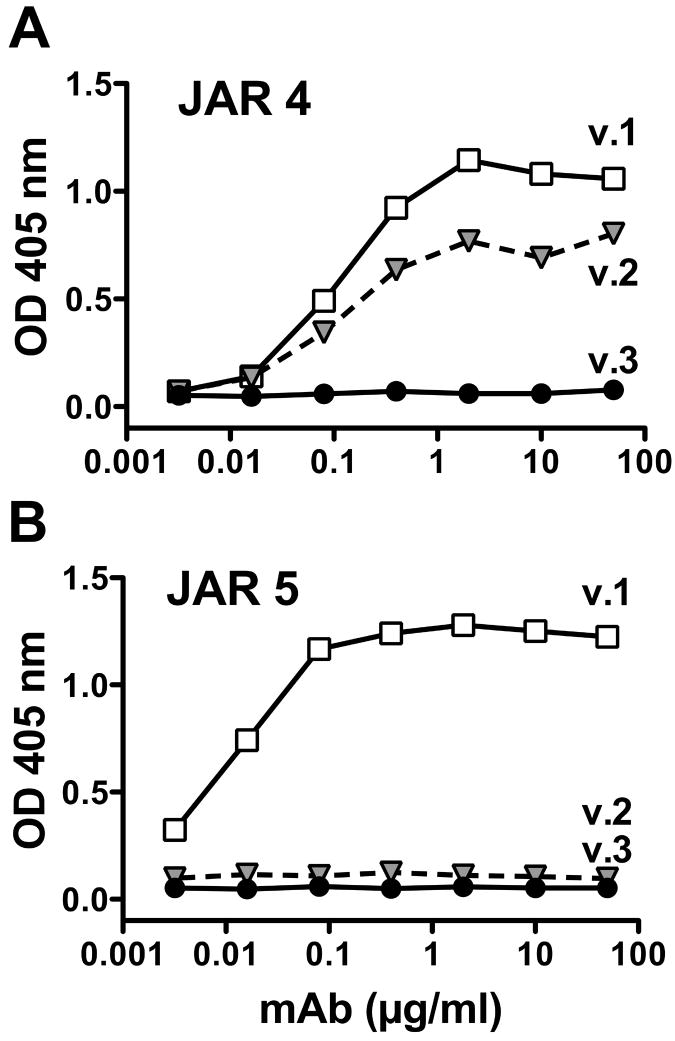
Figure 1
Figure 1
Binding of anti-fHbp mAbs to purified recombinant fHbp as measured by ELISA. The proteins were expressed from genes from strains MC58 (variant 1), 8047 (variant 2) and M1239 (variant 3), respectively. A, Binding of mAb JAR 4 to antigenic variant 1 and 2 proteins but not with a variant 3 protein. B, Binding of a control mAb, anti-fHbp, JAR 5, which recognizes a variant 1-specific epitope in the N-domain involving amino acid residues 121 and 122 (Beernink et al., 2008).
Figure 2
Figure 2
Effect of alanine substitutions at positions 25-27 on ELISA binding of JAR 4 to recombinant mutant fHbp from the variant 1 group (wild type gene from strain MC58). A, Binding of mAb JAR 4. B, Binding of a control anti-fHbp mAb, JAR 5 (see legend to Figure 1).
Figure 3
Figure 3
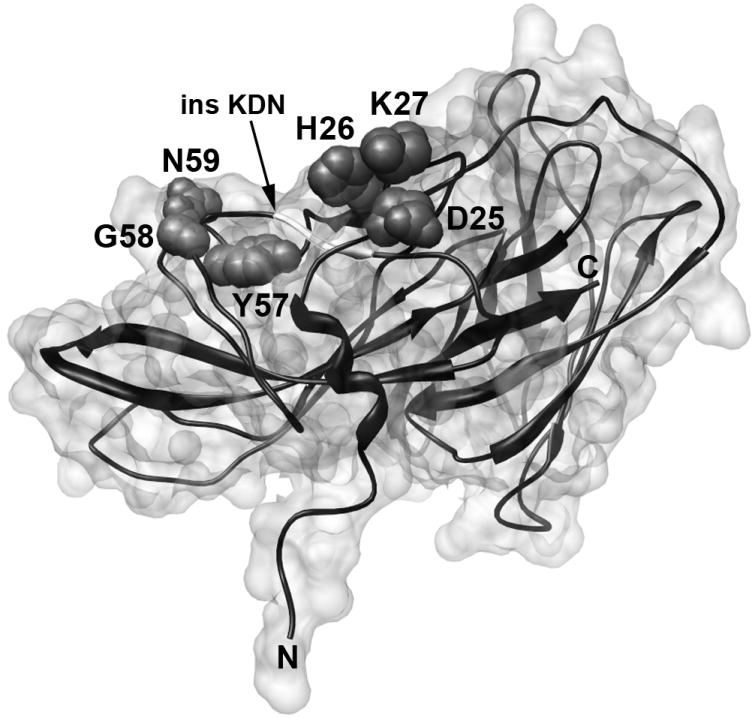
Surface rendering of fHbp variant 1 using coordinates from the NMR solution structure of the entire of fHbp molecule (antigenic variant 1, strain MC58) (Cantini et al., 2009). The relative positions of the DHK and YGN tripeptides that affect binding of JAR 4 are shown. The location of amino acids 67-69, which in the variant 3 protein contains the KDN tripeptide that negatively affects JAR 4 binding and is not present in variant 1 or 2 proteins (See Table 3), is shown as a white insert in the ribbon next to the arrow.
Figure 4
Figure 4
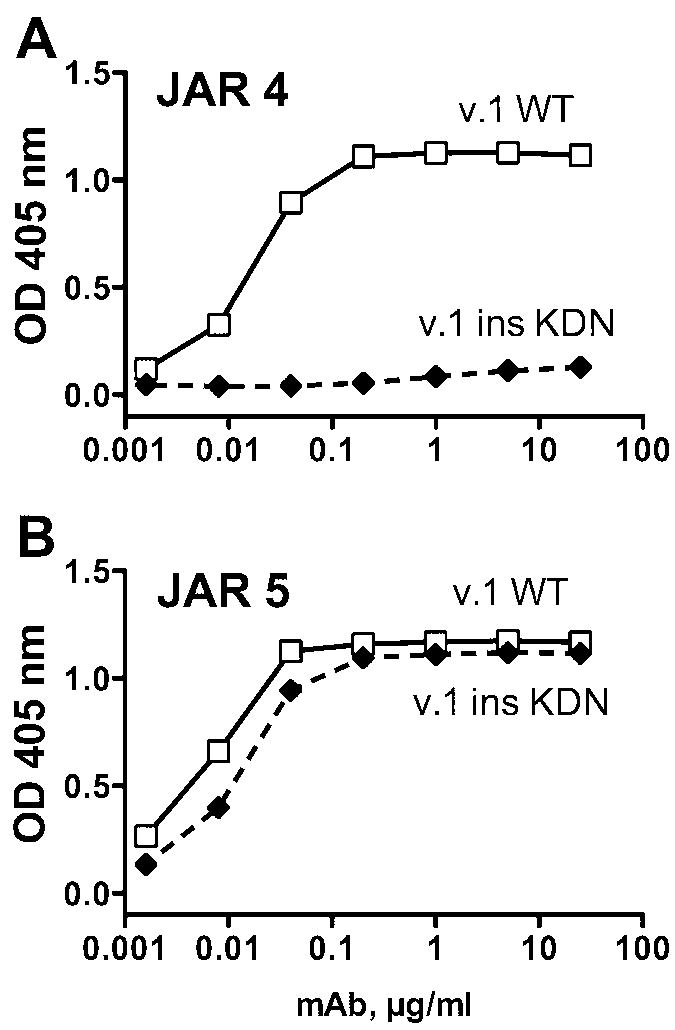
Effect of insertion of a KDN tripeptide in a fHbp from the antigenic variant 1 group (v.1) on reactivity with anti-fHbp mAb JAR 4. The KDN sequence at residues 67-69 was naturally present only in fHbp in the variant 3 group. A, Binding of JAR 4. B, Binding of a control anti-fHbp mAb, JAR 5 (see Legend to Figure 1).
Figure 5
Figure 5
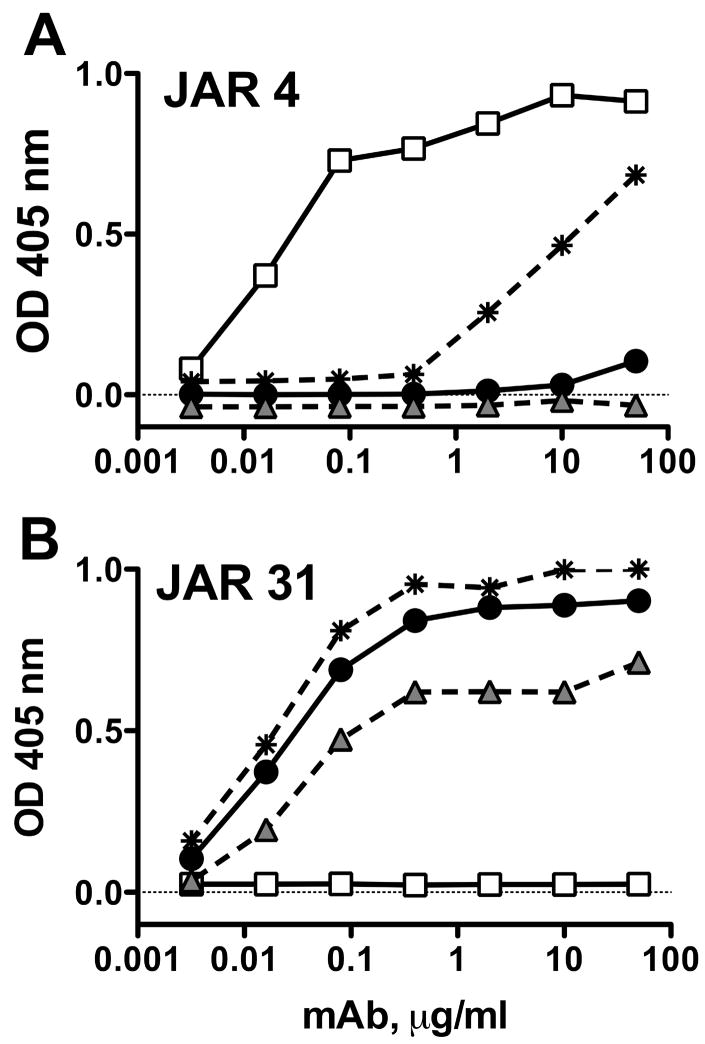
Anti-fHbp mAb binding to mutants of a fHbp in the variant 3 group as measured by ELISA. Open squares, control WT fHbp in the variant 1 group (positive for JAR 4; negative for JAR 31); filled circles, control WT fHbp in the variant 3 group (negative for JAR 4; positive for JAR 31); shaded triangles, ΔKDN mutant of fHbp in the variant 3 group, which did not result in JAR 4 binding; asterisks, a double mutant of fHbp in the variant 3 group with ΔKDN and FKA->YGN, which resulted in partial expression of the JAR 4 epitope. A, Binding of JAR 4. B, Binding of a control anti-fHbp mAb, JAR 31, which recognizes an epitope in the C-domain (Beernink and Granoff, 2008). JAR 31 bound to WT fHbp in the variant 3 group and with the two mutants, but not with the WT fHbp in the variant 1 group.

References

    1. Beernink PT, Granoff DM. Bactericidal antibody responses induced by meningococcal recombinant chimeric factor H-binding protein vaccines. Infect Immun. 2008;76:2568–75. - PMC - PubMed
    1. Beernink PT, Welsch JA, Bar-Lev M, Koeberling O, Comanducci M, Granoff DM. Fine antigenic specificity and cooperative bactericidal activity of monoclonal antibodies directed at the meningococcal vaccine candidate, factor H-binding protein. Infect Immun. 2008;76:4232–40. - PMC - PubMed
    1. Cantini F, Veggi D, Dragonetti S, Savino S, Scarselli M, Romagnoli G, Pizza M, Banci L, Rappuoli R. Solution structure of the factor H binding protein, a survival factor and protective antigen of Neisseria meningitidis. J Biol Chem. 2009 In press. - PMC - PubMed
    1. Dente L, Cesareni G, Micheli G, Felici F, Folgori A, Luzzago A, Monaci P, Nicosia A, Delmastro P. Monoclonal antibodies that recognise filamentous phage: tools for phage display technology. Gene. 1994;148:7–13. - PubMed
    1. Felici F, Castagnoli L, Musacchio A, Jappelli R, Cesareni G. Selection of antibody ligands from a large library of oligopeptides expressed on a multivalent exposition vector. J Mol Biol. 1991;222:301–10. - PubMed

Publication types

MeSH terms

Substances