


Intracerebral hemorrhage volume predicts poor neurologic outcome in children
- PMID: 19286576
- PMCID: PMC2830068
- DOI: 10.1161/STROKEAHA.108.541383
Intracerebral hemorrhage volume predicts poor neurologic outcome in children
Abstract
Background and purpose: Although intracerebral hemorrhage (ICH) volume and location are important predictors of outcome in adults, few data exist in children.
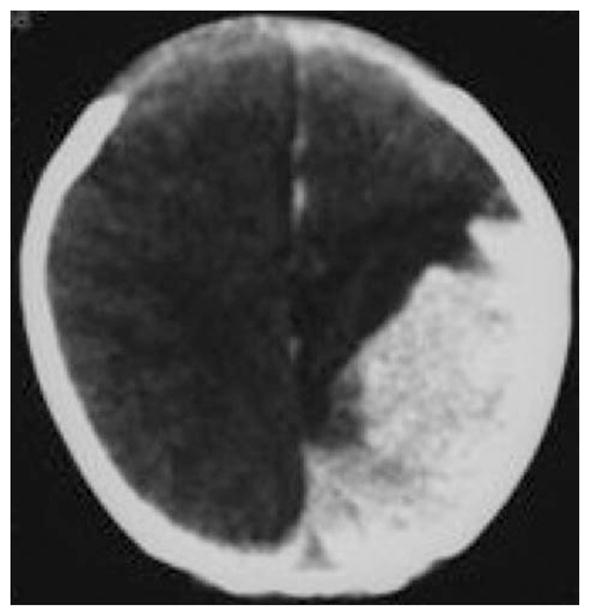
Methods: A consecutive cohort of children, including full-term newborns to those younger than 18 years of age with nontraumatic, acute ICH and head CT available for analysis were studied. Clinical information was abstracted via chart review. Hemorrhage volume was expressed as percentage of total brain volume (TBV) with large hemorrhage defined as >or=4% of TBV. Hemorrhages were manually traced on each head CT slice and volumes were calculated by multiplying by slice thickness. Location was classified as supratentorial or infratentorial. Logistic regression was used to identify predictors of poor neurological outcome, defined as a Glasgow outcome scale <or=2 (death or persistent vegetative state).
Results: Thirty children were included, median age 6 years. Median ICH volume was 20.4 cm(3) and median ICH size as a percentage of TBV was 1.9%. Only 4 of 22 children with ICH <4% of TBV had poor outcomes, vs 5 of 8 children with ICH >or=4% of TBV (P=0.03). In multivariate analysis, hemorrhage >or=4% of TBV (OR, 22.5; 95% CI, 1.4-354; P=0.03) independently predicted poor outcome 30 days after ICH. In this small sample, infratentorial hemorrhage location and the presence of intraventricular hemorrhage did not predict poor outcome.
Conclusions: ICH volume predicts neurological outcome at 30 days in children, with worst outcome when hemorrhage is >or=4% of TBV. Location and ICH etiology may also be important. These findings identify children with ICH who are candidates for aggressive management and may influence counseling regarding prognosis.
Figures

References
-
- Lynch JK, Hirtz DG, DeVeber G, Nelson KB. Report of the National Institute of Neurological Disorders and Stroke workshop on perinatal and childhood stroke. Pediatrics. 2002;109:116–123. - PubMed
-
- National Center for Health Statistics. Deaths, percentage of total deaths, and death rates for the 10 leading causes of death in selected age groups, by race and sex: United States, 2002–2005. [Accessed June 16, 2006]. Available at: www.cdc.gov/nchs/data/nvsr/nvsr53/nvsr53_17.pdf.
-
- Fullerton HJ, Wu YW, Zhao S, Johnston SC. Risk of stroke in children: ethnic and gender disparities. Neurology. 2003;61:189–194. - PubMed
-
- Broderick JP, Brott TG, Duldner JE, Tomsick T, Huster G. Volume of intracerebral hemorrhage. A powerful and easy-to-use predictor of 30-day mortality. Stroke. 1993;24:987–993. - PubMed
-
- Hemphill JC, III, Bonovich DC, Besmertis L, Manley GT, Johnston SC. The ICH score: a simple, reliable grading scale for intracerebral hemorrhage. Stroke. 2001;32:891–897. - PubMed
Publication types
MeSH terms
Grants and funding
LinkOut - more resources
Full Text Sources
