


doi: 10.1128/AEM.01765-08.
Epub 2009 Mar 13.
Global distribution and evolution of a toxinogenic Burkholderia-Rhizopus symbiosis
Affiliations
- PMID: 19286793
- PMCID: PMC2681710
- DOI: 10.1128/AEM.01765-08
Item in Clipboard
Global distribution and evolution of a toxinogenic Burkholderia-Rhizopus symbiosis
Appl Environ Microbiol.
2009 May.
Abstract
Toxinogenic endobacteria were isolated from a collection of Rhizopus spp. representing highly diverse geographic origins and ecological niches. All endosymbionts belonged to the Burkholderia rhizoxinica complex according to matrix-assisted laser desorption ionization-time of flight biotyping and multilocus sequence typing, suggesting a common ancestor. Comparison of host and symbiont phylogenies provides insights into possible cospeciation and horizontal-transmission events.
Figures
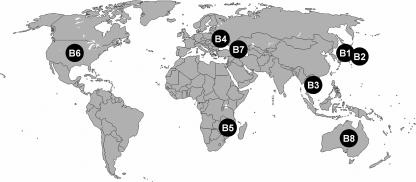
Survey of collection sites of toxinogenic R. microsporus strains used in this study.
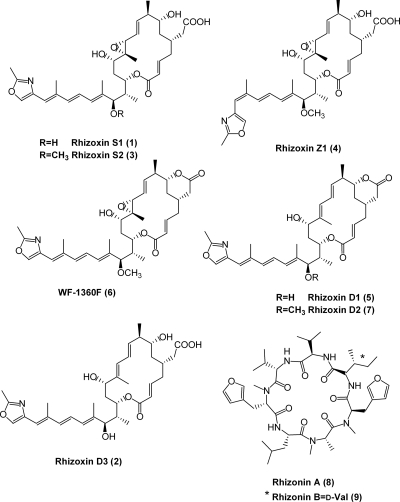
Structures of the main rhizoxin derivatives (derivatives 1 to 7) produced by all eight fungal endosymbionts (isolates B1 to B8) and structures of rhizonin A and B (derivatives 8 and 9), produced by the symbiont B. endofungorum HKI-0456 (isolate B5).
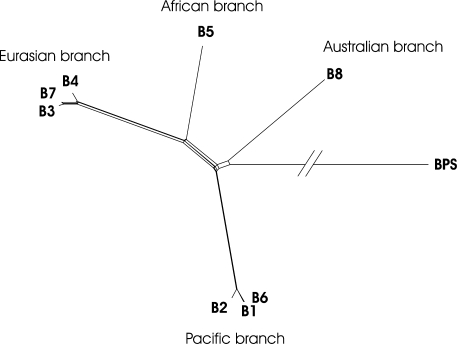
Phylogenetic network of the endofungal symbiont complex (isolates B1 to B8) and B. pseudomallei (BPS), based on MLST. The graph was obtained by the neighbor-net method, implemented with the SplitsTree4 program. Uncertainties in the data are visualized by the network structure in the center.
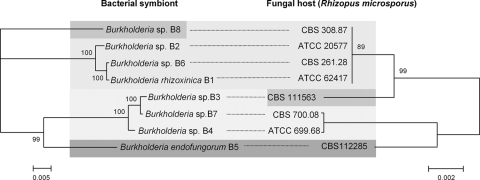
Juxtaposition of phylogenetic trees derived from the MLST data of the endofungal symbiont complex (isolates B1 to B8) and the ITS sequence data of the fungal host (strain designations of fungal isolates of the genus Rhizopus are given). Dashed lines are representative of a symbiotic relationship. The numbers on top of the branches indicate the clade probability values. Shading designates similar clade affiliations for the bacterial symbiont and the fungal host.
References
-
- Abe, A., Y. Oda, K. Asano, and T. Sone. 2006. The molecular phylogeny of the genus Rhizopus based on rDNA sequences. Biosci. Biotechnol. Biochem. 70:2387-2393. - PubMed
-
- Brendel, N., L. P. Partida-Martinez, K. Scherlach, and C. Hertweck. 2007. A cryptic PKS/NRPS gene cluster in the plant commensal Pseudomonas fluorescens Pf-5 codes for the biosynthesis of an antimitotic rhizoxin complex. Org. Biomol. Chem. 5:2211-2213. - PubMed
-
- Brown, J. K., and M. S. Hovmoller. 2002. Aerial dispersal of pathogens on the global and continental scales and its impact on plant disease. Science 297:537-541. - PubMed
Publication types
MeSH terms
Substances
LinkOut - more resources
Full Text Sources
Miscellaneous
