. 2009 May;296(5):H1398-407.
doi: 10.1152/ajpheart.01303.2008. Epub 2009 Mar 13.

Regulation of nitrite transport in red blood cells by hemoglobin oxygen fractional saturation

Affiliations

Regulation of nitrite transport in red blood cells by hemoglobin oxygen fractional saturation

Dario A Vitturi et al. Am J Physiol Heart Circ Physiol. 2009 May.

Abstract

Allosteric regulation of nitrite reduction by deoxyhemoglobin has been proposed to mediate nitric oxide (NO) formation during hypoxia. Nitrite is predominantly an anion at physiological pH, raising questions about the mechanism by which it enters the red blood cell (RBC) and whether this is regulated and coupled to deoxyhemoglobin-mediated reduction. We tested the hypothesis that nitrite transport by RBCs is regulated by fractional saturation. Using human RBCs, nitrite consumption was faster at lower fractional saturations, consistent with faster reactions with deoxyheme. A membrane-based regulation was suggested by slower nitrite consumption with intact versus lysed RBCs. Interestingly, upon nitrite addition, intracellular nitrite concentrations attained a steady state that, despite increased rates of consumption, did not change with decreasing oxygen tensions, suggesting a deoxygenation-sensitive step that either increases nitrite import or decreases the rate of nitrite export. A role for anion exchanger (AE)-1 in the control of nitrite export was suggested by increased intracellular nitrite concentrations in RBCs treated with DIDS. Moreover, deoxygenation decreased steady-state levels of intracellular nitrite in AE-1-inhibited RBCs. Based on these data, we propose a model in which deoxyhemoglobin binding to AE-1 inhibits nitrite export under low oxygen tensions allowing for the coupling between deoxygenation and nitrite reduction to NO along the arterial-to-venous gradient.


Figures

Fig. 1.
Fig. 1.
Effects of red blood cells (RBCs) on nitrite- and nitric oxide (NO)-dependent vasodilation at high and low oxygen tension (Po2). Relaxation of aortic rings by bolus additions of either Mahma-NONOate (MNO; 30 nM) or nitrite (10 μM) in the absence or presence of RBCs [0.3% hematocrit (Hct)] was determined at 21% and 0% oxygen. Shown is the inhibition of MNO- or nitrite-dependent vasodilation by RBCs at 21% and 0% oxygen. Data are means ± SE; n = 4–6. P values were calculated by unpaired t-test.
Fig. 2.
Fig. 2.
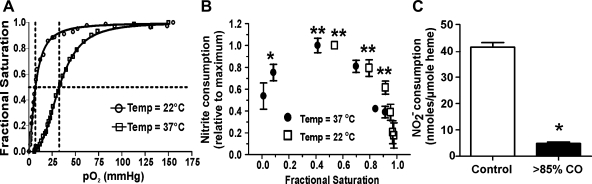
RBC hemoglobin (Hb)-oxygen fractional saturation regulates nitrite consumption. A: oxygen binding curves for RBC (0.3–0.5% Hct) in Krebs-Henseleit buffer (pH 7.4) determined at 22 or 37°C in the presence of 5% CO2. Calculated 50% Hb-oxygen fractional saturation (P50 values) and Hill constants were 7.1 mmHg and 1.6, respectively, at 22°C and 32.6 mmHg and 2.9 at 37°C, respectively. B: oxygen-equilibrated RBC suspensions (5% Hct) were incubated in the presence of 100 μM nitrite at the indicated temperatures and pH 7.4. Remaining nitrite in the media was measured after 15 min. Since rates of consumption are faster at higher temperatures, data are presented as relative consumption normalized to the maximum at each respective temperature. Data are means ± SE; n = 3. Data were analyzed by one-way ANOVA and the Bonferroni post test. *P < 0.05 and **P < 0.01 vs. the highest fractional saturation at each respective temperature. C: control or carbon monoxide (CO) gas-preequilibrated RBCs (5% Hct) in Tris buffer were incubated with nitrite (100 μM) at 28-mmHg Po2, 37°C, and pH 7.4. for 15 min, and nitrite consumption was measured. Data are means ± SE; n = 3. Data were analyzed by a two-tailed Student's t-test. *P < 0.001.
Fig. 3.
Fig. 3.
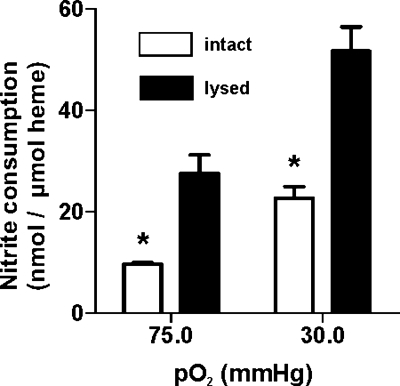
The RBC membrane regulates nitrite-heme reactivity. Nitrite (100 μM) was added to intact (hemolysis < 0.5%) or mechanically lysed (hemolysis > 70%) RBCs (5% Hct) at 75- or 30-mmHg Po2, 37°C, and pH 7.4, and nitrite consumption was measured after 10 min. Data are means ± SE; n = 3. Data were analyzed by an unpaired t-test versus intact cells at the respective Po2 (*P < 0.001).
Fig. 4.
Fig. 4.
Effects of RBC deoxygenation on intracellular nitrite concentration. A: nitrite (100 μM) was added to RBCs (5% Hct) preequilibrated at 75 mmHg (⧫, dashed lines) or 30 mmHg (○, solid lines) of oxygen at 37°C, and time-dependent losses of nitrite from the extracellular compartment and accumulation in the intracellular compartment were determined. Data show changes in absolute nitrite concentrations and are means ± SE (n = 3) from a single experiment. Data were analyzed by two-way ANOVA and the Bonferroni post test. ***P < 0.001 relative to the corresponding time at higher Po2. Intracellular nitrite concentrations were calculated by assuming a RBC volume of 100 fl and an intraerythrocytic heme concentration of 20 mM. B and C: normalized data for extracellular nitrite consumption (B) and intracellular nitrite accumulation (C) from 3 to 4 independent experiments (and RBC preparations). The absolute amounts of nitrite consumed and intracellular levels were found to vary between RBC preparations [from 52 to 139 nmol/μmol heme and from 46 to 121 pmol/μmol heme for maximum consumption and maximal intracellular nitrite levels (15 min), respectively]. Therefore, to compare results from different RBC preparations, data in B and C are plotted as relative to the maximum in each preparation. Data are means ± SE; n = 4 in B and 3 in C. Data were analyzed by two-way ANOVA and the Bonferroni post test. *P < 0.05 and **P < 0.001 vs. the corresponding time point at 75-mmHg Po2. D and E: nitrite at the indicated doses was added to RBCs (5% Hct) preequilibrated at either 73.5- or 21.4-mmHg Po2 at 37°C and pH 7.4, and both nitrite consumption from the extracellular compartment (D) and intracellular nitrite levels (E) were measured after 15 min. Data are means ± SE; n = 3. P values were determined by two-way ANOVA. The solid lines in D show the best fits as determined by linear regression. F: changes in metHb and nitrosylHb (HbNO) after the addition of 100 μM nitrite to RBCs (5% Hct) at 37°C and pH 7.4. Dashed lines show metHb at 75-mmHg (⧫) and 30-mmHg (○) Po2. Solid lines show HbNO at 75-mmHg (⧫) and 30-mmHg (○) Po2. Data were normalized to maximal metHb (99.2 nmol/μmol heme) and HbNO (1.81 nmol/μmol heme), respectively, and are means ± SE. Data were analyzed by two-way ANOVA and the Bonferroni post test. *P < 0.05 and **P < 0.001 vs. the corresponding time point at 75 mmHg for HbNO formation.
Fig. 5.
Fig. 5.
Model showing a proposed reaction scheme assuming that fractional saturation does not regulate nitrite transport. k1 and k−1 represent the rate constants for reversible nitrite transport across the membrane, and kox and kred are the rate constants for the reaction between nitrite and oxyHb or deoxyHb (dHb), respectively [where kred > kox and k2 represents other (non-Hb) sinks for nitrite consumption in the cell]. [NO2]in is the intracellular nitrite concentration; [NO2]out is the extracellular nitrite concentration.
Fig. 6.
Fig. 6.
Effect of 4,4′-diisothiocyanostilbene-2,2′-disulfonic acid (DIDS) on nitrite-RBC interactions. A: control and DIDS (100 μM)-treated RBCs (5% Hct) were equilibrated at either ∼75- or ∼30-mmHg Po2 at 37°C for 15 or 30 min, respectively, resulting in fractional saturations of ∼0.95 or ∼0.5, respectively. Nitrite (100 μM) was then added, and consumption from the extracellular compartment after 15 min was measured. Data are means ± SE; n = 8. *P < 0.01 by paired t-test relative to corresponding lower fractional saturation. NS, not significant by t-test. B: time-dependent changes in intracellular nitrite in control and DIDS-treated RBCs at a fractional saturation of 0.5. Data are means ± SE; n = 3. *P < 0.001 relative to the corresponding time point in control by two-way ANOVA and the Bonferroni post test. C: intracellular steady-state levels in control and DIDS-treated RBCs at oxygenated (0.95) and deoxygenated (0.5) fractional saturations. Data are means ± SE; n = 5. *P < 0.01 by paired t-test relative to the corresponding high fractional saturation condition. D: nitrite (100 μM) was added to control or DIDS-pretreated RBCs (5% Hct) at 27-mmHg Po2, 37°C, and pH 7.4, and RBC S-nitrosothiol (SNO) concentrations were measured at 60 min. Data are means ± SE; n = 3. Data were analyzed by a two-tailed Student's t-test. *P < 0.05.
Fig. 7.
Fig. 7.
Scheme showing the proposed mechanism by which Hb deoxygenation regulates nitrite metabolism by RBCs. In step 1, nitrite moves into the RBC down an electrochemical/concentration gradient through either a channel and/or as nitrous acid. Under oxygenated conditions, the nitrite concentration gradient is regulated by intracellular reactions with oxyHb, resulting in nitrite oxidation (step 2) and export via anion exchanger (AE-1) (step 3). As RBCs desaturate, nitrite consumption is accelerated due to deoxyHb reactions, resulting in a species (NOx) that can ultimately produce NO outside the RBC (step 4) reaching maximal rates at the Hb P50. Concomitantly, deoxyHb binds to and inhibits AE-1, thereby preventing export and maintaining intracellular nitrite levels (step 5).

References

    1. Adragna NC, Lauf PK. Role of nitrite, a nitric oxide derivative, in K-Cl cotransport activation of low-potassium sheep red blood cells. J Membr Biol 166: 157–167, 1998. - PubMed
    1. Alzawahra WF, Talukder MA, Liu X, Samouilov A, Zweier JL. Heme proteins mediate the conversion of nitrite to nitric oxide in the vascular wall. Am J Physiol Heart Circ Physiol 295: H499–H508, 2008. - PMC - PubMed
    1. Angelo M, Singel DJ, Stamler JS. An S-nitrosothiol (SNO) synthase function of hemoglobin that utilizes nitrite as a substrate. Proc Natl Acad Sci USA 103: 8366–8371, 2006. - PMC - PubMed
    1. Barvitenko NN, Adragna NC, Weber RE. Erythrocyte signal transduction pathways, their oxygenation dependence and functional significance. Cell Physiol Biochem 15: 1–18, 2005. - PubMed
    1. Basu S, Grubina R, Huang J, Conradie J, Huang Z, Jeffers A, Jiang A, He X, Azarov I, Seibert R, Mehta A, Patel R, King SB, Hogg N, Ghosh A, Gladwin MT, Kim-Shapiro DB. Catalytic generation of N2O3 by the concerted nitrite reductase and anhydrase activity of hemoglobin. Nat Chem Biol 3: 785–794, 2007. - PubMed

Publication types

MeSH terms

LinkOut - more resources