


The endothelial glycocalyx mediates shear-induced changes in hydraulic conductivity
- PMID: 19286951
- PMCID: PMC2685345
- DOI: 10.1152/ajpheart.00894.2008
The endothelial glycocalyx mediates shear-induced changes in hydraulic conductivity
Abstract
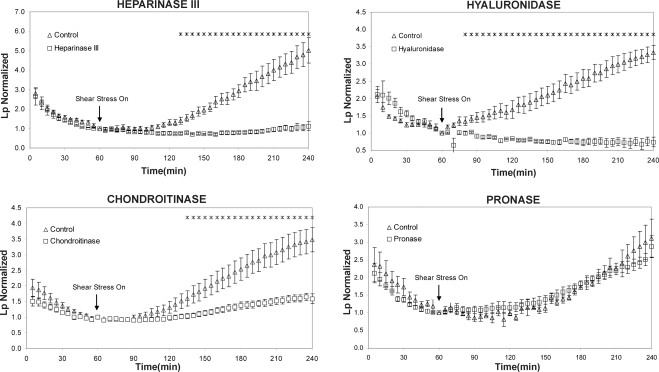
Recent in vitro and in vivo studies have reported fluid shear stress-induced increases in endothelial layer hydraulic conductivity (L(p)) that are mediated by an increased production of nitric oxide (NO). Other recent studies have shown that NO induction by shear stress is mediated by the glycocalyx that decorates the surface of endothelial cells. Here we find that a selective depletion of the major components of the glycocalyx with enzymes can block the shear stress-induced response of L(p). Heparinase and hyaluronidase block shear-induced increases in L(p), which is consistent with their effects on NO production. But chondroitinase, which does not suppress shear-induced NO production, also inhibits shear-induced L(p). A further surprise is that treatment with the general proteolytic enzyme pronase does not suppress the shear L(p) response. We also find that heparinase does not alter baseline L(p) significantly, whereas chondroitinase, hyaluronidase, and pronase increase it significantly.
Figures
References
-
- Cancel LM, Fitting A, Tarbell JM. In vitro study of LDL transport under pressurized (convective) conditions. Am J Physiol Heart Circ Physiol 293: H126–H132, 2007. - PubMed
-
- Chang YS, Yaccino JA, Lakshminarayanan S, Frangos JA, Tarbell JM. Shear-induced increase in hydraulic conductivity in endothelial cells is mediated by a nitric oxide-dependent mechanism. Arterioscler Thromb Vasc Biol 20: 35–42, 2000. - PubMed
-
- DeMaio L, Chang YS, Gardner TW, Tarbell JM, Antonetti DA. Shear stress regulates occludin content and phosphorylation. Am J Physiol Heart Circ Physiol 281: H105–H113, 2001. - PubMed
-
- DeMaio L, Tarbell JM, Scaduto RC Jr, Gardner TW, Antonetti DA. A transmural pressure gradient induces mechanical and biological adaptive responses in endothelial cells. Am J Physiol Heart Circ Physiol 286: H731–H741, 2004. - PubMed
Publication types
MeSH terms
Substances
Grants and funding
LinkOut - more resources
Full Text Sources
