


Reproductive biology of Datura wrightii: the benefits of a herbivorous pollinator
- PMID: 19287014
- PMCID: PMC2701751
- DOI: 10.1093/aob/mcp053
Reproductive biology of Datura wrightii: the benefits of a herbivorous pollinator
Abstract
Background and aims: A deeper understanding of mutualism can be reached by studying systems with measurable costs and benefits. Most studies of this type focus on an unusual class of obligate, species-specific pollination mutualisms. The interaction between Datura wrightii (Solanaceae) and the hawkmoth Manduca sexta offers similar advantages but greater generality. Adult moths both nectar at and deposit eggs on the same plant; larvae are herbivorous. The antagonistic component of this interaction has been well studied. Here the role of M. sexta as a pollinator of D. wrightii, particularly in the context of this moth's frequent nectaring visits to the bat-pollinated plant Agave palmeri, is documented.
Methods: Hand-pollinations were used to determine breeding system and the reproductive consequences of mixed loads of A. palmeri and D. wrightii pollen. Plants and moths were caged overnight to assess whether nectaring visits led to fruit and seed set. Finally, pollen deposited on field-collected stigmas was identified, with a particular focus on documenting the presence of D. wrightii and A. palmeri grains.
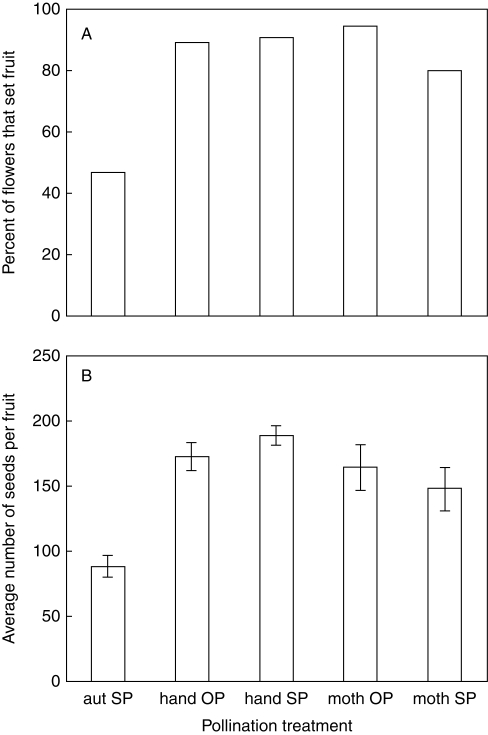
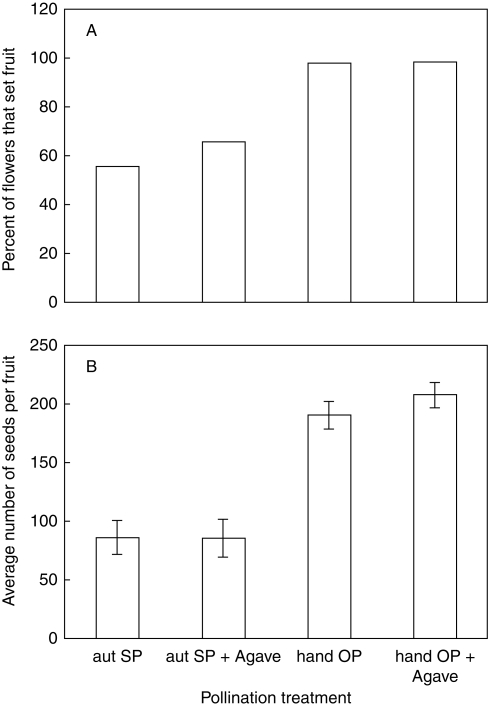
Key results: Datura wrightii is highly self-compatible, and a visit that deposits either outcross or self pollen almost doubles fruit and seed set compared with unvisited flowers. Manduca sexta transferred enough pollen to produce fruit and seed sets comparable to hand-pollination treatments. Agave palmeri did not interfere with D. wrightii success: in the field, stigmas received almost pure D. wrightii pollen, and hand-addition of large quantities of A. palmeri pollen had no measurable effect on fruit and seed set.
Conclusions: The floral visitation component of the D. wrightii-M. sexta interaction is indeed mutualistic. This finding is essential background to future development of this interaction as a model system for studying mutualism's costs and benefits. It is already proving valuable for dissecting third-species effects on the outcome of mutualism. Results indicate that M. sexta's heavy visitation to A. palmeri has no negative effect on the benefits conferred to D. wrightii. However, it can be predicted to augment M. sexta populations to the point where the costs of the interaction begin to exceed its benefits.
Figures
References
-
- Adler LS, Bronstein JL. Attracting antagonists: does floral nectar increase leaf herbivory? Ecology. 2004;85:1519–1526.
-
- Alarcón R, Davidowitz G, Bronstein JL. Nectar usage in a southern Arizona hawkmoth community. Ecological Entomology. 2008;33:503–509.
-
- Andersson S. The cost of floral attractants in Achillea ptarmica (Asteraceae): evidence from a ray removal experiment. Plant Biology. 1999;1(5):69–572.
-
- Andersson S. The cost of flowers in Nigella degenii inferred from flower and perianth removal experiments. International Journal of Plant Sciences. 2000;161:903–908.
-
- Bernays EA, Woods HA. Foraging in nature by larvae of Manduca sexta – influenced by an endogenous oscillation. Journal of Insect Physiology. 2000;46:825–836. - PubMed
Publication types
MeSH terms
LinkOut - more resources
Full Text Sources
Other Literature Sources
