


Comparison of the discriminative stimulus effects of dimethyltryptamine with different classes of psychoactive compounds in rats
- PMID: 19288085
- PMCID: PMC2865430
- DOI: 10.1007/s00213-009-1501-z
Comparison of the discriminative stimulus effects of dimethyltryptamine with different classes of psychoactive compounds in rats
Abstract
Rationale: There has been increased recreational use of dimethyltryptamine (DMT), but little is known of its discriminative stimulus effects.
Objectives: The present study assessed the similarity of the discriminative stimulus effects of DMT to other types of hallucinogens and to psychostimulants.
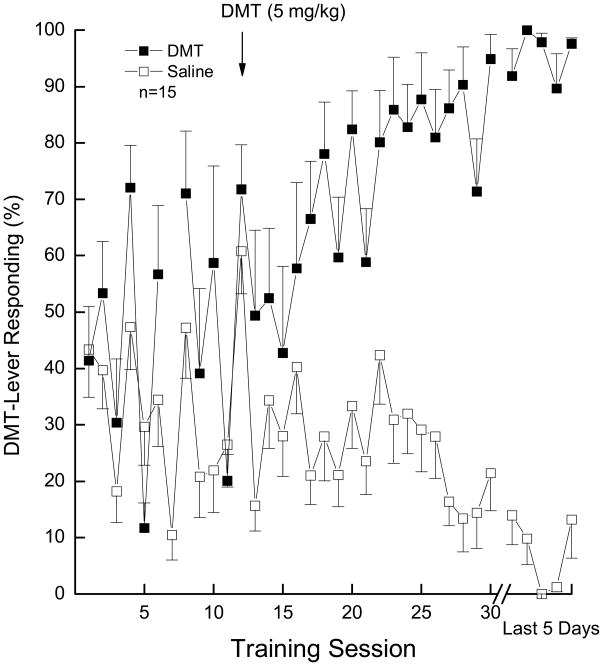
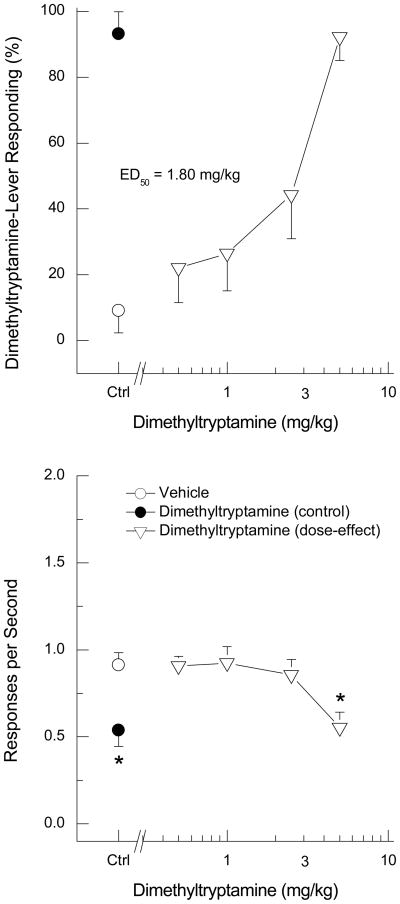
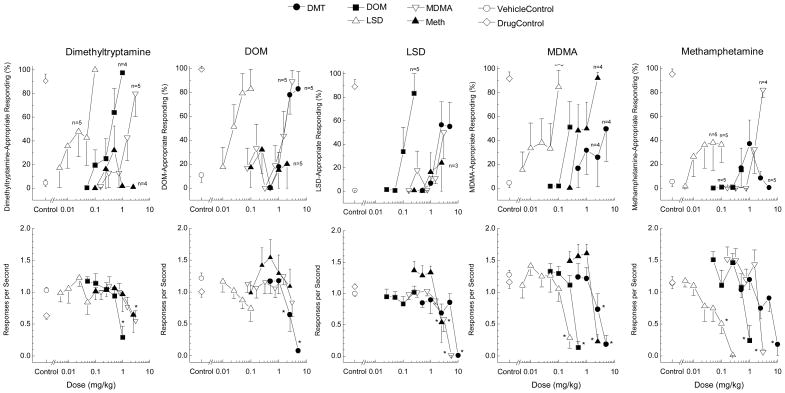
Methods: Rats were trained to discriminate DMT from saline. To test the similarity of DMT to known hallucinogens, the ability of (+)-lysergic acid diethylamide (LSD), (-)-2,5-dimethoxy-4-methylamphetamine (DOM), (+)-methamphetamine, or (+/-)3,4-methylenedioxymethyl amphetamine (MDMA) to substitute in DMT-trained rats was tested. The ability of DMT to substitute in rats trained to discriminate each of these compounds was also tested. To assess the degree of similarity in discriminative stimulus effects, each of the compounds was tested for substitution in all of the other training groups.
Results: LSD, DOM, and MDMA all fully substituted in DMT-trained rats, whereas DMT fully substituted only in DOM-trained rats. Full cross-substitution occurred between DMT and DOM, LSD and DOM, and (+)-methamphetamine and MDMA. MDMA fully substituted for (+)-methamphetamine, DOM, and DMT, but only partially for LSD. In MDMA-trained rats, LSD and (+)-methamphetamine fully substituted, whereas DMT and DOM did not fully substitute. No cross-substitution was evident between (+)-methamphetamine and DMT, LSD, or DOM.
Conclusions: DMT produces discriminative stimulus effects most similar to those of DOM, with some similarity to the discriminative stimulus effects of LSD and MDMA. Like DOM and LSD, DMT seems to produce predominately hallucinogenic-like discriminative stimulus effects and minimal psychostimulant effects, in contrast to MDMA which produced hallucinogen- and psychostimulant-like effects.
Figures
References
-
- Adams LM, Geyer MA. Effects of DOM and DMT in a proposed animal model of hallucinogenic activity. Prog Neuropsychopharmacol Biol Psychiatry. 1985;9:121–132. - PubMed
-
- Appel JB, West WB, Rolandi WG, Alici T, Pechersky K. Increasing the selectivity of drug discrimination procedures. Pharmacol Biochem Behav. 1999;64:353–358. - PubMed
-
- Baker LE, Broadbent J, Michael EK, Matthews PK, Metosh CA, Saunders RB, West WB, Appel JB. Assessment of the discriminative stimulus effects of the optical isomers of ecstasy (3,4-methylenedioxymethamphetamine; MDMA) Behav Pharmacol. 1995;6:263–275. - PubMed
-
- Balster RL. Drug abuse potential evaluation in animals. Brit J Addict. 1991;86:1549–1558. - PubMed
-
- Barker SA, Monti JA, Christian ST. N, N-dimethyltryptamine: an endogenous hallucinogen. Int Rev Neurobiol. 1981:83–110. - PubMed
Publication types
MeSH terms
Substances
Grants and funding
LinkOut - more resources
Full Text Sources
