


Minimizing attrition bias: a longitudinal study of depressive symptoms in an elderly cohort
- PMID: 19288971
- PMCID: PMC2733930
- DOI: 10.1017/S104161020900876X
Minimizing attrition bias: a longitudinal study of depressive symptoms in an elderly cohort
Abstract
Background: Attrition from mortality is common in longitudinal studies of the elderly. Ignoring the resulting non-response or missing data can bias study results.
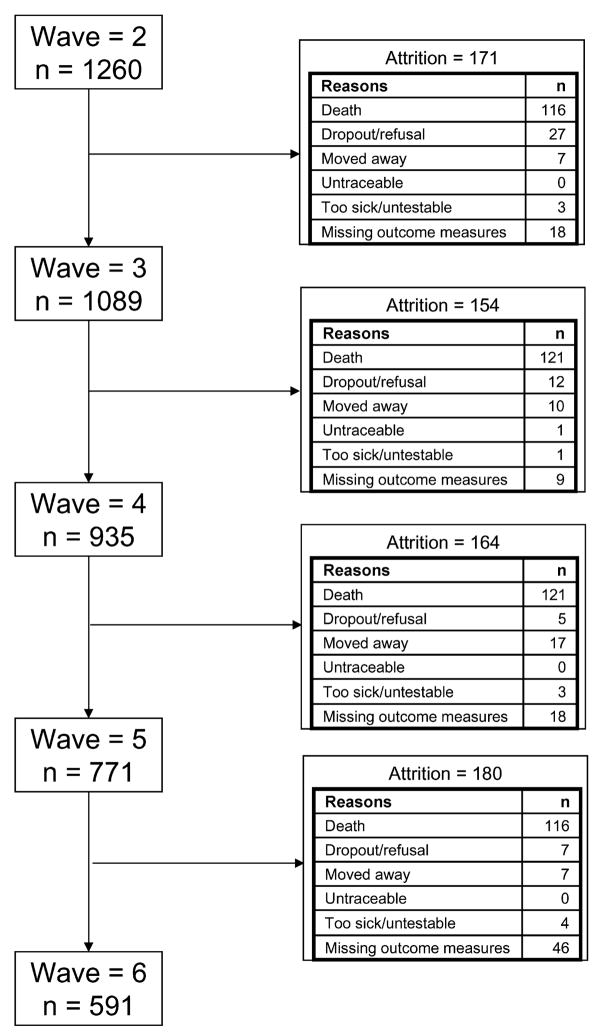
Methods: 1260 elderly participants underwent biennial follow-up assessments over 10 years. Many missed one or more assessments over this period. We compared three statistical models to evaluate the impact of missing data on an analysis of depressive symptoms over time. The first analytic model (generalized mixed model) treated non-response as data missing at random. The other two models used shared parameter methods; each had different specifications for dropout but both jointly modeled both outcome and dropout through a common random effect.
Results: The presence of depressive symptoms was associated with being female, having less education, functional impairment, using more prescription drugs, and taking antidepressant drugs. In all three models, the same variables were significantly associated with depression and in the same direction. However, the strength of the associations differed widely between the generalized mixed model and the shared parameter models. Although the two shared parameter models had different assumptions about the dropout process, they yielded similar estimates for the outcome. One model fitted the data better, and the other was computationally faster.
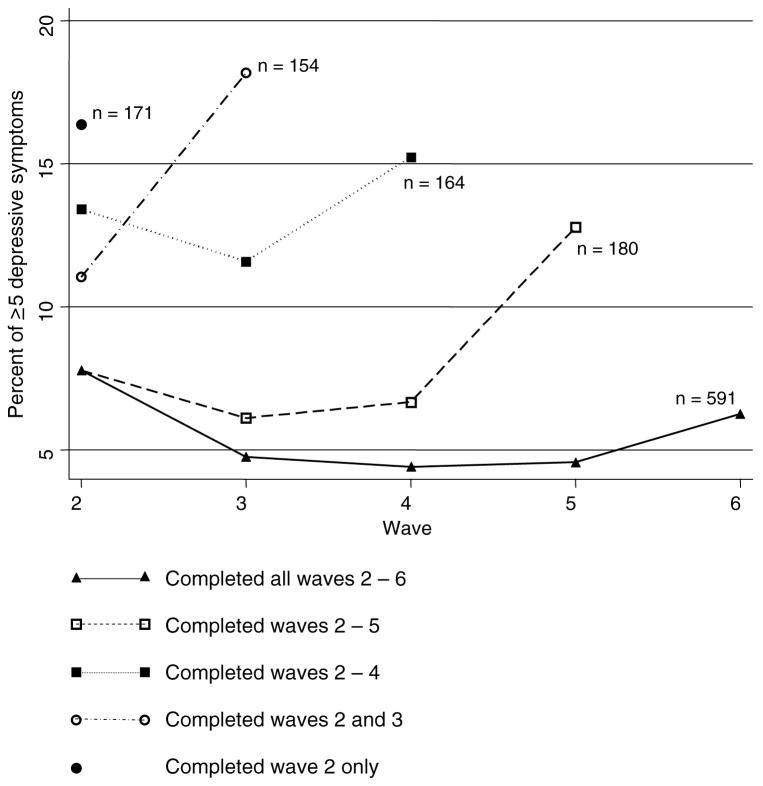
Conclusions: Dropout does not occur randomly in longitudinal studies of the elderly. Thus, simply ignoring it can yield biased results. Shared parameter models are a powerful, flexible, and easily implemented tool for analyzing longitudinal data while minimizing bias due to nonrandom attrition.
Conflict of interest statement
None.
Figures
References
-
- Beunckens C, Molenberghs G, Kenward MG. Direct likelihood analysis versus simple forms of imputation for missing data in randomized clinical trials. Clinical Trials. 2005;2:379–386. - PubMed
-
- Casey E, Hughes JW, Waechter D, Josephson R, Rosneck J. Depression predicts failure to complete phase-II cardiac rehabilitation. Journal of Behavioral Medicine. 2008;31:421–431. - PubMed
-
- Eerola M, Huurre T, Aro H. The problem of attrition in a Finnish longitudinal survey on depression. European Journal of Epidemiology. 2005;20:113–120. - PubMed
-
- Folstein MF, Folstein SE, McHugh PR. “Mini-mental state”: a practical method for grading the cognitive state of patients for the clinician. Journal of Psychiatric Research. 1975;12:189–198. - PubMed
Publication types
MeSH terms
Grants and funding
LinkOut - more resources
Full Text Sources
Molecular Biology Databases
