. 2009 Mar 18;96(6):2371-81.
doi: 10.1016/j.bpj.2008.11.061.

Mitigating unwanted photophysical processes for improved single-molecule fluorescence imaging

Affiliations

Mitigating unwanted photophysical processes for improved single-molecule fluorescence imaging

Richa Dave et al. Biophys J. .

Abstract

Organic fluorophores common to fluorescence-based investigations suffer from unwanted photophysical properties, including blinking and photobleaching, which limit their overall experimental performance. Methods to control such processes are particularly important for single-molecule fluorescence and fluorescence resonance energy transfer imaging where uninterrupted, stable fluorescence is paramount. Fluorescence and FRET-based assays have been carried out on dye-labeled DNA and RNA-based systems to quantify the effect of including small-molecule solution additives on the fluorescence and FRET behaviors of both cyanine and Alexa fluorophores. A detailed dwell time analysis of the fluorescence and FRET trajectories of more than 200,000 individual molecules showed that two compounds identified previously as triplet state quenchers, cyclooctatetraene, and Trolox, as well as 4-nitrobenzyl alcohol, act to favorably attenuate blinking, photobleaching, and influence the rate of photoresurrection in a concentration-dependent and context-dependent manner. In both biochemical systems examined, a unique cocktail of compounds was shown to be optimal for imaging performance. By simultaneously providing the most rapid and direct access to multiple photophysical kinetic parameters, smFRET imaging provides a powerful avenue for future investigations aimed at discovering new compounds, and effective combinations thereof. These efforts may ultimately facilitate tuning organic dye molecule performance according to each specific experimental demand.


Figures
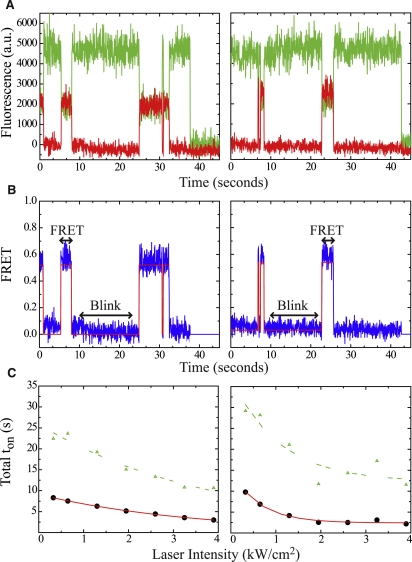
Figure 1
Figure 1
Photophysical processes in Cy and Alexa fluorophores are strongly power-dependent. (A) Blinking observed in the fluorescence trajectories of single Cy (left) and Alexa (right) dye pairs linked to a 12-basepair DNA under oxygen scavenging conditions and without the presence of triplet state quenchers (0.65 kW/cm2). (B) Corresponding smFRET time traces for Cy (left) and Alexa (right) dyes showing dwells in FRET and dark states. FRET is calculated from the relationship:EFRET=IdonorIdonor+Iacceptor. Idealization of smFRET time traces (red line) using hidden Markov modeling procedures is used to estimate the kinetics of switching between zero and nonzero FRET states. (C) Total ton (circles; red) decreases with increasing laser intensities for Cy (left) and Alexa (right) dye pairs. The photobleaching rate of the donor fluorophore (dotted green line) is shown for reference to indicate that trends in Total ton are largely independent of donor lifetime.
Figure 2
Figure 2
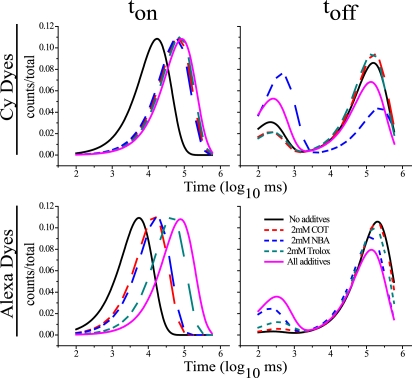
Photophysical processes in Cy5 and Alexa-647N are observed to be strongly attenuated under direct 635 nm excitation by the solution additives Trolox, COT, and NBA. The lifetimes of fluorescence, ton, and dark states, toff, are shown as overlaid histograms for both Cy5 and Alexa 647N fluorophores linked DNA oligonucleotides under direct 635 nm illumination in the absence (black), and presence of 2 mM COT (dashed red), 2 mM NBA (dashed blue), 2 mM Trolox (dashed green), and all three additives combined (2 mM each) (magenta). Each histogram fit represents a minimum of 1156 events where R2 values were >0.90 for ton and >0.7 for toff with the exception of 2 mM NBA where the R2 value of toff fit, due to a limited number of observed transitions, was 0.65.
Figure 3
Figure 3
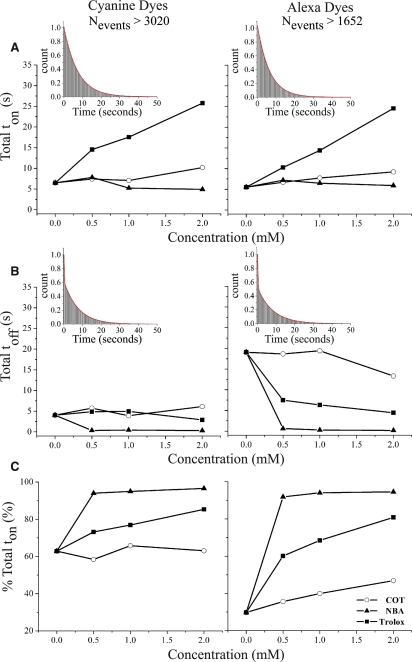
Photophysical processes in Cy5 and Alexa-647N are observed to be strongly attenuated in FRET-based experiments by the solution additives Trolox, COT, and NBA. FRET-based experiments (0.65 kW/cm2 532 nm excitation) carried out on donor and acceptor labeled DNA oligonucleotides show that COT (circles), NBA (triangles), and Trolox (squares) effect (A) Total ton, (B) Total toff, and (C) the percent time in nonzero FRET states % Total ton (Total ton/Total ton + Total toff), in a concentration dependent manner. Inset figures show examples of the single exponential decay fittings of Total ton and double exponential decay fittings of Total toff.
Figure 4
Figure 4
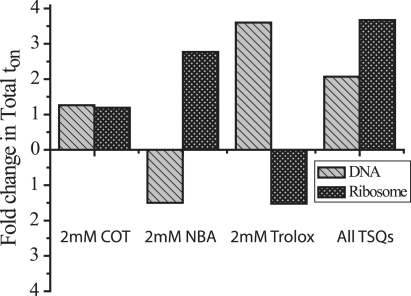
Solution additives effect photophysical processes in Cy5 and Alexa-647N in an environment specific manner. Trolox, COT, and NBA differentially impact Total ton in DNA and ribosome systems. Fold changes (increase or decrease) in Total ton for the ribosome and DNA systems are plotted in the presence of 2 mM NBA, 2 mM COT, and 2 mM Trolox added separately or together normalized to those observed in their absence (defined as the x axis).
Figure 5
Figure 5
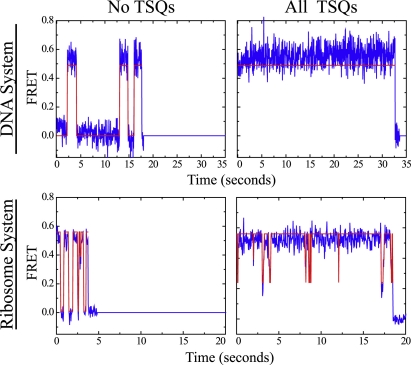
Solution additives, when used in combination mitigate unwanted photophysical processes in Cy5 and Alexa-647N. (upper panels) smFRET trajectories observed for Cy-labeled DNA oligonucleotides in the absence (left) and presence (right) of all three solution additives COT, Trolox, and NBA (2 mM each). (lower panels) smFRET trajectories observed for Cy-labeled tRNA molecules on the ribosome in the absence (left) and presence (right) of COT, Trolox, and NBA (2 mM each).

References

    1. Michalet X., Kapanidis A.N., Laurence T., Pinaud F., Doose S. The power and prospects of fluorescence microscopies and spectroscopies. Annu. Rev. Biophys. Biomol.Struct. 2003;32:161–182. - PubMed
    1. Dickson R.M., Cubitt A.B., Tsien R.Y., Moerner W.E. On/off blinking and switching behavior of single molecules of green fluorescent protein. Nature. 1997;388:355–358. - PubMed
    1. Dittrich P.S., Schwille P. Photobleaching and stabilization of fluorophores used for single-molecule analysis with one- and two-photon excitation. Appl. Phys. B. 2001;73:829–837.
    1. Eggeling C., Widengren J., Brand L., Schaffer J., Felekyan S. Analysis of photobleaching in single-molecule multicolor excitation and Förster resonance energy transfer measurements. J. Phys. Chem. A. 2006;110:2979–2995. - PubMed
    1. Eggeling C., Widengren J., Rigler R., Seidel C.A. Photobleaching of fluorescent dyes under conditions used for single-molecule detection: evidence of two-step photolysis. Anal. Chem. 1998;70:2651–2659. - PubMed

Publication types

LinkOut - more resources