. 2009 Mar;16(3):458-65.
doi: 10.1016/j.devcel.2009.01.002.

Intrinsic tumor suppression and epithelial maintenance by endocytic activation of Eiger/TNF signaling in Drosophila

Affiliations

Intrinsic tumor suppression and epithelial maintenance by endocytic activation of Eiger/TNF signaling in Drosophila

Tatsushi Igaki et al. Dev Cell. 2009 Mar.

Abstract

Oncogenic alterations in epithelial tissues often trigger apoptosis, suggesting an evolutionary mechanism by which organisms eliminate aberrant cells from epithelia. In Drosophila imaginal epithelia, clones of cells mutant for tumor suppressors, such as scrib or dlg, lose their polarity and are eliminated by cell death. Here, we show that Eiger, the Drosophila tumor necrosis factor (TNF), behaves like a tumor suppressor that eliminates oncogenic cells from epithelia through a local endocytic JNK-activation mechanism. In the absence of Eiger, these polarity-deficient clones are no longer eliminated; instead, they grow aggressively into tumors. We show that in scrib clones endocytosis is elevated, which translocates Eiger to endocytic vesicles and leads to activation of apoptotic JNK signaling. Furthermore, blocking endocytosis prevents both JNK activation and cell elimination. Our data indicate that TNF signaling and the endocytic machinery could be components of an evolutionarily conserved fail-safe mechanism by which animals protect against neoplastic development.


Figures
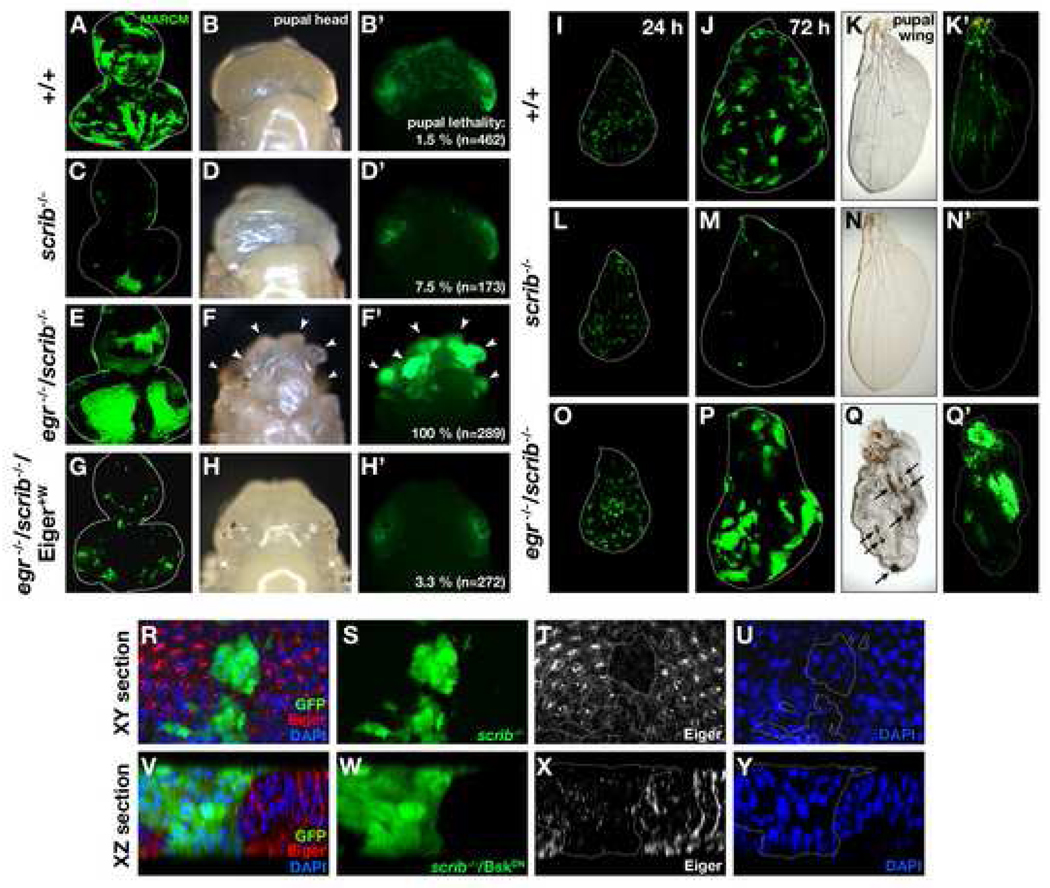
Figure 1
Figure 1. Eiger is required for elimination of tumorigenic scrib clones
(A–H’) GFP-labeled wild-type (A–B’) or scrib mutant (C–H’) clones were generated in eye-antennal discs of wild-type (A–D’) or eiger (egr) homozygous mutant (E–H’) animals. scrib clones in eiger mutant animals develop into tumors in pupal eye-antennal tissue (F, F’, arrowheads). Expression of Eiger+W within scrib clones prevented both tumor development and pupal lethality (G–H’). (I–Q’) GFP-labeled wild-type (I–K’) or scrib mutant (L–Q’) clones were generated in wing discs of wild-type (I–N’) or eiger mutant (O–Q’) animals. Shown are larval wing discs or pupal wings (unfolded with water) at 24, 72, and 96 hours after clone induction. scrib clones in eiger mutant animals form tumors in pupal wings (Q, arrows). (R–Y) GFP-labeled scrib clones were produced in eye-antennal discs and were stained with anti-Eiger antibody. The XY section (R–U) and the XZ section (V–Y) of the confocal images are shown. BskDN was coexpressed to make the clone bigger for XZ analysis. See Supplemental Data for genotypes.
Fig. 2
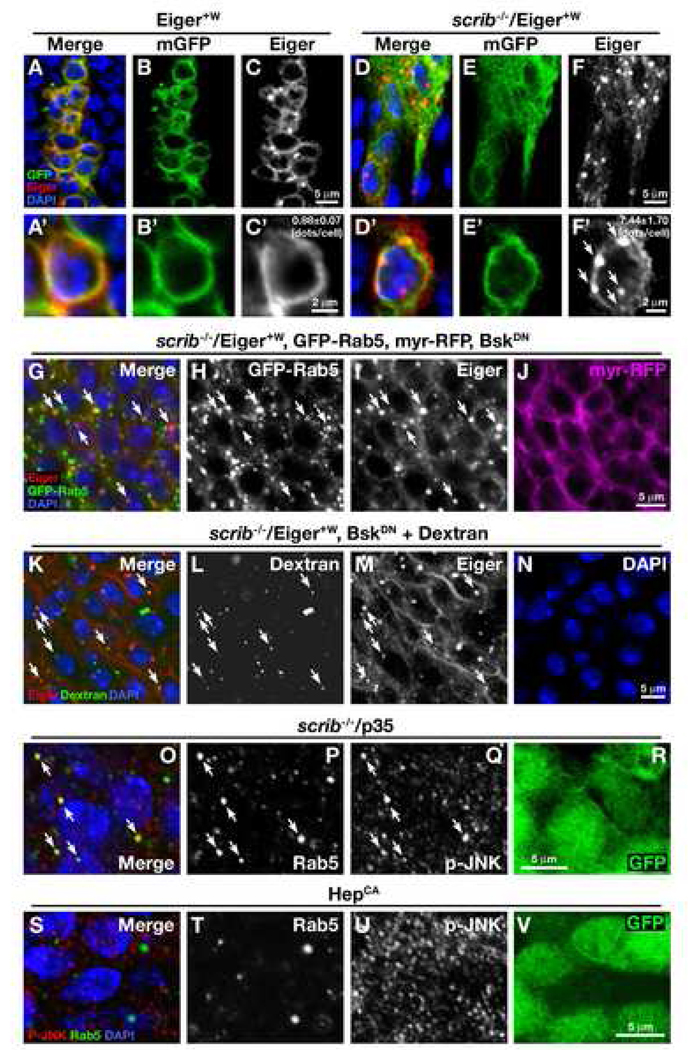
Fig. 2. Eiger-JNK signaling is activated in endosomes in scrib clones
(A–F, A’–F’) Eiger+W and mGFP were coexpressed in wild-type (A–C, A’–C’) or scrib mutant (D–F, D’–F’) clones in wing discs, and were stained with anti-Eiger antibodies. The numbers of Eiger-positive dots/cell ± S.E. are as follows: Eiger+W clones, 0.88 ± 0.07 (n=105, N=5); scrib/Eiger+W clones: 7.44 ± 1.70 (n=117, N=11) (n=number of cells examined, N=number of discs examined). (G–J) Eiger+W, GFP-Rab5, and myr-RFP were coexpressed in scrib mutant clones in eye disc, and were stained with anti-Eiger antibodies. Arrows indicate specific colocalization of Eiger and GFP-Rab5. A dominant-negative form of JNK (BskDN) was coexpressed to keep the clones alive. (K–N) Eiger+W was expressed in scrib mutant clones in eye disc, and were assayed for dextran uptake for 120 min (see Materials and Methods). After the dextran uptake, tissues were fixed and stained with anti-Eiger antibodies. Arrows indicate colocalization of Eiger and endocytosed dextran. A dominant-negative form of JNK (BskDN) was coexpressed to keep the clones alive. (O–R) GFP-labeled scrib clones were generated in eye discs and were co-stained with anti-DRab5 and anti-p-JNK antibodies. Arrows indicate colocalization of these two signals. The caspase inhibitor p35 was co-expressed to keep the clones alive. No signs of compensatory proliferation or non-cell autonomous growth were seen in this mosaic tissue (data not shown). (S–V) GFP-labeled HepCA-expressing clones were generated in eye discs and were co-stained with anti-DRab5 and anti-p-JNK antibodies. No colocalization was seen in these two signals. See Supplemental Data for genotypes.
Fig. 3
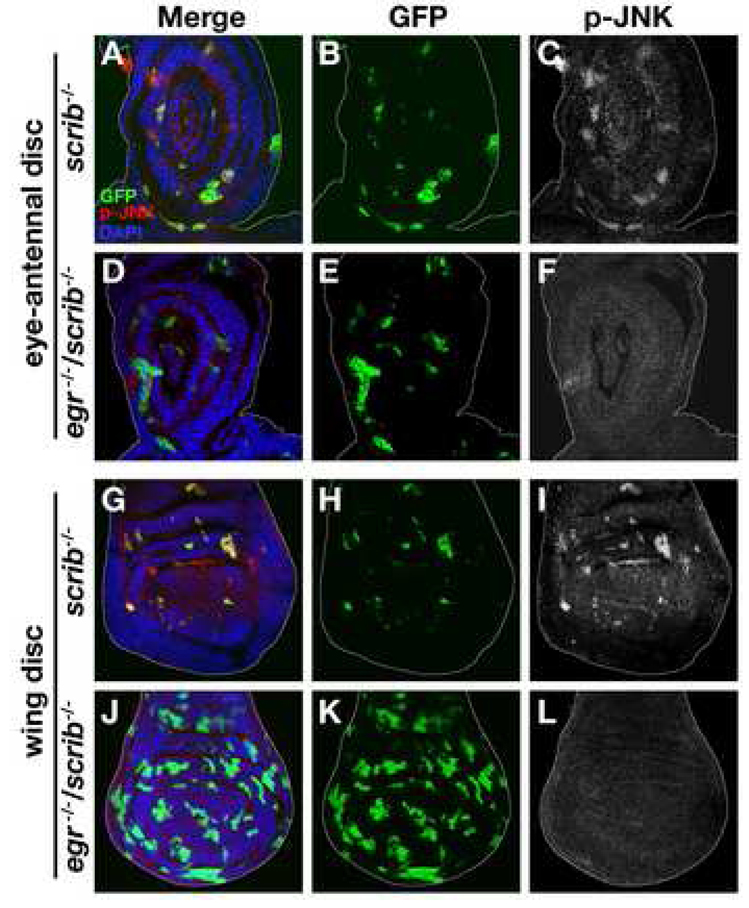
Fig. 3. Eiger is required for JNK activation in scrib clones
GFP-labeled scrib clones were generated in eye-antennal discs or wing discs of wild-type (A–C, G–I) or eiger (egr) mutant (D–F, J–L) larvae, and were stained with anti-p-JNK antibodies. See Supplemental Data for genotypes.
Fig. 4
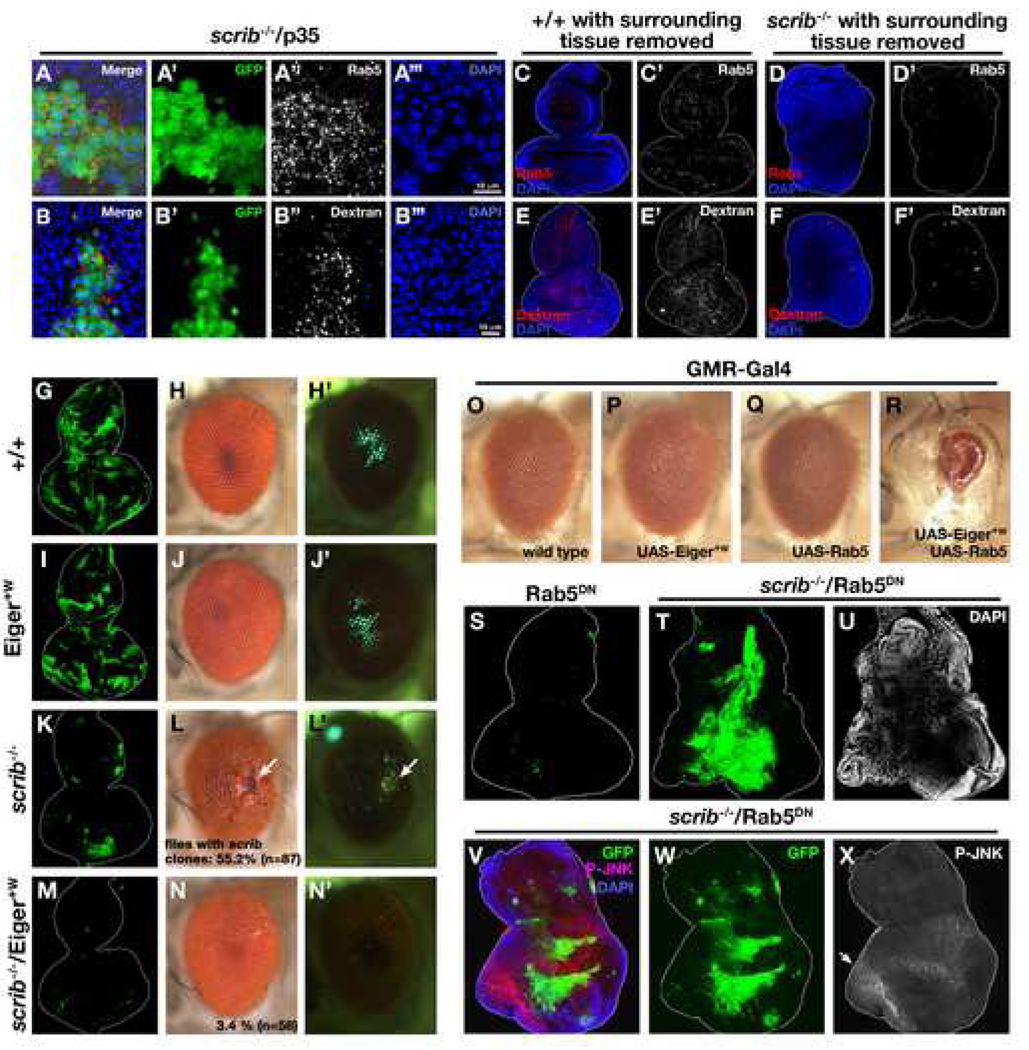
Fig. 4. Eiger-JNK signaling is activated by endocytosis in scrib clones
(A–A’’’) GFP-labeled scrib clones were generated in eye discs and were stained with anti-DRab5 antibodies. (B–B’’’) Eye-antennal discs with GFP-labeled scrib mutant clones were assayed for dextran uptake for 60 min (see Experimental Procedures). (C–F’) Wild-type (C, C’, E, E’) or scrib mutant (D, D’, F, F’) clones were generated in eye-antennal discs and surrounding wild-type tissue was simultaneously removed by a combination of GMR-hid and a recessive cell-lethal mutation CL3R. The discs were either stained with anti-Rab5 antibody (C–D’) or assayed for dextran uptake (E–F’). (G–N’) GFP-labeled wild-type (G–H’), Eiger+W-expressing (I–J’), scrib mutant (K–L’), or scrib mutant also expressing Eiger+W (M–N’) clones were generated in eye-antennal discs. Percentages of adult flies carrying scrib clones in the eyes are shown (L and N). The sizes of the clones in eye-antennal discs are quantified in Supplemental Fig. S1. (O–R) Eyes of adult flies expressing Gal4 alone (O), Eiger+W (P), Rab5 (Q), or both Eiger+W and Rab5 (R) are shown. (S–U) GFP-labeled Rab5DN-expressing (S) or scrib mutant also expressing Rab5DN (T) clones were produced in eye-antennal discs. DAPI staining shows non-cell autonomous overgrowths adjacent to the mutant clones (U, and data not shown), which has also been seen in other endocytic mutants (Moberg et al., 2005; Thompson et al., 2005; Vaccari and Bilder, 2005). scrib−/−/Rab5DN clones eventually died later during the pupal stage (data not shown). This is probably due to the lethality of endocytosis-deficient cells, which was also reported in other endocytic mutants (Moberg et al., 2005; Thompson et al., 2005; Vaccari and Bilder, 2005). (V–X) Eye-antennal discs with GFP-labeled scrib−/−/Rab5DN clones were stained with anti-p-JNK antibodies. Endogenous activation of JNK can be detected in eye discs posterior to the morphogenetic furrow (Agnes et al., 1999; Igaki et al., 2002) (allow), while scrib−/−/Rab5DN clones do not activate JNK. See Supplemental Data for genotypes.

References

    1. Adachi-Yamada T, Fujimura-Kamada K, Nishida Y, Matsumoto K. Distortion of proximodistal information causes JNK-dependent apoptosis in Drosophila wing. Nature. 1999a;400:166–169. - PubMed
    1. Adachi-Yamada T, Gotoh T, Sugimura I, Tateno M, Nishida Y, Onuki T, Date H. De novo synthesis of sphingolipids is required for cell survival by down-regulating c-Jun N-terminal kinase in Drosophila imaginal discs. Mol Cell Biol. 1999b;19:7276–7286. - PMC - PubMed
    1. Aggarwal BB. Signalling pathways of the TNF superfamily: a double-edged sword. Nat Rev Immunol. 2003;3:745–756. - PubMed
    1. Agnes F, Suzanne M, Noselli S. The Drosophila JNK pathway controls the morphogenesis of imaginal discs during metamorphosis. Development. 1999;126:5453–5462. - PubMed
    1. Agrawal N, Kango M, Mishra A, Sinha P. Neoplastic transformation and aberrant cell-cell interactions in genetic mosaics of lethal(2)giant larvae (lgl), a tumor suppressor gene of Drosophila. Dev Biol. 1995;172:218–229. - PubMed

Publication types

MeSH terms

Substances