. 2009 Jun;75(6):1400-11.
doi: 10.1124/mol.108.054510. Epub 2009 Mar 16.

Activation and modulation of concatemeric GABA-A receptors expressed in human embryonic kidney cells

Affiliations

Activation and modulation of concatemeric GABA-A receptors expressed in human embryonic kidney cells

Gustav Akk et al. Mol Pharmacol. 2009 Jun.

Abstract

We have employed whole-cell and single-channel electrophysiology to examine the kinetic and pharmacological properties of GABA-A receptors consisting of gamma2L-beta2-alpha1 and beta2-alpha1 subunit concatemeric constructs expressed in human embryonic kidney cells. Concatemeric receptors activated by GABA exhibited the same single-channel conductance, channel opening rate constant, and basic open- and closed-time properties as receptors containing free subunits. However, the whole-cell GABA dose-response and the single-channel effective opening rate curves were shifted to higher GABA concentrations, suggesting that the concatemeric receptors have a lower affinity to GABA. Pharmacological tests demonstrated that the concatemeric receptors were potentiated by pentobarbital, diazepam, and the neurosteroid (3alpha,5alpha)-3-hydroxypregnan-20-one (3alpha5alphaP), and were insensitive to Zn(2+). Selective introduction of the alpha1Q241L mutation, previously shown to abolish alpha1beta2gamma2L channel potentiation by neurosteroids, into one of the two concatemeric constructs had a relatively small effect on receptor activation by GABA or macroscopic potentiation by the neurosteroid 3alpha5alphaP. Single-channel measurements showed that the kinetic mechanism of action of the steroid is unchanged when the mutation is introduced to the gamma2L-beta2-alpha1 concatemer. We infer that a single wild-type alpha subunit is capable of mediating the full set of kinetic effects in the presence of steroids. Introduction of the alpha1Q241W mutation, previously shown to mimic the effect of the steroid on alpha1beta2gamma2L channels, selectively into either concatemeric construct altered the mode of activity elicited by P4S, but the presence of mutations in both alpha subunits was required to affect open-time distributions. The data indicate that the alpha1Q241W mutation acts as a partial steroid modulator.


Figures
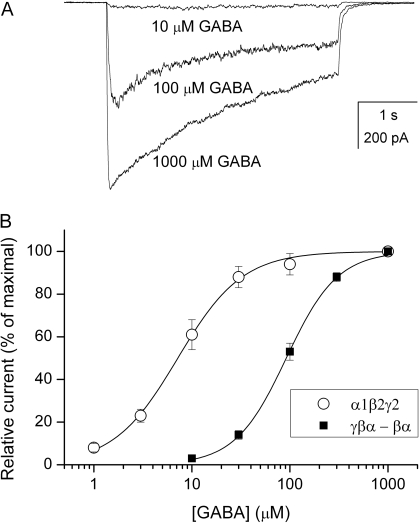
Fig. 1.
Fig. 1.
Receptors formed of wild-type concatemeric γβα-βα subunits are activated by GABA. A, sample responses from a HEK cell transfected with γβα and βα constructs exposed to 10, 100 or 1000 μM GABA. B, GABA dose-response properties for the γβα-βα concatemeric receptors and receptors consisting of free α1β2γ2L subunits. The data show mean ± S.E.M. from 15 (concatemeric receptors) or 6 cells (α1β2γ2L receptors). The curves were fitted to the Hill equation. For concatemeric receptors, the best-fit parameters are as follows: EC50 = 92 ± 2 μM, nH = 1.7 ± 0.1. For α1β2γ2L receptors, the best-fit parameters are as follows: EC50 = 7.2 ± 0.3 μM, nH = 1.3 ± 0.1.
Fig. 2.
Fig. 2.
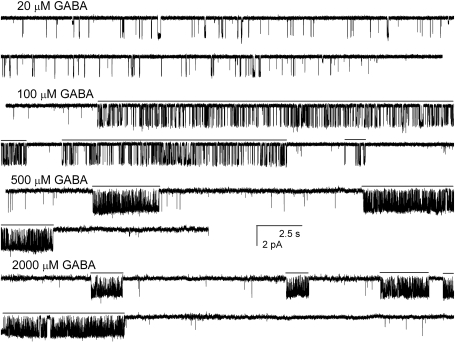
Sample single-channel currents from cells expressing wild-type concatemeric γβα-βα GABA-A receptors. The cells were exposed to 20, 100, 500, or 2000 μM GABA. The increase in agonist concentration results in an increase in cluster open probability. At 20 μM GABA, only isolated openings and short bursts were observed. Channel openings are shown as downward deflections. The putative clusters at 100 to 2000 μM GABA are shown with lines above the current traces.
Fig. 3.
Fig. 3.
Comparison of open-time properties for receptors containing concatemeric versus free subunits. A, mean open durations for the three open-time components at 20 to 5000 μM GABA. Each symbol corresponds to data from one patch. The lines correspond to mean ± S.D. for the open-time durations from α1β2γ2L receptors (Steinbach and Akk, 2001). The data indicate that the mean durations of OT2 and OT3 are increased in concatemeric receptors. B, the prevalence (fraction) of the three open-time components at 20-5000 μM GABA. Each symbol corresponds to data from one patch. The lines correspond to mean ± S.D. for the relative frequencies of OT1-3 from α1β2γ2L receptors (Steinbach and Akk, 2001).
Fig. 4.
Fig. 4.
Single-channel activation properties of the wild-type concatemeric γβα-βα receptor. A, relationship between the effective opening rate and GABA concentration. The effective opening rate is the inverse duration of the GABA concentration-dependent closed-time component. Each symbol corresponds to data from one patch. The curve was fitted to the Hill equation. The best-fit parameters are as follows: β (maximal effective opening rate) = 2950 ± 686 s-1, EC50 = 1452 ± 488 μM, nH = 1.4 ± 0.1. The dashed line is from previous data on α1β2γ2L receptors (Steinbach and Akk, 2001), with the following best-fit parameters: β = 1883 ± 686 s-1, EC50 = 359 ± 162 μM, nH = 1.7 ± 0.2. B, relationship between the intracluster open probability (Po) and GABA concentration. Each symbol corresponds to data from one patch. The curve was fitted to the Hill equation. The best-fit parameters are as follows: Pomax = 0.88 ± 0.03, EC50 = 83 ± 10 μM, nH = 1.4 ± 0.2. The dashed line is from previous data on α1β2γ2L receptors (Steinbach and Akk, 2001), with the following best-fit parameters: Pomax = 0.82 ± 0.04, EC50 = 70 ± 9 μM, nH = 1.2 ± 0.2.
Fig. 5.
Fig. 5.
The neurosteroid 3α5αP potentiates wild-type concatemeric γβα-βα GABA-A receptors. A, sample whole-cell responses to 40 μM GABA in the absence and presence of 1 μM 3α5αP. B, potentiation dose-response properties. The data show mean ± S.E.M. from seven cells. The test applications lasted 4 s and were separated from flanking control (GABA alone) applications by 30 s washouts. The curve was fitted to the Hill equation with an offset (fixed at 100%). The best-fit parameters are as follows: maximal potentiation = 386 ± 11%, EC50 = 63 ± 9 nM, and nH = 1.5 ± 0.2. The dashed line applies to α1β2γ2L receptors (Akk et al., 2008), with best-fit parameters as follows: maximal potentiation = 351 ± 4%, EC50 = 41 ± 2 nM, and nH = 1.2 ± 0.1. C, sample single-channel clusters elicited by 50 μM GABA in the absence and presence of 1 μM 3α5αP. The clusters are shown with lines above the traces. The intracluster open- and closed-time histograms from the respective patches are shown next to data traces. For GABA, the open times were 0.17 ms (24%), 4.3 ms (58%) and 17 ms (18%), and the closed times were 0.13 ms (54%), 1.5 ms (10%) and 42 ms (36%). For GABA + 3α5αP, the open times were 0.24 ms (47%), 1.4 ms (14%) and 26 ms (39%), and the closed times were 0.19 ms (72%), 1.5 ms (22%) and 39 ms (6%).
Fig. 6.
Fig. 6.
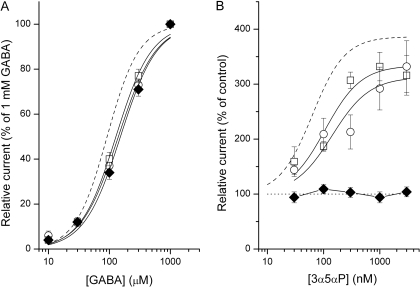
The effect of the α1Q241L mutation on the activation and modulation of concatemeric receptors. A, GABA dose-response properties for the γβαQ241L-βα (hollow circles), γβα-βαQ241L (hollow squares), and γβαQ241L-βαQ241L receptors (filled diamonds). The data show mean ± S.E.M. from 8-19 cells. The curves were fitted to the Hill equation. The best-fit parameters are: EC50 = 140 ± 13 μM, nH = 1.4 ± 0.2 (γβαQ241L-βα); EC50 = 128 ± 8 μM, nH = 1.5 ± 0.1 (γβα-βαQ241L); EC50 = 152 ± 14 μM, nH = 1.5 ± 0.2 (γβαQ241L-βαQ241L). The dashed curve applies to data from the wild-type γβα-βα receptor (reproduced from Fig. 1B). B, potentiation dose-response properties for the γβαQ241L-βα (hollow circles), γβα-βαQ241L (hollow squares), and γβαQ241L-βαQ241L receptors (filled diamonds). The data show mean ± S.E.M. from 4-6 cells. The test applications lasted 4 s and were separated from flanking control (30 μM GABA alone; ∼EC20) applications by 30 s washouts. The curve was fitted to the Hill equation with an offset (fixed at 100%). The best-fit parameters for the γβαQ241L-βα are: maximal potentiation = 313 ± 27%, EC50 = 142 ± 65 nM. The best-fit parameters for the γβα-βαQ241L are: maximal potentiation = 334 ± 28%, EC50 = 106 ± 41 nM. No fitting was attempted for the data from the γβαQ241L-βαQ241L receptor. The dashed curve applies to data from the wild-type γβα-βα receptor (reproduced from Fig. 5B).
Fig. 7.
Fig. 7.
The potentiation of single-channel currents from the concatemeric γβαQ241L-βα receptor by the neurosteroid 3α5αP. A, a sample single-channel cluster from the γβαQ241L-βα receptor activated by 10 μM GABA, and the open- and closed-time histograms. The open times were 0.13 ms (15%), 2.5 ms (73%), and 7.1 ms (12%), and the closed times were 0.15 ms (57%), 1.0 ms (11%), and 13.0 ms (31%). B, a sample single-channel cluster from the γβαQ241L-βα receptor activated by 10 μM GABA in the presence of 1 μM 3α5αP, and the open- and closed-time histograms. The open times were 0.33 ms (44%), 1.6 ms (22%), and 16.9 ms (34%), and the closed times were 0.16 ms (72%), 1.0 ms (22%), and 15.6 ms (6%). Averaged data are shown in Table 5.
Fig. 8.
Fig. 8.
The presence of the α1Q241W mutation affects channel activation by P4S. A, sample single-channel currents from the γβα-βα receptor exposed to 1 mM P4S. No clusters were evident. A portion of the current trace is shown at higher resolution in the bottom trace. B, sample single-channel currents from the γβαQ241W-βα receptor exposed to 1 mM P4S. One cluster is shown. A portion of the cluster is shown at higher resolution in the bottom trace. C, sample single-channel currents from the γβα-βαQ241W receptor exposed to 1 mM P4S. One cluster is shown. A portion of the cluster is shown at higher resolution in the bottom trace. D, sample single-channel currents from the γβαQ241W-βαQ241W receptor exposed to 1 mM P4S. One cluster is shown. A portion of the cluster is shown at higher resolution in the bottom trace.

References

    1. Akk G, Bracamontes J, and Steinbach JH (2001) Pregnenolone sulfate block of GABAA receptors: mechanism and involvement of a residue in the M2 region of the α subunit. J Physiol 532 673-684. - PMC - PubMed
    1. Akk G, Bracamontes JR, Covey DF, Evers A, Dao T, and Steinbach JH (2004) Neuroactive steroids have multiple actions to potentiate GABAA receptors. J Physiol 558 59-74. - PMC - PubMed
    1. Akk G, Shu HJ, Wang C, Steinbach JH, Zorumski CF, Covey DF, and Mennerick S (2005) Neurosteroid access to the GABAA receptor. J Neurosci 25 11605-11613. - PMC - PubMed
    1. Akk G, Li P, Bracamontes J, Reichert DE, Covey DF, and Steinbach JH (2008) Mutations of the GABA-A receptor α1 subunit M1 domain reveal unexpected complexity for modulation by neuroactive steroids. Mol Pharmacol 74 614-627. - PMC - PubMed
    1. Baumann SW, Baur R, and Sigel E (2001) Subunit arrangement of γ-aminobutyric acid type A receptors. J Biol Chem 276 36275-36280. - PubMed

Publication types

LinkOut - more resources